
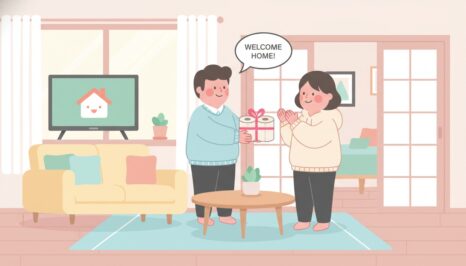
Welcome! Let’s Party at My New House! 🏠
Intro
Hello, everyone! It’s your energetic Korean tutor, Daily Hangul (DailyHangul.com)! 😊👋
Have you ever seen a scene in a K-Drama where characters visit a friend’s new house carrying big packs of toilet paper or laundry detergent? 🧻🫧 You might have wondered, “Why are they giving cleaning supplies as a gift?”
Today, we are going to learn about “Jipdeuri” (집들이), the Korean housewarming culture! Moving into a new place is a huge event, and knowing these expressions will make you the perfect guest (or host) when you visit a Korean friend’s home. Let’s dive in! 🚀
Key Expressions
1. 집들이 (Jipdeuri)
- Pronunciation: [Jip-deu-ri]
- English Meaning: Housewarming party
- Explanation: This is a compound word of ‘집’ (Jip – house) and ‘들’ (Deul – entering/in). It literally means “entering the house.” It’s a party where you invite friends, family, or colleagues to celebrate your new home! 🎉
- 💡 Pronunciation Tip: The ‘eu’ (으) sound in ‘Deu’ can be tricky. It’s not ‘doo’ like ‘do’. Try to smile widely while making a sound deep in your throat!
2. 초대해 줘서 고마워요 (Chodaehae jwoseo gomawoyo)
- Pronunciation: [Cho-dae-hae jwo-seo go-ma-wo-yo]
- English Meaning: Thank you for inviting me.
- Explanation: This is the polite way to greet your host when you enter their house. It shows your gratitude and good manners.
- 💡 Pronunciation Tip: In natural speech, the ‘h’ sound in ‘hae’ (해) is often very soft. It sounds almost like “Chodae-ae.”
3. 이거 집들이 선물이에요 (Igeo jipdeuri seonmul-ieyo)
- Pronunciation: [I-geo jip-deu-ri seon-mul-i-e-yo]
- English Meaning: This is a housewarming gift.
- Explanation: You shouldn’t go empty-handed! Use this phrase when handing over the toilet paper or detergent you bought. ‘Igeo’ means ‘this’ and ‘Seonmul’ means ‘gift’. 🎁
- 💡 Pronunciation Tip: When saying 선물이에요 (seonmul-ieyo), connect the ‘l’ (ㄹ) sound to the next vowel. It sounds like [Seon-mu-ri-e-yo]. This is called liaison!
Real Conversation 💬
Imagine Min-su invited his foreign friend Lisa to his new apartment.
Min-su: 어서 와, 리사! (Eoseo wa, Lisa!)
(Welcome, Lisa!)
Lisa: 민수 씨, 초대해 줘서 고마워요! (Minsu-ssi, chodaehae jwoseo gomawoyo!)
(Minsu, thank you for inviting me!)
Min-su: 와, 이게 뭐야? (Wa, ige mwoya?)
(Wow, what is this?)
Lisa: 이거 집들이 선물이에요. 휴지 샀어요! (Igeo jipdeuri seonmul-ieyo. Hyuji sasseoyo!)
(This is a housewarming gift. I bought toilet paper!)
Min-su: 센스쟁이! 고마워. (Senseu-jaengi! Gomawo.)
(You have great taste! Thanks.)
Culture Tip: Why Toilet Paper? 🧻🇰🇷
In Korea, giving toilet paper (휴지 – hyuji) or laundry detergent (세제 – seje) is a tradition! It’s not just for cleaning.
- Toilet Paper: Just like toilet paper unrolls easily, we hope the host’s problems unravel easily and their life goes smoothly.
- Detergent: Just like the bubbles that rise up, we hope the host’s wealth and luck will bubble up and grow!
So next time you see this in a K-Drama, you’ll know it’s a wish for good luck! 🍀
Wrap-up & Quiz 📝
Today we learned about Korean housewarming parties! Are you ready to visit a Korean friend’s house now? Let’s check what you remember!
Q1. Fill in the blank:
“I’m going to a housewarming party.” -> “_______에 가요.”
(A) 집들이 (Jipdeuri)
(B) 학교 (Hakgyo)
Q2. True or False:
Giving toilet paper as a gift means you think the house is dirty.
(O / X)
Answers:
1. (A) 집들이
2. (X) – It means you wish for their life to go smoothly!
See you next time with more fun Korean! Annyeong! 👋😊
Frequently Asked Questions (FAQ)
Q: What does "집들이 (Jipdeuri)" mean in Korean and how do you pronounce it?
A: In Korean, "집들이 (Jipdeuri)" is pronounced [Jip-deu-ri] and means: Housewarming party
Q: What does "초대해 줘서 고마워요 (Chodaehae jwoseo gomawoyo)" mean in Korean and how do you pronounce it?
A: In Korean, "초대해 줘서 고마워요 (Chodaehae jwoseo gomawoyo)" is pronounced [Cho-dae-hae jwo-seo go-ma-wo-yo] and means: Thank you for inviting me.
Q: What does "이거 집들이 선물이에요 (Igeo jipdeuri seonmul-ieyo)" mean in Korean and how do you pronounce it?
A: In Korean, "이거 집들이 선물이에요 (Igeo jipdeuri seonmul-ieyo)" is pronounced [I-geo jip-deu-ri seon-mul-i-e-yo] and means: This is a housewarming gift.


