
Introduction
Hello! This is Daily Hangul (DailyHangul.com), here to upgrade your Korean skills! 🌟
Today, we are diving into a slightly more advanced but super useful topic: The Economy (경제, Gyeongje). Even if you are a beginner, knowing a few key business terms can make you sound incredibly smart and help you understand Korean news or office conversations! 💼
Have you ever heard the news in a K-Drama where characters worry about the company’s future? Or maybe you want to work in Korea one day? We are going to learn how to talk about “Tariffs” and “Exports” simply. Don’t worry, we will break down the big words into easy bites! Let’s go! 🚀
Key Expressions
Here are 4 essential expressions to discuss economic trends like a pro!
1. 관세 (Gwanse)
- Pronunciation: [Gwan-se]
- English Meaning: Tariff / Customs duty
- Detail: This is the tax paid on goods coming into a country. When countries want to protect their own products (protectionism), they raise the Gwanse. You’ll hear this a lot in international news.
- 💡 Pronunciation Tip: The ‘Gwan’ sounds like the English word ‘Guan’ in ‘Guantanamo’. Make sure to pronounce the ‘S’ in ‘Se’ clearly, not as a ‘Z’.
2. 수출 (Suchul) / 수입 (Suip)
- Pronunciation: [Su-chul] / [Su-ip]
- English Meaning: Export / Import
- Detail: Korea is famous for exporting cars and K-Pop!
- Su-chul (수출) = Sending out (Export) 📤
- Su-ip (수입) = Bringing in (Import) 📥
- 💡 Pronunciation Tip: In 수출 (Suchul), the ‘ch’ is aspirated. Imagine spitting a little air out when you say ‘ch’. It sounds strong!
3. 오르다 (Oreuda)
- Pronunciation: [O-reu-da]
- English Meaning: To go up / To rise
- Detail: Use this when taxes, prices, or popularity goes up! In news, they might use difficult words like ‘인상 (Insang)’, but in conversation, we simply say “Gwanse-ga ollayo” (Tariffs are going up).
- 💡 Pronunciation Tip: The ‘Reu’ (르) sound is tricky. It’s soft, somewhere between an ‘L’ and an ‘R’. Place your tongue on the roof of your mouth gently.
4. ~을/를 걱정하다 (~eul/reul Geokjeong-hada)
- Pronunciation: [Geok-jeong-ha-da]
- English Meaning: To worry about ~
- Detail: When predicting bad economic trends, people worry. You can say, “I am worrying about the economy.”
- 💡 Pronunciation Tip: The ‘K’ in ‘Geok’ stops abruptly in your throat. It’s not ‘Geok-kuh’, just a sharp stop ‘Geok’.
Real-life Conversation
Let’s see how two colleagues, Min-su and Jason, discuss the recent economic news.
Min-su: 제이슨 씨, 뉴스 봤어요? 미국 관세가 오를 것 같아요.
(Jason-ssi, nyuseu bwasseoyo? Miguk gwanse-ga oreul geot gatayo.)
Jason, did you see the news? It seems US tariffs will go up.
Jason: 정말요? 그러면 한국 수출이 힘들 거예요.
(Jeongmal-yo? Geureomyeon Hanguk suchul-i himdeul geoyeyo.)
Really? Then Korean exports will be difficult.
Min-su: 맞아요. 회사 매출을 걱정하고 있어요.
(Majayo. Hoesa maechul-eul geokjeong-hago isseoyo.)
That’s right. I am worrying about the company sales.
Jason: 우리 팀이 더 열심히 해야겠네요! 💪
(Uri tim-i deo yeolsimhi haeyagenneyo!)
Our team will have to work harder!
Culture Tip 🇰🇷
“The Miracle on the Han River” (한강의 기적)
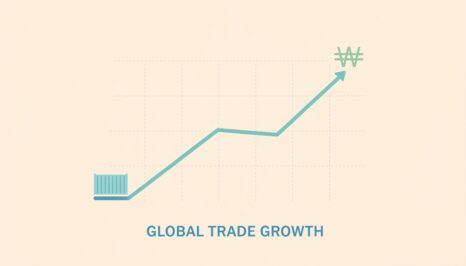
Did you know? Korea’s economy relies heavily on trade (무역, Muyeok). Because Korea doesn’t have many natural resources, the economy grew rapidly by making good products and exporting (수출) them abroad. This rapid growth is often called “The Miracle on the Han River.”
Because of this, regular Koreans are very interested in global economic news like exchange rates and tariffs, because it directly affects major companies like Samsung, Hyundai, and LG, and eventually, their own jobs!
Conclusion & Quiz
Great job! Today we learned how to talk about the scary topic of protectionism using simple words like Gwanse (Tariff) and Suchul (Export). Now you can understand why the K-Drama CEO looks so stressed! 🤯
Let’s test your knowledge!
- Fill in the blank: When you send products to another country, it is called ______.
- (A) 수입 (Suip)
- (B) 수출 (Suchul)
- True or False: 관세 (Gwanse) means the price of a flight ticket.
- (O / X)
- Fill in the blank: If taxes go up, we say “Segeum-i ______.”
- (A) 오르다 (Oreuda)
- (B) 자다 (Jada)
[Answers]
1. (B) 수출
2. (X) – It means Tariff/Tax.
3. (A) 오르다
Frequently Asked Questions (FAQ)
Q: What does "관세 (Gwanse)" mean in Korean and how do you pronounce it?
A: In Korean, "관세 (Gwanse)" is pronounced [Gwan-se] and means: Tariff / Customs duty
Q: What does "수출 (Suchul) / 수입 (Suip)" mean in Korean and how do you pronounce it?
A: In Korean, "수출 (Suchul) / 수입 (Suip)" is pronounced [Su-chul] and means: Export / Import
Q: What does "오르다 (Oreuda)" mean in Korean and how do you pronounce it?
A: In Korean, "오르다 (Oreuda)" is pronounced [O-reu-da] and means: To go up / To rise
Q: What does "~을/를 걱정하다 (~eul/reul Geokjeong-hada)" mean in Korean and how do you pronounce it?
A: In Korean, "~을/를 걱정하다 (~eul/reul Geokjeong-hada)" is pronounced [Geok-jeong-ha-da] and means: To worry about ~


