
Introduction
Hello! It’s Daily Hangul (DailyHangul.com), here to upgrade your Korean skills! 🌟
Do you love watching TikTok or Instagram Reels? From K-Pop dance covers to funny trends, Social Media Challenges (SNS 챌린지) are everywhere! But have you ever seen a challenge that looked a bit… dangerous? 😨
Today, we are going to learn how to talk about the positive and negative effects of these trends. Imagine you are discussing the latest viral video with your Korean friends or commenting on your favorite idol’s post. Let’s learn how to express your concerns and excitement just like a local!
Ready to become a Korean trendsetter? Let’s go! 🚀
Core Expressions
Here are 4 useful expressions to discuss social media trends!
1. 유행하다 (Yuhaenghada)
- English Meaning: To be trendy / To be popular
- Detailed Explanation: You will hear this word constantly in Korea. Whether it’s a new song, a fashion item, or a viral challenge, if everyone is doing it, it is “유행 (Yuhaeng)”.
- 💡 Pronunciation Tip: [Yu-haeng-ha-da]. The ‘h’ sound in ‘ha’ is often pronounced very softly, almost like ‘Yu-haeng-a-da’.
2. 위험하다 (Wiheomhada)
- English Meaning: To be dangerous
- Detailed Explanation: Not all challenges are safe! If you see a trend that involves risky behavior (like dancing in the street), you can use this adjective. It’s a very important survival word, too!
- 💡 Pronunciation Tip: [Wi-heom-ha-da]. The ‘h’ (ㅎ) in ‘heom’ is strong here. Make sure to pronounce the ‘eo’ (ㅓ) sound clearly, like the ‘u’ in ‘bus’.
3. 따라 하다 (Ttarahada)
- English Meaning: To follow / To copy / To mimic
- Detailed Explanation: In the context of social media, this means “doing the challenge” or copying the moves. It’s a combination of 따라 (following) and 하다 (to do).
- 💡 Pronunciation Tip: [Tta-ra-ha-da]. The ‘Tt’ (ㄸ) is a tensed sound. Tense your tongue and throat more than a normal ‘t’. It sounds sharper and stronger!
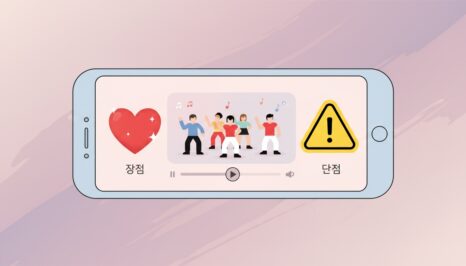
4. 장단점 (Jangdanjeom)
- English Meaning: Pros and cons (Strengths and weaknesses)
- Detailed Explanation: This is a “magic word” that makes you sound very fluent! It combines 장점 (strong point) and 단점 (weak point). You use it when something has both good and bad sides.
- 💡 Pronunciation Tip: [Jang-dan-jeom]. Pronounce each syllable clearly with a steady rhythm.
Real-life Conversation
Let’s see how Minji and Jason talk about a new video they saw on Instagram.
Minji: 제이슨, 이 영상 봐. 요즘 유행해.
[Jeiseun, i yeongsang bwa. Yojeum yuhaenghae.]
(Jason, look at this video. It’s trendy these days.)
Jason: 와, 춤이 멋지다! 그런데 좀 위험해 보여.
[Wa, chumi meotjida! Geureonde jom wiheomhae boyeo.]
(Wow, the dance is cool! But it looks a bit dangerous.)
Minji: 맞아. SNS 챌린지는 장단점이 있어.
[Maja. SNS chaellinjineun jangdanjeomi isseo.]
(Right. SNS challenges have pros and cons.)
Jason: 응. 우리는 그냥 눈으로만 보자. 따라 하지 말고.
[Eung. Urineun geunyang nuneuroman boja. Ttarahaji malgo.]
(Yeah. Let’s just watch with our eyes. Let’s not copy it.)
Culture Tip 🇰🇷
“Challenge Culture” in K-Pop!
Did you know that almost every K-Pop group now films a “Challenge” (챌린지) video when they release a new song? They often invite other idols to dance with them!
If you successfully copy the dance and post it, people might call you an “Inssa” (인싸), which is short for “Insider” (someone who is popular and up-to-date with trends). Conversely, if you don’t know the trends, you might be jokingly called an “Assa” (아싸) or “Outsider.”
Conclusion & Quiz
Today, we learned how to debate the impact of social media! You can now say if something is trendy (유행하다), dangerous (위험하다), or has pros and cons (장단점).
Let’s test your knowledge! (Answers are at the bottom)
- How do you say “To be dangerous” in Korean?
(A) 안전하다 (Anjeonhada) (B) 위험하다 (Wiheomhada) -
Fill in the blank: “This dance has pros and cons.”
= 이 춤은 ( ________ )이/가 있어. -
True or False: “Ttarahada” (따라 하다) means “To stop watching.”
(O / X)
See you next time! 안녕! 👋
📝 Answers:
1. (B) 위험하다
2. 장단점
3. X (It means “To copy/follow”)
Frequently Asked Questions (FAQ)
Q: What does "유행하다 (Yuhaenghada)" mean in Korean and how do you pronounce it?
A: In Korean, "유행하다 (Yuhaenghada)" is pronounced [Tip: [Yu-haeng-ha-da] and means: To be trendy / To be popular
Q: What does "위험하다 (Wiheomhada)" mean in Korean and how do you pronounce it?
A: In Korean, "위험하다 (Wiheomhada)" is pronounced [Tip: [Wi-heom-ha-da] and means: To be dangerous
Q: What does "따라 하다 (Ttarahada)" mean in Korean and how do you pronounce it?
A: In Korean, "따라 하다 (Ttarahada)" is pronounced [Tip: [Tta-ra-ha-da] and means: To follow / To copy / To mimic
Q: What does "장단점 (Jangdanjeom)" mean in Korean and how do you pronounce it?
A: In Korean, "장단점 (Jangdanjeom)" is pronounced [Tip: [Jang-dan-jeom] and means: Pros and cons (Strengths and weaknesses)


