
Hello! I’m Daily Hangul (DailyHangul.com), here to upgrade your Korean skills! 🚀
Have you ever watched a Korean historical drama (Sageuk) like Hwarang or Queen Seondeok? You often see foreign merchants or exotic goods in those shows. That’s not just fiction! It’s because of the Silk Road.
Today, we will learn how to talk about this fascinating historical connection. Talking about history makes your Korean sound very intellectual and deep! Let’s travel back in time together! 🐪🌏
Core Expressions: 3~5 Keywords
Here are the essential words to discuss history and the Silk Road.
1. 역사 (History)
- Pronunciation: [Yeoksa]
- Meaning: History
- Details: This is the most basic word you need today. You can say “한국 역사” (Korean history) or “세계 역사” (World history).
- 💡 Pronunciation Tip: The ‘ㄱ’ (k) in ‘역’ acts as a stop sound. Don’t release the air! It sounds sharp: Yeok-sa, not Yeo-ku-sa.
2. 비단길 (Silk Road)
- Pronunciation: [Bidangil]
- Meaning: Silk Road
- Details: ‘비단’ (Bidan) means Silk, and ‘길’ (Gil) means Road. It is the direct translation of Silk Road. It sounds very poetic, doesn’t it?
- 💡 Pronunciation Tip: When pronouncing ‘ㄴ’ (n) and ‘ㄱ’ (g) together, flow them smoothly. Bi-dan-gil.
3. 교류 (Exchange / Interchange)
- Pronunciation: [Gyoryu]
- Meaning: Exchange (cultural or trade)
- Details: This is a slightly advanced word, but very useful! Use it when you want to say countries shared goods or culture. “교류가 있었어요” means “There was an exchange.”
- 💡 Pronunciation Tip: The ‘ryu’ (류) sound can be tricky. It’s like a soft ‘r’ mixed with ‘y’. Try to make your tongue touch the roof of your mouth lightly.
Real-life Conversation 🗣️
Situation: Alex and Minji are visiting a museum in Gyeongju (the ancient capital of the Silla dynasty).
Alex: 우와, 이 유리잔 정말 예뻐요! 한국 스타일이 아니에요.
(Uwa, i yurijan jeongmal yeppeoyo! Hanguk seutairi anieyo.)
Wow, this glass cup is so pretty! It’s not Korean style.
Minji: 맞아요. 이건 비단길을 통해서 왔어요.
(Majayo. Igeon Bidangil-eul tonghaeseo wasseoyo.)
That’s right. This came via the Silk Road.
Alex: 정말요? 한국도 교류를 했어요?
(Jeongmalyo? Hanguk-do gyoryu-reul haesseoyo?)
Really? Did Korea have exchanges too?
Minji: 네, 신라 시대 역사에서 아주 중요해요!
(Ne, Silla sidae yeoksa-eseo aju jungyohaeyo!)
Yes, it is very important in Silla dynasty history!
Culture Tip 🇰🇷
Did the Silk Road really end in Korea?
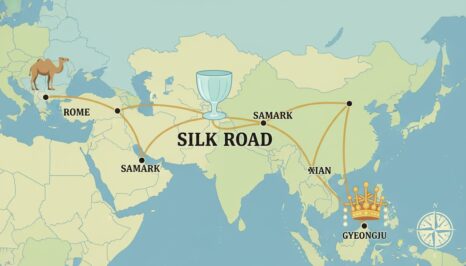
Yes! While many people think the Silk Road ended in China, it actually extended into the Korean peninsula, specifically to the Kingdom of Silla (Gyeongju).
If you visit the Gyeongju National Museum, you can see Roman-style glass cups and golden daggers that look very Persian. This proves that ancient Koreans were global citizens who loved exotic items! Next time you watch a historical drama, look closely at the accessories! ✨
Wrap-up & Quiz 📝
Today we learned how to talk about the Silk Road (비단길) and History (역사). Now you can impress your Korean friends with your historical knowledge!
Let’s practice!
- What is “History” in Korean?
( ) -
“Silk Road” is called “Sugar Road” in Korean. (O / X)
-
Fill in the blank: “Korea had cultural (exchange).”
( 교 )
[Answers]
1. 역사 (Yeoksa)
2. X (It is 비단길 [Bidangil] – Silk Road)
3. 교류 (Gyoryu)
Frequently Asked Questions (FAQ)
Q: What does "역사 (History)" mean in Korean and how do you pronounce it?
A: In Korean, "역사 (History)" is pronounced [Yeoksa] and means: History
Q: What does "비단길 (Silk Road)" mean in Korean and how do you pronounce it?
A: In Korean, "비단길 (Silk Road)" is pronounced [Bidangil] and means: Silk Road
Q: What does "교류 (Exchange / Interchange)" mean in Korean and how do you pronounce it?
A: In Korean, "교류 (Exchange / Interchange)" is pronounced [Gyoryu] and means: Exchange (cultural or trade)


