Introduction
Annyeonghaseyo! (안녕하세요!) Hello! It’s Daily Hangul, here to upgrade your Korean skills! 🌟
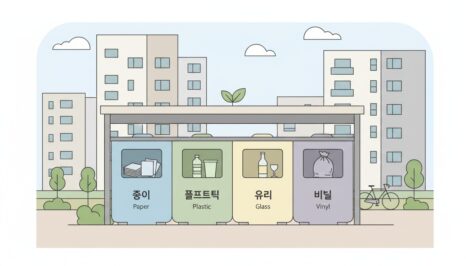
Have you ever watched a K-Drama and noticed characters meticulously sorting their trash in the apartment complex? 🏙️ Korea has a very strict and organized recycling system. If you visit or live in Korea, you will need to visit the recycling center (usually in the parking lot or basement).
Today, we will learn how to ask questions at a recycling area so you don’t get confused (or scolded by the security guard! 😅). Let’s become eco-friendly Korean speakers together! 🌱
Key Expressions
Here are 3 essential phrases to survive Korean recycling day!
1. 이거 어떻게 버려요?
- Pronunciation: [Igeo eotteoke beoryeoyo?]
- Meaning: How do I throw this away?
- Explanation: This is the most useful phrase. If you are holding an item (like a pizza box with cheese stuck on it) and don’t know where it goes, ask this!
- Igeo = This
- Eotteoke = How
- Beoryeoyo = Throw away
- 💡 Pronunciation Tip: In 어떻게 (How), the ‘ㅎ’ (h) meets ‘ㄱ’ (g) and makes a strong ‘k’ sound. So it sounds like [Eotteoke], not [Eotteoh-ge].
2. 이거 일반 쓰레기예요?
- Pronunciation: [Igeo ilban sseuregi-yeyo?]
- Meaning: Is this general waste?
- Explanation: In Korea, you must separate “Recyclables” from “General Waste” (non-recyclable trash). General waste goes into special paid bags.
- Ilban sseuregi = General waste / Regular trash
- 💡 Pronunciation Tip: 쓰레기 (Trash) has a double consonant ‘ㅆ’ (ss). Tense your tongue and make a strong ‘S’ sound, almost like a hiss!
3. 여기에 버려도 돼요?
- Pronunciation: [Yeogie beoryeodo dwaeyo?]
- Meaning: Can I throw it away here?
- Explanation: Use this when pointing to a specific bin or bag to check if you are right.
- Yeogie = Here
- ~do dwaeyo? = Is it okay to…?
Real Conversation 🗣️
Situation: Mina is at the apartment recycling center holding a dirty cup noodle container. She asks a neighbor for help.
Mina: 저기요, 이거 어떻게 버려요?
(Jeogiyo, igeo eotteoke beoryeoyo?)
Excuse me, how do I throw this away?
Neighbor: 국물 자국이 있네요. 일반 쓰레기예요.
(Gungmul jagugi inneyo. Ilban sseuregi-yeyo.)
There are soup stains. It is general waste.
Mina: 아, 정말요? 여기에 버려도 돼요?
(Ah, jeongmaryo? Yeogie beoryeodo dwaeyo?)
Oh, really? Can I throw it here? (Pointing to the white bag)
Neighbor: 네, 맞아요!
(Ne, majayo!)
Yes, that’s right!
Culture Tip & K-Drama Moment 📺
The Mystery of the Colored Bags! 🛍️
Did you know you can’t just use black plastic bags for trash in Korea? You must buy Jongnyangje (Volume-rate garbage disposal bags) at convenience stores or supermarkets.
- White/Pink bags: General trash (burnable).
- Yellow/Orange bags: Food waste (very important to separate!).
In dramas, you often see characters running out of the house in sweatpants to throw away trash. That is a real “slice of life” moment! If you mix trash, the apartment security guard (Gyeongbi-ajeossi) might come running after you! 👮♂️
Review & Quiz 📝
Great job today! Now you are ready to protect the environment in Korea. Let’s check what you remember.
Q1. How do you say “How do I throw this away?” in Korean?
( ) 어떻게 버려요?
Q2. True or False?
‘Ilban sseuregi’ means ‘Recyclable plastic’. ( O / X )
Q3. Fill in the blank.
To ask “Can I throw it here?”, you say: “Yeogie beoryeodo ( )?”
⬇️ Answers ⬇️
- 이거 (Igeo)
- X (It means General Waste/Regular Trash)
- 돼요 (dwaeyo)
Frequently Asked Questions (FAQ)
Q: What does "이거 어떻게 버려요?" mean in Korean and how do you pronounce it?
A: In Korean, "이거 어떻게 버려요?" is pronounced [Igeo eotteoke beoryeoyo?] and means: How do I throw this away?
Q: What does "이거 일반 쓰레기예요?" mean in Korean and how do you pronounce it?
A: In Korean, "이거 일반 쓰레기예요?" is pronounced [Igeo ilban sseuregi-yeyo?] and means: Is this general waste?
Q: What does "여기에 버려도 돼요?" mean in Korean and how do you pronounce it?
A: In Korean, "여기에 버려도 돼요?" is pronounced [Yeogie beoryeodo dwaeyo?] and means: Can I throw it away here?