Introduction
Annyeonghaseyo! (안녕하세요!) It’s your favorite Korean tutor, Daily Hangul, here to upgrade your Korean skills! 🚀
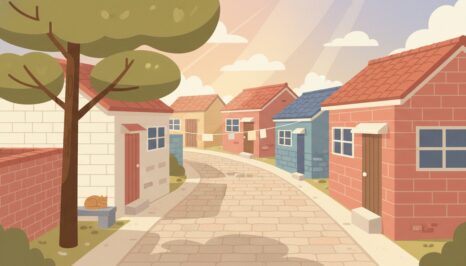
Have you ever watched a K-drama like Reply 1988 (응답하라 1988)? There are often scenes where characters look back at their childhoods with nostalgia. Today, we are going to learn how to describe the neighborhood where you lived as a child! 🏘️
Being able to talk about your past is a huge step in learning a language. It helps you share your story and make deeper connections with Korean friends. Let’s take a time machine back to your childhood! ⏰✨
Key Expressions (핵심 표현)
Here are 3 essential expressions to describe your past environment.
1. ~에 살았어요 (I lived in…)
- Pronunciation: [~e sarasseoyo]
- English Meaning: I lived in [place].
- Detail: This is the most basic phrase to state your past residence. You put the location name before
~에. - 💡 Pronunciation Tip: When saying 살았어요, the bottom consonant
ㄹ(l/r)moves over to the next empty circleㅇ. So it sounds like [사라써요 / sarasseoyo]. Smooth like butter! 🧈
2. 조용했어요 (It was quiet)
- Pronunciation: [joyong-haesseoyo]
- English Meaning: It was quiet.
- Detail: This is the past tense of “quiet” (조용해요). If your neighborhood was loud or busy, you can say 시끄러웠어요 (sikkeureowasseoyo) meaning “It was noisy.”
- 💡 Pronunciation Tip: The
ㅎ(h)sound is often weak. You might hear it softly, almost like [joyong-aesseoyo].
3. 공원이 있었어요 (There was a park)
- Pronunciation: [gong-woni isseosseoyo]
- English Meaning: There was a park.
- Detail: Use
[Noun] + 이/가 있었어요to describe what facilities were in your town.- Word ends with consonant: ~이 있었어요
- Word ends with vowel: ~가 있었어요
Real-life Dialogue (실전 대화)
Let’s see how two friends, Mina and Leo, talk about their childhoods at a cafe. ☕
Mina: 레오 씨, 어렸을 때 어디에 살았어요?
(Leo, where did you live when you were young?)
[Leo ssi, eoryeosseul ttae eodie sarasseoyo?]
Leo: 저는 부산에 살았어요. 바다 근처였어요.
(I lived in Busan. It was near the sea.)
[Jeoneun Busane sarasseoyo. Bada geuncheoyeosseoyo.]
Mina: 우와, 정말요? 동네가 어땠어요?
(Wow, really? How was the neighborhood?)
[Uwa, jeongmaryo? Dongnega eottaesseoyo?]
Leo: 아주 조용했어요. 그리고 예쁜 공원이 있었어요.
(It was very quiet. And there was a pretty park.)
[Aju joyonghaesseoyo. Geurigo yeppeun gong-woni isseosseoyo.]
Mina: 정말 좋았겠네요!
(That must have been really nice!)
[Jeongmal joatgenneyo!]
Culture Tip & K-Drama Scene 🎬
“Golmok-gil” (골목길 – Alleyway)
In many Korean dramas depicting the past, you will see narrow alleyways called Golmok-gil. In the past, Korean neighborhoods were tight-knit communities where kids played in these alleys until dinner time, just like in Squid Game or Reply 1988.
When Koreans talk about their childhood neighborhoods, they often mention “Munbanggu” (문방구 – Stationery Store). It was a magical place where kids bought toys, candy, and school supplies. If you mention, “My neighborhood had an old Munbanggu,” Koreans will be surprised by your cultural knowledge! 😲👍
Wrap-up & Quiz (마무리 및 연습 문제)
Today we traveled back in time to describe our childhood neighborhoods! 🕰️ Remember, practice makes perfect. Try to describe your hometown using these sentences!
📝 Mini Quiz
Fill in the blanks with the correct form.
- I lived in Seoul.
= 저는 서울에 ( ________ ). -
The neighborhood was quiet.
= 동네가 ( ________ ). -
There was a school.
= 학교가 ( ________ ).
See you next time! Annyeong! 👋
Answers:
1. 살았어요 (sarasseoyo)
2. 조용했어요 (joyonghaesseoyo)
3. 있었어요 (isseosseoyo)
Frequently Asked Questions (FAQ)
Q: What does "~에 살았어요 (I lived in...)" mean in Korean and how do you pronounce it?
A: In Korean, "~에 살았어요 (I lived in...)" is pronounced [~e sarasseoyo] and means: I lived in [place].
Q: What does "조용했어요 (It was quiet)" mean in Korean and how do you pronounce it?
A: In Korean, "조용했어요 (It was quiet)" is pronounced [joyong-haesseoyo] and means: It was quiet.
Q: What does "공원이 있었어요 (There was a park)" mean in Korean and how do you pronounce it?
A: In Korean, "공원이 있었어요 (There was a park)" is pronounced [gong-woni isseosseoyo] and means: There was a park.