
Introduction
Hello! It’s Daily Hangul, your friendly guide to upgrading your Korean skills! 🌟
Today, we are diving into a fascinating topic: Synesthesia (공감각, Gong-gam-gak)! 🧠✨ This sounds like a difficult scientific term, right? But don’t worry! In the world of K-Dramas and K-Pop, we use “mixing senses” all the time to describe feelings, voices, and vibes.
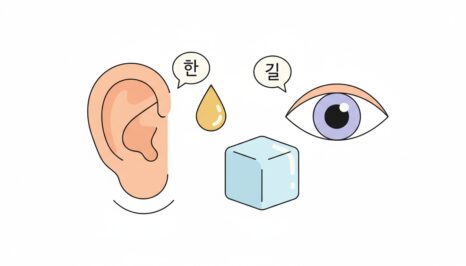
Have you ever heard someone say a voice tastes like honey? 🍯 Or that a gaze feels cold like ice? 🧊 Learning these expressions will make your Korean sound incredibly poetic and natural, just like your favorite K-Pop idol’s lyrics!
Let’s discover how to “taste sounds” and “feel colors” in Korean! 🚀
Core Expressions
Here are 3 common expressions where senses mix together!
1. 목소리가 꿀이에요 (Moksori-ga kkul-ieyo)
- Pronunciation: [Mok-so-ri-ga kkul-i-e-yo]
- English Meaning: Your voice is honey (Your voice is very sweet).
- Detail: This mixes Hearing (Sound) with Taste. In English, you might say “sweet voice,” but in Korean, we literally say the voice is “honey” (꿀). You will see fans commenting this on YouTube music videos all the time!
- 💡 Pronunciation Tip: The ‘꿀’ (kkul) uses a double consonant ‘ㄲ’ (kk). You need to tense your throat and make a strong, sharp ‘K’ sound, different from a soft ‘g’ or ‘k’.
2. 눈빛이 차가워요 (Nunbichi chagawoyo)
- Pronunciation: [Nun-bi-chi cha-ga-wo-yo]
- English Meaning: The gaze is cold.
- Detail: This mixes Sight (Visual) with Touch (Temperature). It describes someone who looks unfriendly, scary, or chic. It’s a classic description for the “bad boy” lead in a K-Drama before he falls in love. 😉
- 💡 Pronunciation Tip: Notice how 눈빛이 is written
Nunbit-ibut pronounced[Nun-bi-chi]. This is because when the final consonantㅊ(ch) meets the vowel이(i), the sound carries over!
3. 맛있는 소리 (Masitneun sori)
- Pronunciation: [Ma-sin-neun so-ri]
- English Meaning: A delicious sound.
- Detail: This mixes Hearing with Taste. We use this often in Mukbang (eating shows). When the sound of frying chicken or slurping noodles is perfect, we say the sound itself is “delicious.”
- 💡 Pronunciation Tip: 맛있는 is pronounced
[Ma-sin-neun], not[Mat-it-neun]. Theㅅ(s/t sound) changes to annsound because of the followingㄴ. It flows much smoother this way!
Real-life Conversation
Situation: Two friends are watching a music variety show featuring a famous singer.
Minji: 와, 이 가수 노래 진짜 잘한다.
(Wa, i gasu norae jinjja jalhanda.)
Wow, this singer is really good at singing.
Jason: 맞아. 목소리가 완전 꿀이야!
(Maja. Moksori-ga wanjeon kkul-iya!)
Right. His voice is totally honey!
Minji: 근데 표정은 좀 무섭지 않아?
(Geunde pyojeong-eun jom museopji ana?)
But isn’t his expression a bit scary?
Jason: 응, 눈빛이 너무 차가워.
(Eung, nunbichi neomu chagawo.)
Yeah, his gaze is too cold.
Minji: 컨셉인가 봐. 시크한 매력이 있네!
(Keonsep-in-ga bwa. Sikeuhan maeryeok-i itne!)
It must be his concept. He has a chic charm!
Culture Tip & K-Drama Scene 🎬
The “Cold City Man” (차가운 도시 남자)
In many romantic K-Dramas, the male lead often starts with “차가운 눈빛” (cold gaze). There is even a slang term for this: 차도남 (Cha-do-nam), which is short for “Cold City Man.”
Even though his visual feels “cold” (synesthesia!), he usually has a warm heart. If you tell a Korean friend, “He looks like a Cha-do-nam,” they will be surprised by your high-level cultural knowledge! 😎
Wrap-up & Quiz
Today we learned how to mix our senses to describe voices, looks, and sounds like a native Korean! Using these “synesthetic” words adds so much flavor (taste!) to your speech.
📝 Mini Quiz: Fill in the blanks!
- When a singer’s voice is very sweet, we say: “Moksori-ga _____.”
(목소리가 _____.) - When someone looks unfriendly or icy, we say: “Nunbichi _____.”
(눈빛이 _____.) - (O/X Quiz) In Korean, you can say a sound is “delicious” (맛있는 소리) during a Mukbang.
Answers:
1. 꿀 (Kkul – Honey)
2. 차가워요 (Chagawoyo – Cold)
3. O (True!)
See you next time! Annyeong! 👋
Frequently Asked Questions (FAQ)
Q: What does "목소리가 꿀이에요 (Moksori-ga kkul-ieyo)" mean in Korean and how do you pronounce it?
A: In Korean, "목소리가 꿀이에요 (Moksori-ga kkul-ieyo)" is pronounced [Mok-so-ri-ga kkul-i-e-yo] and means: Your voice is honey (Your voice is very sweet).
Q: What does "눈빛이 차가워요 (Nunbichi chagawoyo)" mean in Korean and how do you pronounce it?
A: In Korean, "눈빛이 차가워요 (Nunbichi chagawoyo)" is pronounced [Nun-bi-chi cha-ga-wo-yo] and means: The gaze is cold.
Q: What does "맛있는 소리 (Masitneun sori)" mean in Korean and how do you pronounce it?
A: In Korean, "맛있는 소리 (Masitneun sori)" is pronounced [Ma-sin-neun so-ri] and means: A delicious sound.


