

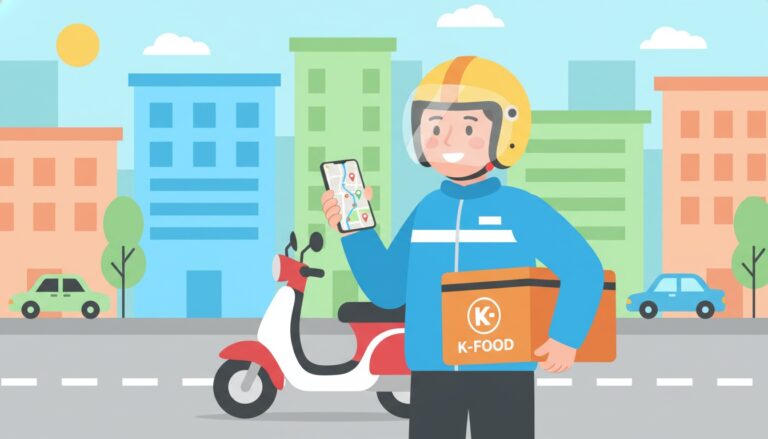
🛵 Delivery Hero: Confirming Your Address in Korean!
1. Introduction
Hello, K-culture fans! 👋 Welcome back to [Daily Hangul], your best friend for learning Korean!
Have you ever watched a K-Drama where the characters order Fried Chicken or Jajangmyeon (Black bean noodles) and it arrives magically fast? 🍗🍜 Korea is often called the “Nation of Delivery” (Baedal Minjok). You can even order food to a park bench at the Han River!
However, the most important part of ordering is telling them exactly where you are. If the driver calls you asking for details, don’t panic! Today, we will learn how to confirm your exact delivery address so your food arrives hot and delicious. Let’s get started! 🚀
2. Key Expressions
Here are the 3 most useful phrases when the delivery driver needs to find you.
1️⃣ 여기 [Location]인데요.
- Pronunciation: [Yeogi [Location]-indeyo]
- Meaning: This is [Location]. / I am at [Location].
- Explanation: When a driver calls and asks “Where are you?” (eodisyeyo?), you use this phrase.
Yeogimeans “here.”Indeyois a polite way to state a fact or background information. - 💡 Pronunciation Tip: The
ginYeogiis a soft ‘g’ sound, almost like a ‘k’ but voiced. Don’t stress it too hard!
2️⃣ [Number]층이에요.
- Pronunciation: [[Number]-cheung-ieyo]
- Meaning: It is the [Number] floor.
- Explanation: In Korea, we use Sino-Korean numbers (Il, I, Sam…) for floors. So, 1st floor is Il-cheung, 2nd floor is I-cheung.
- 💡 Pronunciation Tip:
Cheung(floor) is an aspirated sound. Imagine spitting a little air out when you say ‘Ch’.
3️⃣ 문 앞에 놔 주세요.
- Pronunciation: [Mun ape nwa juseyo]
- Meaning: Please leave it in front of the door.
- Explanation: This is the #1 most used phrase in delivery apps these days! If you want contactless delivery or just want them to drop the food off, use this.
- 💡 Pronunciation Tip: Linking Sound! When you say
Mun ape, the ‘n’ sound moves over. It sounds more like [Mu-na-pe]. Try saying it smoothly: Mu-na-pe nwa juseyo.
3. Real-life Dialogue 🗣️
Imagine you ordered chicken, but the driver is confused about your building.
(Phone Rings 📞)
🛵 Driver: 도착했는데, 건물이 안 보여요.
(Dochakhaenneunde, geonmuri an boyeoyo.)
I’ve arrived, but I don’t see the building.
👩 You: 아, 여기 스타벅스 건물인데요.
(Ah, yeogi Starbucks geonmul-indeyo.)
Ah, this is the Starbucks building.
🛵 Driver: 아, 네! 몇 층이세요?
(Ah, ne! Myeot cheung-iseyo?)
Ah, okay! Which floor are you on?
👩 You: 3층이에요. 문 앞에 놔 주세요. 감사합니다!
(Sam-cheung-ieyo. Mun ape nwa juseyo. Gamsahamnida!)
It’s the 3rd floor. Please leave it in front of the door. Thank you!
4. Culture Tip & K-Drama Scene 🎬
Did you know? Delivery Zones at the Han River! 🏞️
In K-Dramas, you often see couples eating Ramyeon or Chicken on the grass by the Han River. How do drivers find them in such a huge park?
They have “Delivery Zones” (Baedal Zone – 배달존)! 📍
Instead of giving a vague address, you just tell the driver “I am at Yeouido Park Delivery Zone 2.” The drivers know exactly where these zones are. Next time you visit Korea, try a picnic at the Han River and order like a local!
5. Wrap-up & Quiz 📝
Great job today! Now you are ready to receive your delivery food without fear. Let’s check if you remember the key phrases.
Quiz Time!
- How do you say “Please leave it in front of the door”?
( M__ a__ n__ j____ ) -
(True/False) When counting floors (1st floor, 2nd floor), you use Native Korean numbers (Hana, Dul, Set).
Answers:
1. Mun ape nwa juseyo (문 앞에 놔 주세요)
2. False! (We use Sino-Korean numbers: Il, I, Sam…)
See you next time! 안녕! (An-nyeong!) 👋







