

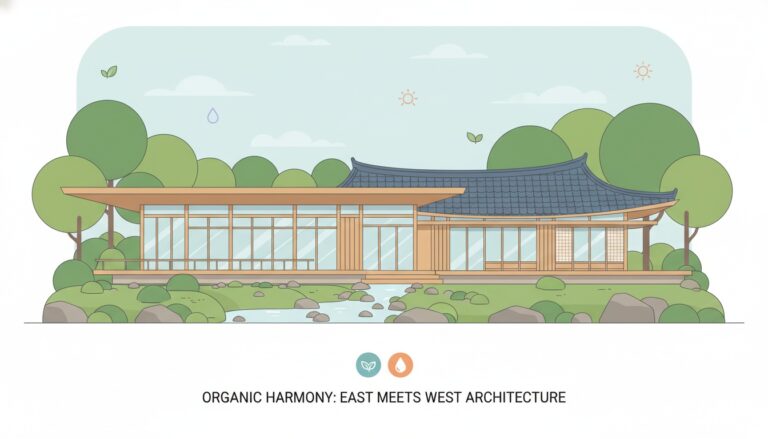
🏠 Nature & Design: Describing Architecture in Korean!
1. Introduction
Hello, everyone! This is [Daily Hangul], here to upgrade your Korean skills! 🌟
Have you ever watched the movie Parasite or the drama The Heirs and marveled at the beautiful houses? Architecture is everywhere! Today, we are going to learn how to talk about Frank Lloyd Wright’s “Organic Architecture” in simple Korean.
Wait, isn’t that too hard? 😱 Don’t worry! We will focus on easy words to describe buildings that look like nature and feel comfortable. If you visit a beautiful cafe or a Hanok village in Korea, these expressions will make you sound like a pro! Let’s build our vocabulary together! 🧱✨
2. Core Expressions (핵심 표현)
Here are 4 key expressions to describe architecture that blends with nature.
1. 자연 (Nature)
- Pronunciation: [Jayeon]
- Meaning: Nature
- Detail: This is the most important word for Organic Architecture! Frank Lloyd Wright loved nature. You can say, “This is nature” (이건 자연이에요).
- 💡 Pronunciation Tip: The ‘J’ sounds soft, like the ‘j’ in ‘jam’. The ‘yeon’ part sounds like ‘yawn’ but shorter.
2. 어울려요 (Matches / Harmonizes)
- Pronunciation: [Eoul-ryeo-yo]
- Meaning: It matches well / It harmonizes
- Detail: Used when two things look good together. In architecture, we say the building “matches nature” (자연이랑 어울려요).
- 💡 Pronunciation Tip: This is a bit tricky! ‘Eoul’ flows into ‘ryeo’. Think of it as linking the sounds smoothly: Eoul-lyeo-yo.
3. 편안해요 (Comfortable)
- Pronunciation: [Pyeon-an-hae-yo]
- Meaning: It is comfortable / relaxed
- Detail: Organic architecture isn’t just about looking good; it’s about feeling good inside. Use this when a space feels relaxing.
- 💡 Pronunciation Tip: Due to sound linking rules, the ‘h’ sound often becomes very weak. It sounds more like Pyeon-an-ae-yo.
4. 지었어요 (Built)
- Pronunciation: [Ji-eo-sseo-yo]
- Meaning: Built (past tense)
- Detail: The base form is 짓다 (Jit-da). But when we change it to the past tense, the bottom ‘ㅅ’ (s) disappears! This is an irregular verb rule.
3. Real Conversation (실전 대화)
Let’s see how to use these words while looking at a photo of Fallingwater (a famous building by Frank Lloyd Wright).
(At a gallery)
👩 Minji: 우와, 이 집 보세요! 정말 예뻐요.
(Uwa, i jip boseyo! Jeongmal yeppeoyo.)
Wow, look at this house! It’s really pretty.
👨 Paul: 네, 건물이 자연 속에 있는 것 같아요.
(Ne, geonmuri jayeon soge inneun geot gatayo.)
Yes, it looks like the building is inside **nature.**
👩 Minji: 맞아요. 나무랑 정말 잘 어울려요.
(Majayo. Namurang jeongmal jal eoulryeoyo.)
Right. It **matches the trees really well.**
👨 Paul: 여기서 살면 마음이 편안할 것 같아요.
(Yeogiseo salmyeon maeumi pyeonanhal geot gatayo.)
I think I would feel **comfortable if I lived here.**
4. Culture Tip & Drama Vibe 🎭
Did you know? Korean Hanok is also “Organic Architecture”!
Frank Lloyd Wright believed buildings should belong to their surroundings. Korea has a traditional concept called Baesanimsu (배산임수), which means “Mountain in the back, water in the front.”
Just like Wright’s designs, traditional Korean houses (Hanok) are built to fit into the landscape, not destroy it. So, if you visit Bukchon Hanok Village in Seoul, you can say: “이 한옥은 자연이랑 잘 어울려요!” (This Hanok matches nature well!).
Fans of the K-drama Personal Taste (개인의 취향) will remember the beautiful Hanok called “Sanggojae.” That is a perfect example of architecture harmonizing with nature! 🏡
5. Wrap-up & Quiz 📝
Today we learned how to describe beautiful, nature-friendly architecture! You are now ready to be an architecture critic in Korean! 😎
Let’s check what you remember:
- What is the Korean word for “Nature”?
( Hint: J _ _ _ _ _ ) - How do you say “It matches well” in Korean?
( Hint: Eoul – _ _ _ – _ _ ) - (O/X Quiz) When you conjugate the verb ‘짓다’ (to build) to past tense, the ‘ㅅ’ stays. (True/False)
Answers:
1. 자연 (Jayeon)
2. 어울려요 (Eoul-ryeo-yo)
3. X (False! The ‘ㅅ’ disappears -> 지었어요)
See you next time! 안녕! 👋
Frequently Asked Questions (FAQ)
Q: What does "어울려요 (Matches / Harmonizes)" mean in Korean and how do you pronounce it?
A: In Korean, "어울려요 (Matches / Harmonizes)" is pronounced [Eoul-ryeo-yo] and means: It matches well / It harmonizes
Q: What does "편안해요 (Comfortable)" mean in Korean and how do you pronounce it?
A: In Korean, "편안해요 (Comfortable)" is pronounced [Pyeon-an-hae-yo] and means: It is comfortable / relaxed
Q: What does "지었어요 (Built)" mean in Korean and how do you pronounce it?
A: In Korean, "지었어요 (Built)" is pronounced [Ji-eo-sseo-yo] and means: Built (past tense)







