

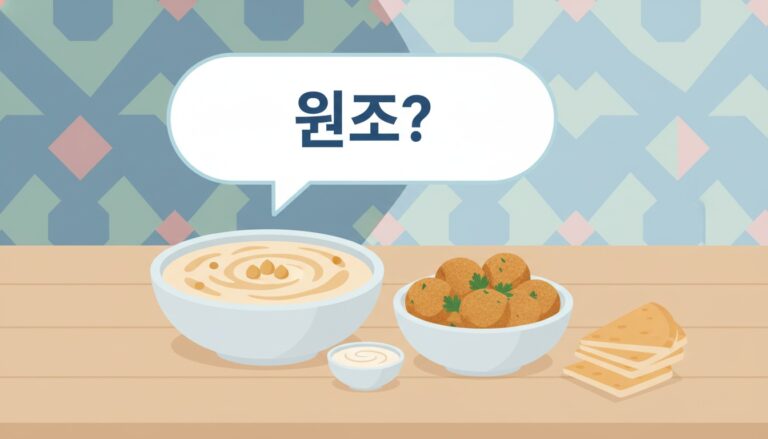
Is This the Original? 🥙 Talking Food Roots in Korean!
2. Hello, K-Culture Fans! 👋
안녕하세요! (Annyeonghaseyo!) It’s your favorite Korean tutor, [Daily Hangul]! 🍎
Today, we are going on a delicious journey to the Middle East and North Africa without leaving our desks! 🌍✈️ Have you ever eaten Hummus or Falafel? They are super trendy in Korea right now too!
But wait… do you know which country these foods actually come from? 🤔 This is a huge topic of debate! Just like people argue about who makes the best Kimchi, many countries claim these foods as their own.
Today, let’s learn how to talk about origins and express opinions in Korean. These phrases are perfect for when you want to discuss culture deeply (or just argue about food playfully 😉).
Let’s dive in! 시작해 볼까요? (Sijakae bolkkayo?)
3. Core Expressions (핵심 표현) 🗣️
1. 원조 (Wonjo)
- Meaning: The original / The originator
- Pronunciation: [Won-jo]
- Detail: This is a MUST-KNOW word in Korea. You will see signs on restaurants saying “원조 할머니” (Original Grandma). In our context, it’s used to claim who invented a dish first.
- 💡 Pronunciation Tip: The ‘W’ sound is rounded. Say it like “One-jo” but softer.
2. 어디 거예요? (Eodi geoyeyo?)
- Meaning: Where is it from? / Whose is it?
- Pronunciation: [Eo-di geo-ye-yo?]
- Detail: A very useful phrase! You can use this to ask about the origin of food, a souvenir, or even a brand.
- Example: 이 후무스 어디 거예요? (Where is this Hummus from?)
- 💡 Pronunciation Tip: Linking sound! ‘Geoyeyo’ flows together smoothly. Don’t pause between the syllables.
3. 제 생각에는… (Je saenggageneun…)
- Meaning: In my opinion…
- Pronunciation: [Je saeng-ga-ge-neun…]
- Detail: When you want to join a debate politely, start with this! It shows you are sharing your view, not stating a fact. Essential for discussing sensitive cultural topics.
- Example: 제 생각에는 맛이 제일 중요해요. (In my opinion, taste is most important.)
- 💡 Pronunciation Tip: The ‘g’ in ‘saeng-ga-ge’ connects to the next vowel. It sounds like [Je saeng-ga-ge-neun].
4. Real Life Conversation (실전 대화) 💬
Situation: Minji and her friend Amir are eating at a Middle Eastern restaurant.
Minji: 우와, 이 팔라펠 진짜 맛있어요! 어디 거예요?
(Uwa, i pallapel jinjja masisseoyo! Eodi geoyeyo?)
Wow, this Falafel is really delicious! Where is it from?
Amir: 여러 나라가 서로 자기네가 원조라고 해요.
(Yeoreo naraga seoro jaginega wonjorago haeyo.)
Many countries say that they are the original.
Minji: 아, 정말요? 음식 문화는 참 복잡하네요.
(A, jeongmalyo? Eumsik munhwaneun cham bokjaphaneyo.)
Oh, really? Food culture is quite complex.
Amir: 맞아요. 하지만 제 생각에는 같이 즐기는 게 더 중요해요.
(Majayo. Hajiman je saenggageneun gachi jeulgineun ge deo jungyohaeyo.)
That’s right. But in my opinion, enjoying it together is more important.
5. Culture Tip & K-Drama Vibes 📺
🌶️ The “Wonjo” (Original) Obsession
In Korea, being the “Original” (원조) is a huge deal! If you walk down a food street in Seoul, you might see five restaurants in a row all claiming to be the “Real Original.” 🤣
Just like the debate over Hummus and Falafel in the Middle East, Koreans take pride in the origins of their local dishes. In K-Dramas, you often see characters fighting over whose mother’s Kimchi recipe is the “original” or “authentic” one.
Pro Tip: If you want to compliment a Korean friend’s cooking, say “Wow, this tastes like wonjo!” (It means it tastes authentic and amazing!).
6. Wrap-up & Quiz 📝
Today we learned how to discuss the origins of food like Hummus and Falafel using Korean! Food connects us all, even if we argue about where it started. 😋
Let’s practice! (Quiz Time)
- How do you say “The Original” in Korean?
( Hint: W _ _ j _ ) - Translate this: “In my opinion…”
( Hint: Je s_ _ _ _ _ _ _ _ _ _… )
Answers:
1. 원조 (Wonjo)
2. 제 생각에는 (Je saenggageneun)
See you next time! 다음에 또 만나요! 👋
Frequently Asked Questions (FAQ)
Q: What does "어디 거예요? (Eodi geoyeyo?)" mean in Korean and how do you pronounce it?
A: In Korean, "어디 거예요? (Eodi geoyeyo?)" is pronounced [Eo-di geo-ye-yo?] and means: Where is it from? / Whose is it?
Q: What does "제 생각에는... (Je saenggageneun...)" mean in Korean and how do you pronounce it?
A: In Korean, "제 생각에는... (Je saenggageneun...)" is pronounced [Je saeng-ga-ge-neun...] and means: In my opinion...







