

Can I Borrow This? 🖊️ Asking Permission Like a K-Drama Star!
👋 Hello! It’s Daily Hangul!
Hello, K-Culture lovers! Welcome back to [Daily Hangul], your best friend for learning Korean! 🇰🇷✨
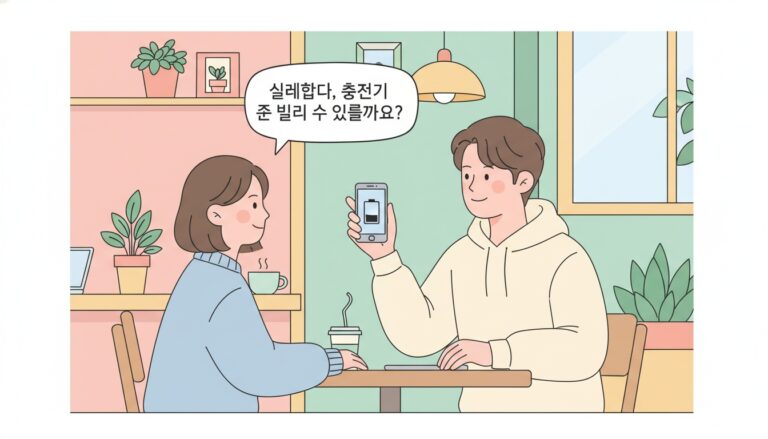
Have you ever been to a Korean cafe and realized your phone battery is at 1%? 😱 Or maybe you are in a class and forgot your pen? In K-Dramas, these are classic moments where the main characters start talking!
Today, we will learn how to ask for permission to borrow or use something. This is a super essential survival skill for your next trip to Korea. Let’s learn how to ask politely and naturally!
Let’s get started! (시작해 볼까요?) 🚀
🔑 Key Expressions
Here are the 3 most useful phrases when you need to borrow something.
1. 이거 빌려도 돼요?
- Pronunciation: [I-geo bil-lyeo-do dwae-yo?]
- Meaning: Can I borrow this?
- Explanation:
- 이거 (I-geo) means “this.”
- 빌리다 (Billida) means “to borrow.”
- ~어도 돼요? (~eo-do dwae-yo?) is the magic grammar pattern meaning “Is it okay if I…?”
- Use this when you want to take something temporarily (like a book or umbrella).
💡 Pronunciation Tip:
The word 돼요 (dwae-yo) can be tricky! Try to say it like “Dwe-yo”. Make your mouth wide when making the ‘W’ sound!
2. 이거 써도 돼요?
- Pronunciation: [I-geo sseo-do dwae-yo?]
- Meaning: Can I use this?
- Explanation:
- 쓰다 (Sseuda) means “to use.”
- Sometimes you don’t want to “borrow” (take away) something, but just “use” it right there (like a chair, a charger, or a pen at a counter). In that case, 써도 돼요? is more natural than 빌려도 돼요.
3. 혹시 … 있어요?
- Pronunciation: [Hok-si … iss-eo-yo?]
- Meaning: By any chance, do you have …?
- Explanation:
- 혹시 (Hok-si) means “by any chance.” It makes your question very polite and soft.
- Before asking to borrow, it’s polite to ask if they have the item first!
🗣️ Real-life Conversation
Imagine you are at a cafe and your phone is dying. You see someone with a charger. 🔌
A (You): 저기요, 혹시 충전기 있어요?
(Excuse me, by any chance, do you have a charger?)
B (Korean): 네, 있어요.
(Yes, I do.)
A (You): 잠깐만 빌려도 돼요?
(Can I borrow it for a moment?)
B (Korean): 네, 여기요.
(Yes, here you go.)
A (You): 감사합니다!
(Thank you!)
🎬 Culture Tip & K-Drama Vibes
🌟 The Magic Word: “좀 (Jom)”
In Korean dramas, you might hear characters say, “이거 좀 빌려도 돼요?”
좀 (Jom) literally means “a little,” but in requests, it acts as a softener, like saying “please” or “would you mind.”
If you add 좀 before the verb, you sound much more native and polite! It shows you are being considerate of the other person.
- Native Style: “이거 좀 빌려주세요.” (Please lend me this a little.)
Also, when you receive the item, remember to take it with two hands (or support your right arm with your left hand) to show respect! 🙌
📝 Wrap-up & Practice
Today we learned how to ask for permission using “~도 돼요?” (Is it okay if…?). Now you can survive without a charger in Seoul! 😉
🧠 Mini Quiz
Let’s check your understanding!
- Fill in the blank: “Can I use this?”
-> 이거 ______ 돼요? (Hint: Verb for ‘to use’) -
True or False: Adding “좀 (Jom)” makes your request rude.
-> ( O / X )
Drop your answers in the comments! 👇
See you next time! 안녕! 👋
[Answers]
1. 써도 (Sseo-do)
2. X (False! It makes it polite!)
Frequently Asked Questions (FAQ)
Q: What does "이거 빌려도 돼요?" mean in Korean and how do you pronounce it?
A: In Korean, "이거 빌려도 돼요?" is pronounced [I-geo bil-lyeo-do dwae-yo?] and means: Can I borrow this?
Q: What does "이거 써도 돼요?" mean in Korean and how do you pronounce it?
A: In Korean, "이거 써도 돼요?" is pronounced [I-geo sseo-do dwae-yo?] and means: Can I use this?
Q: What does "혹시 ... 있어요?" mean in Korean and how do you pronounce it?
A: In Korean, "혹시 ... 있어요?" is pronounced [Hok-si ... iss-eo-yo?] and means: By any chance, do you have ...?







