

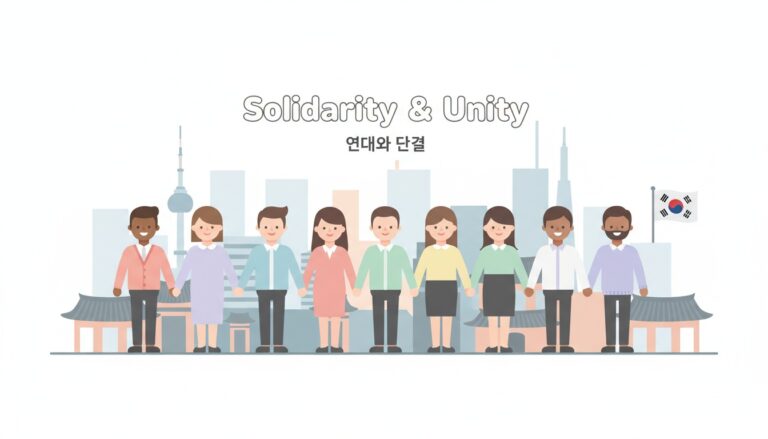
Work & Rights: Real Korean for Office Life! 🏢
Introduction
Hello! This is Daily Hangul, here to upgrade your Korean skills! 😊
Have you ever watched the K-Drama “Awl” (송곳) or “Misaeng” (미생)? These dramas show the intense life of Korean office workers. Today, we are going to learn some slightly serious but very important words related to Social Movements and Work.
Even if you are a beginner, knowing these words will help you understand Korean news and the deep passion Koreans have for social issues! Let’s dive in! 💪
Core Expressions
1. 노동조합 (Labor Union)
- Pronunciation: [Nodongjohap]
- English Meaning: Labor Union
- Detail: This is often shortened to 노조 (Nojo) in news headlines. It refers to an organization formed by workers to protect their rights. In modern Korea, unions play a big role in society!
- 💡 Pronunciation Tip: The ‘h’ in ‘hap’ is often pronounced softly. Try saying it like No-dong-jo-ap quickly!
2. 권리 (Right)
- Pronunciation: [Gwolli]
- English Meaning: Right (as in human rights, workers’ rights)
- Detail: This is a key word in civic engagement. You might hear sentences like “권리를 지키다” (To protect one’s rights).
- 💡 Pronunciation Tip: Lateralization Alert! When the consonant ㄴ (n) meets ㄹ (l), the sound changes to a double ‘L’ sound. So, instead of Gwon-ri, it sounds like [Gwol-li].
3. 함께하다 (To stand together / To be with)
- Pronunciation: [Hamkkehada]
- English Meaning: To be together, to join in solidarity
- Detail: While “solidarity” (연대) is a difficult word, in daily life and movements, Koreans simply say “Let’s do it together!” This verb implies supporting each other in a cause.
- 💡 Pronunciation Tip: The ㄲ (kk) is a tense sound. Tense your throat slightly to make a sharp ‘k’ sound!
Real Conversation
Minji and Soo-ho are talking about a workplace announcement.
👩 Minji: 뉴스 봤어요? 우리 회사 노동조합이 생겼대요.
(Did you see the news? They say a labor union was formed in our company.)
[Nyuseu bwasseoyo? Uri hoesa nodongjohap-i saenggyeotdaeyo.]
👨 Soo-ho: 정말요? 잘됐네요! 우리의 권리를 찾아야 해요.
(Really? That’s great! We need to find (claim) our rights.)
[Jeongmalyo? Jaldwaetneyo! Uri-ui gwonli-reul chajaya haeyo.]
👩 Minji: 맞아요. 저도 함께할 거예요.
(That’s right. I will stand together too.)
[Majayo. Jeodo hamkkehal geoyeyo.]
👨 Soo-ho: 네, 같이 가요! 파이팅!
(Yes, let’s go together! Fighting!)
[Ne, gachi gayo! Paiting!]
Culture Tip & Drama Context 🎬
🕯️ The Culture of “Candlelight” (촛불)
In Korea, when people want to express their opinions or change society peacefully, they often gather in squares (like Gwanghwamun) holding candles. This is called a Candlelight Vigil (촛불 집회).
Historically, Korean labor unions and civic groups have played a massive role in democratizing the country. If you watch the movie “A Taxi Driver” (택시운전사) or the drama “Awl”, you can see how ordinary people come together to create change. Koreans value the power of “gathering voices” (목소리를 모으다) very much!
Wrap-up & Quiz 📝
Today we learned how to talk about rights and working together! These words will make you sound very sophisticated in Korean. 😎
Let’s check what you learned!
- What is the short form of ‘Labor Union’ (노동조합)?
( Hint: No__ ) - How do you pronounce 권리 (Right)?
( A. Gwon-ri / B. Gwol-li ) - “Let’s protect our rights!” = 우리의 OOO를 지키자!
[Answers]
1. Nojo (노조)
2. B (Due to the sound change rule!)
3. 권리 (Gwonli)
See you next time! 안녕! 👋
Frequently Asked Questions (FAQ)
Q: What does "노동조합 (Labor Union)" mean in Korean and how do you pronounce it?
A: In Korean, "노동조합 (Labor Union)" is pronounced [Nodongjohap] and means: Labor Union
Q: What does "권리 (Right)" mean in Korean and how do you pronounce it?
A: In Korean, "권리 (Right)" is pronounced [Gwolli] and means: Right (as in human rights, workers' rights)
Q: What does "함께하다 (To stand together / To be with)" mean in Korean and how do you pronounce it?
A: In Korean, "함께하다 (To stand together / To be with)" is pronounced [Hamkkehada] and means: To be together, to join in solidarity






