

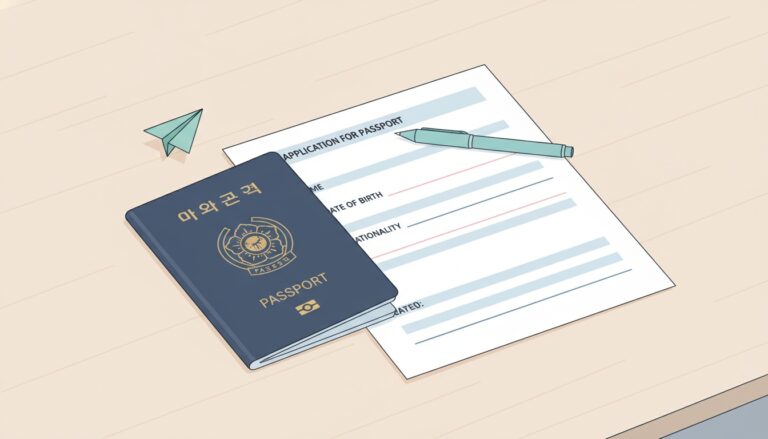
Getting Your Passport Ready in Korea! ✈️
👋 Hello! This is Daily Hangul!
Hello, K-Culture fans! 🌟 Are you planning a trip to Korea, or maybe dreaming of living there? Dealing with paperwork is always scary, even in your own language! 😱
Today, we will learn how to fill out a Passport Application Form (yeogwon balgeup sincheongseo). Even if you aren’t applying for a passport right now, these words appear on immigration forms, hotel check-ins, and hospital forms too!
Let’s master these essential words so you can handle Korean paperwork like a pro! 📝✨
📚 Key Expressions
1. 성명 (Name)
- Pronunciation: [Seongmyeong]
- Meaning: Name (Full Name)
- Explanation: You usually say “ileum” (이름) for “name” in casual conversation. However, on official documents or forms, we use 성명 (Seongmyeong). It sounds more formal!
- 💡 Pronunciation Tip: Make sure to pronounce the ‘ng’ (ㅇ) sound clearly at the end of both syllables! It’s not “Seon-myeon”, it is “Seong-myeong“.
2. 생년월일 (Date of Birth)
- Pronunciation: [Saengnyeonwolil]
- Meaning: Date of Birth
- Explanation: This is a must-know! It combines Year (Saeng-nyeon), Month (Wol), and Day (Il). You will see this on almost every ID check or website sign-up.
- 💡 Pronunciation Tip: This is tricky! Because of sound linking (liaison), it flows like [Saeng-nyeon-wo-ril]. The ‘l’ sound in ‘wol’ moves over to ‘il’ to make it smoother.
3. 연락처 (Contact Info)
- Pronunciation: [Yeollakcheo]
- Meaning: Contact Information (Phone Number)
- Explanation: This usually refers to your mobile phone number. In K-Dramas, when a guy asks a girl for her number, he might say “Yeollakcheo jom allyeojuseyo” (Please give me your contact info)! 😍
- 💡 Pronunciation Tip: The double ‘ll’ (ㄹㄹ) makes a strong ‘L’ sound. Also, the ‘k’ (ㄱ) meets ‘ch’ (ㅊ), creating a strong aspiration sound.
4. 서명 (Signature)
- Pronunciation: [Seomyeong]
- Meaning: Signature
- Explanation: At the very bottom of the form, you need to sign! Sometimes you might see 인 (In) which means you can use a stamp (dojang), but 서명 is for your handwritten signature.
🗣️ Real-life Conversation
Situation: At the District Office (Gu-office), asking for help with the form.
Clerk: 신청서는 여기에 있습니다. (The application form is here.)
– [Sincheongseoneun yeogie isseumnida.]
You: 감사합니다. 성명은 한글로 써야 해요? (Thank you. Should I write my name in Hangul?)
– [Gamsahamnida. Seongmyeong-eun hangeul-lo sseoya haeyo?]
Clerk: 네, 그리고 여기에 생년월일을 적어주세요. (Yes, and please write your date of birth here.)
– [Ne, geurigo yeogie saengnyeonwolil-eul jeogeojuseyo.]
You: 알겠습니다. 마지막에 서명하면 되나요? (I see. Should I sign at the end?)
– [Algesseumnida. Majimage seomyeong-hamyeon doenayo?]
🎬 Culture Tip & Drama Vibe
“Do I need a Stamp (Dojang)?”
In many historical or business K-Dramas, you see people stamping a red seal on papers with a loud Bang! 😤 That is a Dojang (도장).
While signatures (서명) are very common now, important contracts (like buying a house) still often use a personal seal. But for your passport or simple forms, a signature is perfect! 🖊️
📝 Wrap-up & Quiz
Today we learned essential words for filling out forms! Now you won’t panic when you see a Korean document. 😎
Let’s test your skills!
- What is the formal word for “Name” used in documents?
(A) 이름 (Ileum) (B) 성명 (Seongmyeong) - Which word means “Date of Birth”?
(A) 생년월일 (B) 연락처 - True or False: “Seomyeong” means your phone number.
[Answers]
1. (B)
2. (A)
3. False (It means Signature!)
See you next time! Annyeong! 👋
Frequently Asked Questions (FAQ)
Q: What does "성명 (Name)" mean in Korean and how do you pronounce it?
A: In Korean, "성명 (Name)" is pronounced [Seongmyeong] and means: Name (Full Name)
Q: What does "생년월일 (Date of Birth)" mean in Korean and how do you pronounce it?
A: In Korean, "생년월일 (Date of Birth)" is pronounced [Saengnyeonwolil] and means: Date of Birth
Q: What does "연락처 (Contact Info)" mean in Korean and how do you pronounce it?
A: In Korean, "연락처 (Contact Info)" is pronounced [Yeollakcheo] and means: Contact Information (Phone Number)
Q: What does "서명 (Signature)" mean in Korean and how do you pronounce it?
A: In Korean, "서명 (Signature)" is pronounced [Seomyeong] and means: Signature







