

Invited to a Korean Home? 🏠 Party Etiquette 101
1. Introduction
Hello, everyone! It’s your friendly Korean tutor, Daily Hangul! 👋✨
Have you ever watched a K-Drama and seen a scene where friends gather for a housewarming party, known as ‘Jipdeuri’ (집들이)? Or maybe you’ve been invited to a Korean friend’s house? 🏠
Visiting a Korean home is a special experience, but it comes with its own set of manners! Today, we will learn the essential phrases for being a polite guest and a welcoming host. Mastering these will make you look like a pro who understands Korean culture perfectly. Let’s dive in! 🚀
2. Core Expressions
Here are 4 must-know expressions for social gatherings at home!
1. 어서 오세요 / 들어오세요
- Pronunciation: [Eoseo oseyo / Deureo oseyo]
- English Meaning: Welcome / Please come in.
- Detail: This is the standard greeting used by the host when a guest arrives. “Eoseo oseyo” is a polite “Welcome,” and “Deureo oseyo” literally means “Come inside.”
- 💡 Pronunciation Tip: In 들어오세요, the ‘ㄹ’ (r/l) sound moves to the next block. So it sounds like [Deu-reo-o-se-yo]. Smooth and connected!
2. 초대해 줘서 고마워요
- Pronunciation: [Chodaehae jwoseo gomawoyo]
- English Meaning: Thank you for inviting me.
- Detail: This is the perfect phrase for a guest to say right after entering. It shows gratitude and politeness.
3. 이거 별거 아니에요
- Pronunciation: [Igeo byeolgeo anieyo]
- English Meaning: This is nothing much / It’s a small gift.
- Detail: Koreans are very modest! Even if you bought a nice gift, it is polite to say, “This is nothing special,” to show humility. You will hear this a lot in dramas when a character hands over a gift bag! 🎁
4. 차린 건 없지만 많이 드세요
- Pronunciation: [Charin geon eopjiman mani deuseyo]
- English Meaning: I didn’t prepare much, but please eat a lot.
- Detail: A classic host phrase! Even if the table is full of food, the host says this to be humble. It means, “I prepared this with care, so please enjoy it fully.”
3. Real-life Conversation
Let’s see how these fit into a real situation. Min-su is visiting Ji-eun‘s new apartment.
(Ding-dong! 🔔)
Ji-eun (Host): 어서 와! 밖이 춥지? 얼른 들어와.
(Eoseo wa! Bakki chupji? Eolleun deureowa.)
Welcome! It’s cold outside, right? Come in quickly.
Min-su (Guest): 초대해 줘서 고마워. 집이 정말 예쁘다!
(Chodaehae jwoseo gomawo. Jibi jeongmal yeppeuda!)
Thanks for inviting me. Your house is so pretty!
Ji-eun (Host): 고마워. 편하게 앉아.
(Gomawo. Pyeonhage anja.)
Thanks. Make yourself comfortable.
Min-su (Guest): 아, 이거 선물이야. 별거 아니야.
(A, igeo seonmuriya. Byeolgeo aniya.)
Ah, this is a gift. It’s nothing special.
Ji-eun (Host): 우와, 감동이야! 배고프지? 많이 먹어!
(Uwa, gamdongiya! Baegopeuji? Mani meokeo!)
Wow, I’m touched! You’re hungry, right? Eat a lot!
(Note: Since they are friends, they dropped the ‘yo’ ending for a casual tone!)
4. Culture Tip & K-Drama Moment 📺
🎁 The Secret Meaning of Toilet Paper & Detergent
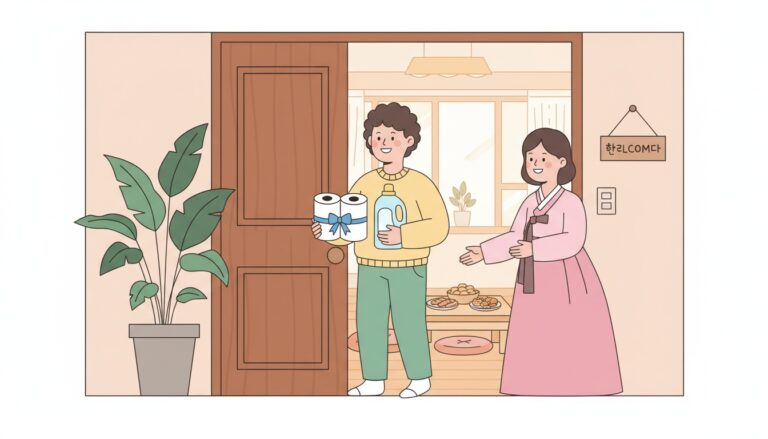
In K-Dramas like Crash Landing on You or Reply 1988, have you seen guests bringing rolls of toilet paper or laundry detergent to a housewarming party?
It’s not because the host ran out of supplies! 😂
* Toilet Paper: Just as the paper unrolls easily, it means “May your life and problems unravel smoothly/easily.”
* Detergent: The bubbles represent “wealth and prosperity bubbling up.”
Next time you visit a Korean friend’s new home, bring toilet paper! You will definitely be praised as a “Sensa-jaeng-i” (someone with great sense)! 👍
5. Wrap-up & Quiz
Today we learned how to be a polite guest and a humble host in Korea. Remember, modesty is key in Korean culture! 😉
📝 Mini Quiz
1. What do you say when you hand a gift to someone to show modesty?
(A) 이거 아주 비싼 거예요 (This is very expensive)
(B) 이거 별거 아니에요 (This is nothing much)
- True or False: If a host says “I didn’t prepare much,” it means there is actually no food.
( ) True / ( ) False -
Fill in the blank: “_______ oseyo” (Welcome / Come in).
Good luck! See you in the next lesson! 👋
Answers:
1. (B)
2. False (It is a humble expression; usually there is a lot of food!)
3. Eoseo (어서) or Deureo (들어)
Frequently Asked Questions (FAQ)
Q: What does "초대해 줘서 고마워요" mean in Korean and how do you pronounce it?
A: In Korean, "초대해 줘서 고마워요" is pronounced [Chodaehae jwoseo gomawoyo] and means: Thank you for inviting me.
Q: What does "이거 별거 아니에요" mean in Korean and how do you pronounce it?
A: In Korean, "이거 별거 아니에요" is pronounced [Igeo byeolgeo anieyo] and means: This is nothing much / It's a small gift.
Q: What does "차린 건 없지만 많이 드세요" mean in Korean and how do you pronounce it?
A: In Korean, "차린 건 없지만 많이 드세요" is pronounced [Charin geon eopjiman mani deuseyo] and means: I didn't prepare much, but please eat a lot.







