

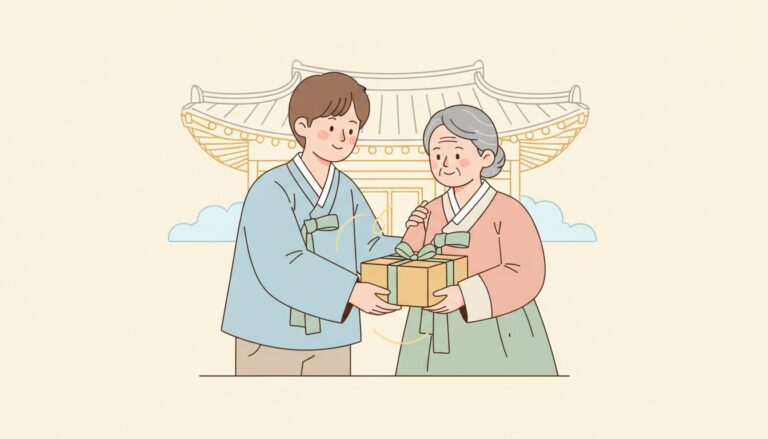
Deep Talk: Caring for the Elderly in Korea 🇰🇷
1. Introduction
Hello, Daily Hangul family! 👋 It’s your favorite Korean tutor, Daily Hangul!
Today, we are going to learn something a bit meaningful. Have you ever watched a K-drama or a documentary that shows the lives of grandmothers and grandfathers in Korea? Sometimes, stories about the elderly (Silver Generation) can be quite touching and sad.
Even if you are a beginner, you might want to express your feelings or concerns about social issues like “elderly poverty” after watching the news. Today, let’s learn how to express empathy and concern in Korean! These phrases will make you sound like a caring and thoughtful friend. Let’s dive in! 👵👴💖
2. Key Expressions
Here are 3 essential expressions to talk about difficult situations and showing care.
1) 살기 힘들어요
- Pronunciation: [Salgi himdeureoyo]
- English Meaning: It is hard to make a living / Life is hard.
- Explanation:
“Salgi” comes from “salda” (to live). “Himdeureoyo” means “it is hard/difficult.” You will hear this phrase constantly in K-dramas when characters face financial difficulties. It’s a very common way to say that life is tough financially. - 💡 Pronunciation Tip:
Notice the linking sound! When you say 힘들어요, the final consonant ‘ㄹ’ (l/r) in ‘들’ moves over to the empty ‘ㅇ’ spot in ‘어’. So it sounds more like [Him-deu-reo-yo]. Try to flow it smoothly!
2) 걱정이에요
- Pronunciation: [Geokjeong-ieyo]
- English Meaning: I am worried / It’s a worry.
- Explanation:
“Geokjeong” means “worry.” When you watch a sad documentary about elderly people living alone, you can simply say this to show your sympathy. It implies “I am worried about them.” - 💡 Pronunciation Tip:
The ‘ㄱ’ (g/k) sound at the end of ‘걱’ stops abruptly before you say ‘정’. It’s not “Geok-uh-jeong,” it’s a tight [Geok-jeong].
3) 관심이 필요해요
- Pronunciation: [Gwansimi piryohaeyo]
- English Meaning: We need to pay attention / Interest is needed.
- Explanation:
“Gwansim” means “interest” or “attention,” and “piryohaeyo” means “is needed.” This is a perfect sentence to use in a discussion when you want to suggest that society should care more about a problem. - 💡 Pronunciation Tip:
In 관심 (Gwansim), the ‘sh’ sound in ‘sim’ should be soft. Also, linking happens again: 관심이 sounds like [Gwan-si-mi].
3. Real Conversation
Let’s see how two friends, Minji and Paul, talk after watching a documentary about elderly people collecting cardboard boxes to earn money.
Minji: 저 할머니, 너무 외로워 보여요.
[Jeo halmeoni, neomu oerowo boyeoyo.]
(That grandmother looks so lonely.)
Paul: 맞아요. 혼자 살기 힘들어요.
[Majayo. Honja salgi himdeureoyo.]
(That’s right. It’s hard to make a living alone.)
Minji: 겨울이라서 더 걱정이에요.
[Gyeouriraseo deo geokjeong-ieyo.]
(I’m more worried because it’s winter.)
Paul: 우리가 더 관심이 필요해요.
[Uriga deo gwansimi piryohaeyo.]
(We need to pay more attention/interest.)
4. Culture Tip & Drama Context 🎬
🇰🇷 The “Cardboard Collecting” Grandparents
If you visit Seoul, you might occasionally see elderly people pulling heavy carts filled with cardboard boxes. This is a sad reality of Elderly Poverty (노인 빈곤) in Korea. They collect recyclables to sell for a small amount of money.
📺 Drama Recommendation: Navillera (나빌레라)
Have you seen the drama “Navillera”? It tells the story of a 70-year-old man who pursues his dream of ballet. While it’s heartwarming, it also shows the realities of aging in Korea. Using today’s expressions while watching this drama will make you feel much closer to the characters!
Also, in Korea, we always use honorifics for the elderly. Instead of just saying “old person” (noin), we use “Eoreusin” (어르신) to show high respect! 🙇♂️
5. Wrap-up & Quiz
Today we learned how to express concern for social issues. It’s a bit serious, but showing empathy is a huge part of Korean culture (Jeong/정)!
📝 Pop Quiz
- How do you say “I am worried” in Korean?
( 걱**__ ) -
True or False: When pronouncing “힘들어요”, you should separate every syllable clearly like “Him-Deul-Eo-Yo”.
( O / X )
Answers:
1. 걱정이에요 (Geokjeong-ieyo)
2. X (False! You should link the sounds: [Him-deu-reo-yo])
See you next time with more useful Korean! Annyeong! 👋
Frequently Asked Questions (FAQ)
Q: What does "걱정이에요" mean in Korean and how do you pronounce it?
A: In Korean, "걱정이에요" is pronounced [Geokjeong-ieyo] and means: I am worried / It’s a worry.
Q: What does "관심이 필요해요" mean in Korean and how do you pronounce it?
A: In Korean, "관심이 필요해요" is pronounced [Gwansimi piryohaeyo] and means: We need to pay attention / Interest is needed.







