

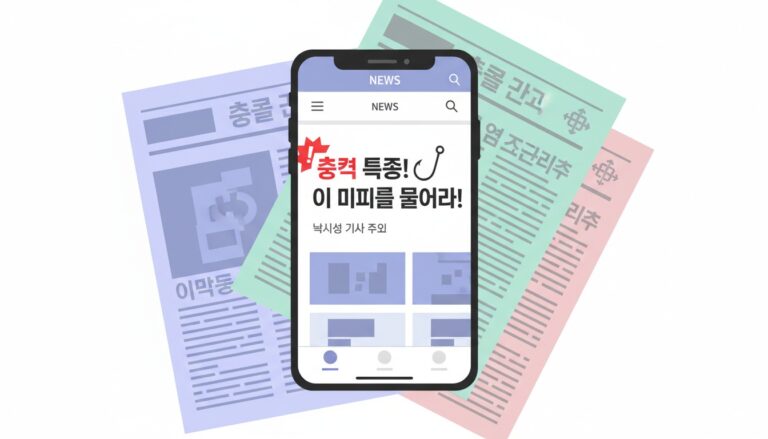
📰 K-News Survival: Decoding “Shocking” Headlines!
2. Introduction
Hello, K-Culture lovers! 👋 It’s your favorite tutor, [Daily Hangul]!
Have you ever clicked on a news article about your favorite K-Pop idol because the title looked scary, only to find out it was nothing serious? 😅
Korean news headlines, especially in entertainment, often use strong emotional words to grab your attention. Today, we will learn how to identify these dramatic words so you don’t get too surprised or worried. Let’s become smart readers together! 🤓
3. Key Expressions
Here are 3 words you will see everywhere on Korean news portals and YouTube thumbnails.
1. 충격 (Chung-gyeok)
- Pronunciation: [Chung-gyeok]
- Meaning: Shock / Impact
- Detail: This is the #1 word for dramatic headlines. It is used to suggest something very surprising has happened. However, in entertainment news, it is often used even for small changes (like a new haircut!).
- 💡 Pronunciation Tip: The ‘k’ (ㄱ) at the end of Chung and gyeok should be a stop sound. Don’t release a breath of air. It’s not “Chung-kuh”, it’s a tight “Chung”.
2. 논란 (Non-lan)
- Pronunciation: [Nollan] (❗️Important)
- Meaning: Controversy
- Detail: Used when people are arguing about a topic. If an actor wears an unusual outfit or a singer makes a mistake, you will see this word.
- 💡 Pronunciation Tip: This is a tricky one! When ‘ㄴ’ (n) meets ‘ㄹ’ (l), the sound changes to a double ‘L’ sound. So instead of Non-lan, we say [Nollan].
3. 낚시 (Nak-si)
- Pronunciation: [Nak-si]
- Meaning: Fishing (Metaphor for Clickbait)
- Detail: Originally means “fishing” for fish 🎣. But in the internet world, it means “Clickbait.” If a title lies to get you to click, Koreans say, “It is fishing!”
- 💡 Pronunciation Tip: The ‘si’ (시) sounds slightly tense, almost like ‘she’ but with a smile.
4. Real-life Conversation
Situation: Min-ji sees a scary news headline about her favorite actor and shows it to her Korean friend, Jun-ho.
Min-ji: 헐! 준호야, 이거 봐! “배우 김철수, 충격 고백?”
(Heol! Jun-ho, look at this! “Actor Kim Cheol-su, shocking confession?”)
Jun-ho: 에이, 너무 걱정하지 마. 그냥 낚시 기사일 거야.
(Ey, don’t worry too much. It’s probably just a clickbait article.)
Min-ji: 진짜? 제목이 너무 무서워.
(Really? The title is so scary.)
Jun-ho: 내용을 봐. 그냥 김치찌개를 좋아한다는 내용이잖아. 논란도 아니네.
(Look at the content. It just says he likes Kimchi-jjigae. It’s not even a controversy.)
Min-ji: 와… 진짜 다행이다!
(Wow… that’s such a relief!)
5. Culture Tip & Drama Context 📺
“Title vs. Content” (제목 vs. 내용)
In Korea, there is a saying among netizens: “믿고 거르는 기사” (Articles you trust to skip).
Korean reporters often use “emotional appeals” to get clicks because competition is high. In K-Dramas featuring reporters (like Pinocchio or Start-Up), you might see editors shouting, “Make the title more stimulating (자극적으로)!”
So, if you see words like 충격 (Shock) or 경악 (Astonishment), take a deep breath! Check the actual content first before you panic. 🧘♀️
6. Wrap-up & Quiz
Today we learned how to spot dramatic words in Korean headlines. Now you won’t be easily fooled by 낚시 (fishing/clickbait) articles!
📝 Pop Quiz!
- What is the Korean word for “Clickbait” (literally meaning ‘fishing’)?
( ) - How do you pronounce the word 논란 (Controversy)?
a) [Non-lan]
b) [Nollan] - True or False: The word 충격 is only used for very serious, life-changing news.
( O / X )
Good luck, and see you next time! 안녕! 👋
Answer Key:
1. 낚시 (Nak-si)
2. b) [Nollan]
3. X (It is often used for small things to exaggerate!)
Frequently Asked Questions (FAQ)
Q: What does "논란 (Non-lan)" mean in Korean and how do you pronounce it?
A: In Korean, "논란 (Non-lan)" is pronounced [Nollan] and means: Controversy
Q: What does "낚시 (Nak-si)" mean in Korean and how do you pronounce it?
A: In Korean, "낚시 (Nak-si)" is pronounced [Nak-si] and means: Fishing (Metaphor for Clickbait)







