

📚 Reading Korean Self-Help Books: Is it True?
1. Introduction
Hello, Daily Hangul family! 👋 Welcome back!
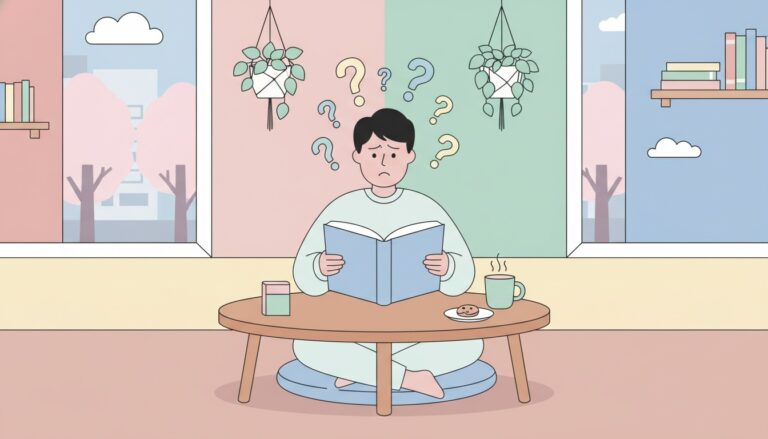
Have you ever walked into a Korean bookstore like Kyobo Bookstore? You will see piles of Self-Help Books in the best-seller section! Koreans are very passionate about Lifelong Learning (평생 학습) and self-improvement.
But wait! 🛑 Should we believe everything written in those books? Today, we will learn how to express critical opinions about what we read. This is super useful not just for books, but for discussing news or articles with your Korean friends! Let’s dive in! 🚀
2. Core Expressions (핵심 표현)
1) 자기계발서 (Self-help book)
- Pronunciation: [Jagi-gyebalseo]
- English: Self-help book
- Explanation: This is a combination of 자기 (Self) + 계발 (Development) + 서 (Book). If you want to find these books in a library, look for this sign!
- 💡 Pronunciation Tip: The syllable 계 (gye) is often pronounced like 게 (ge) in casual speech because it’s easier to say. So it sounds like [Jagi-gebalseo].
2) 제 생각은 달라요 (My opinion is different)
- Pronunciation: [Je saenggageun dallayo]
- English: I think differently / I disagree.
- Explanation: When you read a book and don’t agree with the author, use this phrase. It is a polite way to show you are thinking critically.
3) 말이 안 돼요 (It doesn’t make sense)
- Pronunciation: [Mari an dwaeyo]
- English: It doesn’t make sense / It’s nonsense.
- Explanation: Use this when a book claims something impossible (e.g., “Master Korean in 1 hour!”). It’s a bit strong, so use it with close friends or when you are really skeptical!
- 💡 Pronunciation Tip: When saying 안 돼요, the ‘ㄴ’ in ‘안’ flows into the next sound. It sounds smooth like [Mali-andwaeyo].
4) 성공하다 (To succeed)
- Pronunciation: [Seonggonghada]
- English: To succeed
- Explanation: The ultimate goal of most self-help books! You will hear this word constantly in K-Dramas like Start-Up or Itaewon Class.
3. Real Conversation (실전 대화)
Situation: Min-ji and Jason are looking at a new book in a bookstore.
Min-ji: 제이슨, 이 책 봐! “아침 4시에 일어나면 성공해요.”
(Jason, look at this book! “If you wake up at 4 AM, you succeed.”)
[Jeiseun, i chaek bwa! “Achim 4sie ireonamyeon seonggonghaeyo.”]
Jason: 4시요? 으음… 제 생각은 달라요.
(4 AM? Hmm… My opinion is different.)
[4siyo? Eueum… Je saenggageun dallayo.]
Min-ji: 왜요? 좋은 자기계발서 같은데요?
(Why? It seems like a good self-help book?)
[Waeyo? Joeun jagi-gyebalseo gateundeyo?]
Jason: 잠을 안 자면 병원에 가야 해요. 말이 안 돼요!
(If you don’t sleep, you have to go to the hospital. It doesn’t make sense!)
[Jameul an jamyeon byeongwone gaya haeyo. Mari an dwaeyo!]
Min-ji: 하하, 맞아요. 잠이 최고죠! 😴
(Haha, that’s right. Sleep is the best!)
[Haha, majayo. Jami choegojyo!]
4. Culture Tip & K-Drama Context 🎬
🇰🇷 The “Miracle Morning” (미라클 모닝) Trend
Did you know? In Korea, the trend of waking up very early to study or exercise before work is huge! It’s called “Miracle Morning.” Many Koreans read books about this to stay motivated in a competitive society.
📺 K-Drama Moment:
Think of Park Sae-ro-yi in Itaewon Class. He reads books (biographies of successful people) to build his business. But he doesn’t just copy them; he thinks about his own values. That is true critical reading!
5. Wrap-up & Quiz 📝
Today we learned how to be a smart reader in Korean! Don’t just read—think about it! 🤔
Pop Quiz! (Fill in the blanks)
- A book that helps you improve yourself is called a ( ________ ).
- If you disagree politely, you say: “제 ( ________ )은 달라요.”
- “To succeed” in Korean is ( ________ ).
Answers:
1. 자기계발서 (Jagi-gyebalseo)
2. 생각 (Saenggak)
3. 성공하다 (Seonggonghada)
See you next time! 안녕! 👋
Frequently Asked Questions (FAQ)
Q: What does "제 생각은 달라요 (My opinion is different)" mean in Korean and how do you pronounce it?
A: In Korean, "제 생각은 달라요 (My opinion is different)" is pronounced [Je saenggageun dallayo] and means: a key conversational Korean expression covered in this lesson.
Q: What does "말이 안 돼요 (It doesn't make sense)" mean in Korean and how do you pronounce it?
A: In Korean, "말이 안 돼요 (It doesn't make sense)" is pronounced [Mari an dwaeyo] and means: a key conversational Korean expression covered in this lesson.
Q: What does "성공하다 (To succeed)" mean in Korean and how do you pronounce it?
A: In Korean, "성공하다 (To succeed)" is pronounced [Seonggonghada] and means: a key conversational Korean expression covered in this lesson.







