

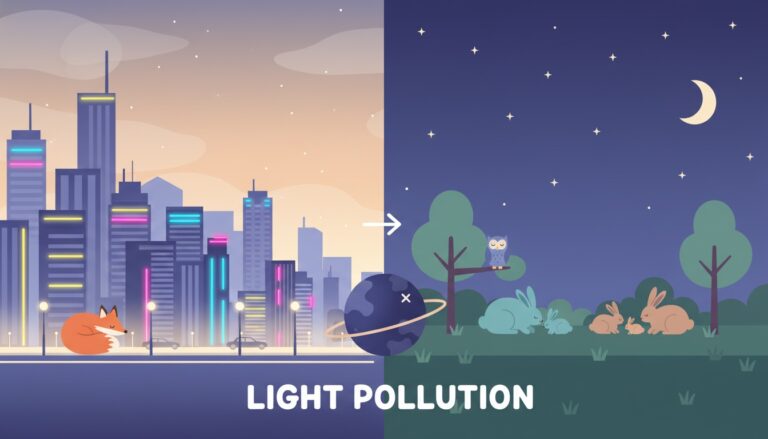
Too Bright at Night? Let’s Talk ‘Light Pollution’ in Korean! 🌃
1. Introduction
Hello, everyone! This is Daily Hangul, here to upgrade your Korean skills! 😊
Have you ever looked at the night sky in a K-Drama scene set in Seoul? The city lights are dazzling and romantic, right? But wait… sometimes, too much light can be a problem! Today, we are going to tackle a slightly more advanced but very important topic: Urban Planning and Nature.
Imagine you are a university student in a Korean drama (like Cheese in the Trap or Law School), and you have to write a group report about the environment. What words would you use? Specifically, we are talking about Light Pollution and how it affects nature.
Don’t worry if it sounds difficult! I’ll make these professional terms super easy to understand. Let’s dive in! 🚀
2. Key Expressions
Here are 4 key expressions to help you sound like a pro when talking about the environment!
1. 빛 공해 (Light Pollution)
- Pronunciation: [Bit gong-hae]
- Meaning: Light pollution
- Detail: This is a combination of 빛 (light) and 공해 (pollution). It refers to excessive artificial light at night. While ‘Night View’ (야경, Yagyeong) is beautiful, ‘Light Pollution’ is the negative side of it.
- 💡 Pronunciation Tip: When you say 빛 (Bit), make sure to stop the ‘t’ sound abruptly at the end. It’s short and sharp!
2. 생태계 (Ecosystem)
- Pronunciation: [Saeng-tae-gye]
- Meaning: Ecosystem
- Detail: This word appears frequently in news and documentaries. It refers to the system where animals and plants live together. If you use this word, your Korean friends will be surprised by your vocabulary level! 🌿
- 💡 Pronunciation Tip: Try to say each syllable clearly. [Saeng] – [Tae] – [Gye].
3. 영향을 미치다 (To affect / To influence)
- Pronunciation: [Yeong-hyang-eul mi-chi-da]
- Meaning: To have an influence / To affect
- Detail: This is a very common phrase in formal writing or reports. instead of just saying “It changes it,” you say “It exerts influence.”
- Example: 빛 공해가 생태계에 영향을 미쳐요. (Light pollution affects the ecosystem.)
- 💡 Pronunciation Tip: The ㅎ (h) in ‘향 (hyang)’ is often pronounced softly. Also, connect the sounds: [Yeong-hyang-eul] sounds like [Yeong-hyang-ngeul] when spoken fast.
4. 줄이다 (To reduce)
- Pronunciation: [Ju-ri-da]
- Meaning: To reduce / To decrease
- Detail: You can use this for anything! Reducing waste, reducing noise, or reducing light pollution. It is the opposite of 늘리다 (to increase).
- 💡 Pronunciation Tip: Because of the ㄹ (l/r) sound moving over, it sounds like [Ju-ri-da]. Soften the ‘r’ sound!
3. Real Conversation: Writing the Report 📝
Let’s see how these words are used in a real life situation. Minji and Jason are university students working on a team project.
Minji: 서울은 밤에도 정말 밝은 것 같아.
(Seoul seems really bright even at night.)
Jason: 맞아. 그걸 ‘빛 공해’라고 해.
(That’s right. They call that ‘light pollution’.)
Minji: 너무 밝으면 동물들이 잠을 못 자서 생태계에 안 좋아.
(If it’s too bright, animals can’t sleep, so it’s bad for the ecosystem.)
Jason: 그럼 우리 보고서 주제는 ‘빛 공해를 줄이는 방법’으로 할까?
(Then shall we make our report topic ‘Ways to reduce light pollution’?)
Minji: 좋은 생각이야! 사람들에게 어떤 영향을 미치는지도 조사하자.
(Great idea! Let’s also research what kind of influence it has on people.)
4. Culture Tip & Drama Context 📺
Did you know?
In Korea, big cities like Seoul are famous for their “24-hour culture.” Convenience stores, PC bangs (internet cafes), and neon signs are on all night. While this is convenient and looks cool in K-Dramas (like the vibrant streets in Itaewon Class), Korea is now trying hard to reduce light pollution to save energy and protect nature.
Also, if you visit the Namsan Seoul Tower, look at the color! It changes color based on air quality (Blue = Good, Red = Bad), but they also turn off lights during “Earth Hour” campaigns to protect the ecosystem. If you mention this to Koreans, they will think you are very knowledgeable! 🧠
5. Wrap-up & Quiz ✅
Today we learned how to talk about Light Pollution and Urban Planning in Korean. These words will make your Korean sound very sophisticated!
Let’s test your knowledge!
Q1. Match the Korean word to its English meaning.
1. 빛 공해 (Bit gong-hae)
2. 줄이다 (Ju-ri-da)
(A) To reduce
(B) Light Pollution
Q2. Fill in the blank.
“Too much light is bad for the _______ (animals and plants system).”
= 너무 밝은 빛은 [ _______ ] 에 안 좋아요.
Answers:
* Q1: 1-(B), 2-(A)
* Q2: 생태계 (Saeng-tae-gye)
Great job today! See you next time for more fun Korean! Annyeong! 👋
Frequently Asked Questions (FAQ)
Q: What does "생태계 (Ecosystem)" mean in Korean and how do you pronounce it?
A: In Korean, "생태계 (Ecosystem)" is pronounced [Saeng-tae-gye] and means: Ecosystem
Q: What does "영향을 미치다 (To affect / To influence)" mean in Korean and how do you pronounce it?
A: In Korean, "영향을 미치다 (To affect / To influence)" is pronounced [Yeong-hyang-eul mi-chi-da] and means: To have an influence / To affect
Q: What does "줄이다 (To reduce)" mean in Korean and how do you pronounce it?
A: In Korean, "줄이다 (To reduce)" is pronounced [Ju-ri-da] and means: To reduce / To decrease






