

1. Intro
Annyeonghaseyo! (안녕하세요!) It’s your friendly Korean tutor, Daily Hangul! 🌟
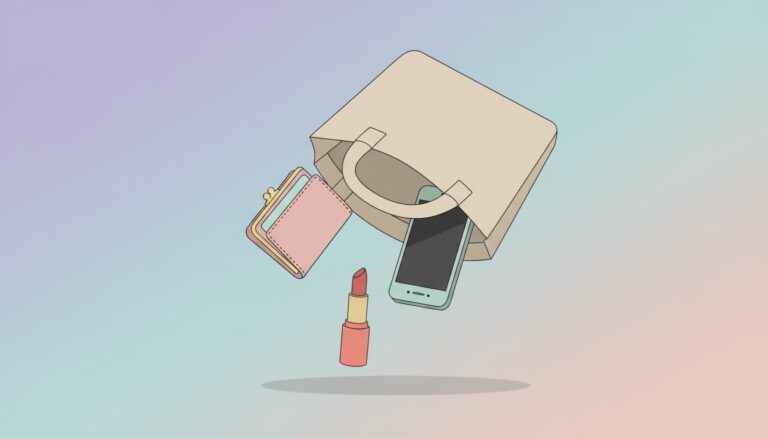
Have you ever watched your favorite K-Pop idols do a “What’s in my bag” (왓츠인마이백) interview on YouTube? It’s the best way to see their favorite items! Today, imagine we found a mysterious bag. We need to guess who it belongs to! 🕵️♀️
To do this, we need to master Possessives—how to say “my,” “your,” or “her” in Korean. This is super useful when you want to ask, “Is this yours?” or say, “Don’t touch, it’s mine!” Let’s dive in! 🚀
2. Key Expressions (Core Vocabulary)
Here are the must-know words to talk about ownership!
1️⃣ 누구의 (Whose)
- Korean: 누구의 (or just 누구)
- Pronunciation: [Nugu-ui] or [Nugue]
- Meaning: Whose
- Detail: Originally, it is ‘Who’ (Nugu) + possession particle ‘ui’ (of). But in spoken Korean, we often drop ‘ui’ or pronounce it like ‘e’.
- 💡 Pronunciation Tip: The particle ‘의’ (ui) can be tricky! When it indicates possession, it sounds more like ‘eh’ (에). So, ‘Nugu-ui’ sounds like ‘Nugue’!
2️⃣ 제 / 내 (My)
- Korean: 제 / 내
- Pronunciation: [Je / Nae]
- Meaning: My
- Detail:
- 제 (Je): Formal/Polite. Use this with strangers or seniors. (From 저의)
- 내 (Nae): Casual. Use this with friends. (From 나의)
3️⃣ ~거 (~geo)
- Korean: ~거 (~koy-a / ~geo-ya in sentences)
- Pronunciation: [Geo]
- Meaning: Thing / One (Belonging to)
- Detail: Added after a name or pronoun to mean “mine,” “yours,” or “hers.” Example: 내 거 (Nae geo) = Mine.
4️⃣ 가방 & 지갑 (Bag & Wallet)
- Korean: 가방 / 지갑
- Pronunciation: [Gabang] / [Jigap]
- Meaning: Bag / Wallet
- Detail: Essential items for our lesson today!
3. Real-Life Conversation (Practice)
Min-ji and Jason find a bag on the chair. Let’s see whose it is!
(Situation: Casual talk between friends)
Jason: 이 가방 누구 거야? 🎒
(I gabang nugu geo-ya?)
Whose bag is this?
Min-ji: 음… 이거 수지 거 같아.
(Eum… Igeo Suji geo gata.)
Hmm… I think this is Suji’s.
Jason: 정말? 이 지갑도 수지 거야?
(Jeongmal? I jigap-do Suji geo-ya?)
Really? Is this wallet Suji’s too?
Min-ji: 아니, 그건 내 거야. 내가 여기 뒀어! 😂
(Ani, geugeon nae geo-ya. Naega yeogi dwosseo!)
No, that one is mine. I put it here!
4. Culture Tip & K-Drama Moment 🎬
💡 The Magic of Dropping ‘의’ (ui)
In K-Dramas, you rarely hear people say the full grammatical form like “Suji-ui Gabang” (Suji’s Bag). Koreans love speed and efficiency! 🏃♂️💨
Instead, they just say “Name + Noun”.
* Textbook: 수지의 가방 (Suji-ui Gabang)
* Real Life: 수지 가방 (Suji Gabang)
It sounds much more natural! So next time you see your “Oppa’s” phone, just say “Oppa phone” (오빠 핸드폰) instead of “Oppa-ui phone”!
5. Wrap-up & Quiz 📝
Great job today! Now you can identify owners of items like a detective! 🕵️♂️ Remember, Je is formal ‘my’, and Nae is casual ‘my’.
Let’s check your understanding! (Answers below)
- How do you say “My” in a casual way to a friend?
( Hint: Starts with ‘N’ ) - How do you pronounce the possession particle ‘의’ in real conversation?
( Hint: Sounds like ‘Eh’ ) - Fill in the blank: “Whose is this?” = “___ 거야?” (Nugu)
Keep practicing, and I’ll see you in the next lesson! Annyeong! 👋
✅ Answers:
1. 내 (Nae)
2. 에 (e)
3. 누구 (Nugu)
Frequently Asked Questions (FAQ)
Q: What does "'의'" mean in Korean and how do you pronounce it?
A: In Korean, "'의'" is pronounced [ui] and means: can be tricky! When it indicates possession, it sounds more like
Q: What does "제" mean in Korean and how do you pronounce it?
A: In Korean, "제" is pronounced [Je] and means: Formal/Polite. Use this with strangers or seniors. (From 저의)
Q: What does "내" mean in Korean and how do you pronounce it?
A: In Korean, "내" is pronounced [Nae] and means: Casual. Use this with friends. (From 나의)
Q: What does "내 거" mean in Korean and how do you pronounce it?
A: In Korean, "내 거" is pronounced [Nae geo] and means: = Mine.







