

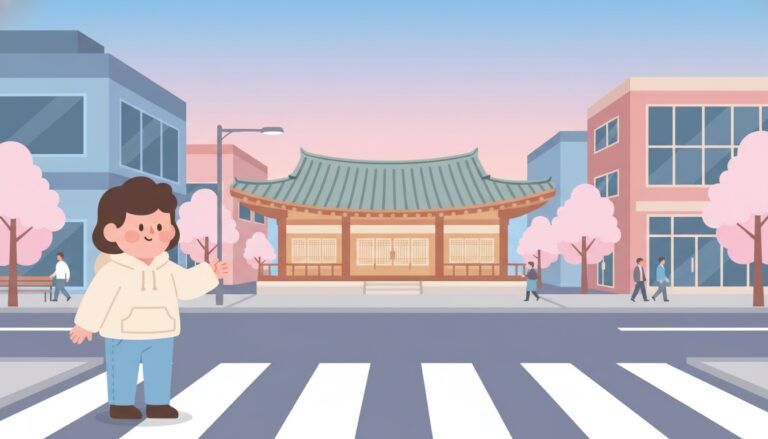
Hello, K-Learners! Welcome to Daily Hangul! 😊
Have you ever wandered the busy streets of Seoul, looking for that famous cafe you saw on Instagram? Imagine asking someone for directions, and they point to the other side of the road. Today, we are going to learn how to say and understand “It’s across the street.”
This is a super useful phrase for travel! Plus, think of all those K-Drama scenes where the main characters spot each other from across the street (and usually run towards each other in slow motion! 🏃♂️🏃♀️). Let’s learn how to navigate like a local!
🔑 Key Expressions
Here are the 3 essential expressions you need to master today:
1. 길 건너편에 있어요
- Pronunciation: [Gil geonneopyeone isseoyo]
- English Meaning: It is across the street.
- Detail: This is the complete sentence.
- 길 (Gil) = Road/Street
- 건너편 (Geonneopyeon) = Across / Opposite side
- ~에 있어요 (~e isseoyo) = It is at/in/on ~
- 💡 Pronunciation Tip: When you say 편에 (pyeon-e), the final ‘n’ sound moves to the next block. So it sounds naturally like [pyeo-ne]. Try to say it smoothly!
2. 맞은편
- Pronunciation: [Majeunpyeon]
- English Meaning: Opposite side / Across
- Detail: This is a synonym for ‘건너편’. You can use them interchangeably. If a building is ‘facing’ another building, it is on the 맞은편.
3. 어디에 있어요?
- Pronunciation: [Eodie isseoyo?]
- English Meaning: Where is it?
- Detail: You can put any place name before this phrase to ask for its location.
- Ex) 화장실 어디에 있어요? (Where is the restroom?)
🗣️ Real Conversation
Imagine you are looking for a convenience store in Hongdae.
Tourist (A): 저기요, 편의점 어디에 있어요?
[Jeogiyo, pyeonuijeom eodie isseoyo?]
(Excuse me, where is the convenience store?)
Local (B): 아, 길 건너편에 있어요.
[A, gil geonneopyeone isseoyo.]
(Ah, it is across the street.)
Tourist (A): 맞은편이요? 감사합니다!
[Majeunpyeoniyo? Gamsahamnida!]
(The opposite side? Thank you!)
🇰🇷 Culture Tip & Drama Vibe
👉 Pointing with an Open Hand
In Korea, when giving directions or pointing at something (or someone!), it is polite to use an open hand rather than pointing with a single index finger. Using one finger can sometimes be seen as rude, especially to older people. So, act like a polite K-Drama lead and guide the way with your whole hand! ✋
Also, Koreans often use famous landmarks like “Starbucks” or “Olive Young” or “Subway Exit Number X” as reference points because street names are not used as commonly in conversation as in Western countries.
📝 Wrap-up & Quiz
Great job today! Now you won’t be afraid to cross the road to find your destination. Remember, “Gil geonneopyeon” is your key to the other side! 🗝️
Let’s practice! (Answers are at the bottom)
- Fill in the blank: “It is across the street.” = 길 [ ? ]에 있어요.
- True or False: 맞은편 (Majeunpyeon) has the same meaning as 건너편 (Geonneopyeon).
See you next time with more useful Korean! Annyeong! 👋
Answers:
1. 건너편 (Geonneopyeon)
2. True (O)
Frequently Asked Questions (FAQ)
Q: What does "길 건너편에 있어요" mean in Korean and how do you pronounce it?
A: In Korean, "길 건너편에 있어요" is pronounced [Gil geonneopyeone isseoyo] and means: It is across the street.
Q: What does "맞은편" mean in Korean and how do you pronounce it?
A: In Korean, "맞은편" is pronounced [Majeunpyeon] and means: Opposite side / Across
Q: What does "어디에 있어요?" mean in Korean and how do you pronounce it?
A: In Korean, "어디에 있어요?" is pronounced [Eodie isseoyo?] and means: Where is it?







