

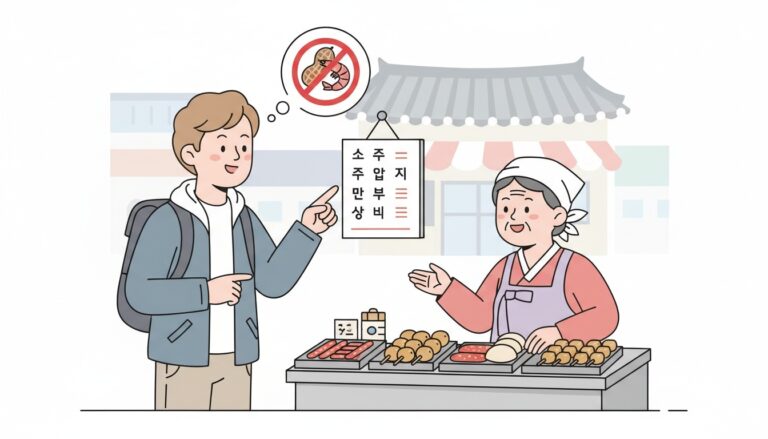
Safe K-Food Adventure: Asking About Allergies! 🥜🍤
1. Hello, K-Food Lovers! 👋
Hello! It’s your Korean fluency upgrade partner, Daily Hangul! 🌟
Are you planning to visit Korea and try delicious street food like Hotteok (sweet pancakes) or Dak-kkochi (chicken skewers)? 🍢 Yum! But wait… if you have food allergies, trying new food can be scary. 😱
Don’t worry! You don’t have to skip the delicious food seen in K-Dramas! Today, we will learn essential phrases to ask about ingredients and ensure your food is safe to eat. Let’s make your food trip safe and tasty! Let’s go! 🚀
2. Key Expressions 🔑
Here are the 3 most important phrases to survive a food stall!
1️⃣ ~ 들어 있어요? (~ deureo isseoyo?)
- Meaning: Is there ~ in it? / Does it contain ~?
- Detail: Use this to ask if a specific ingredient is inside the food. You put the ingredient name at the beginning.
- 💡 Pronunciation Tip:
- Linking Sound (Yeon-eum): When you say
들어 (deureo), the ‘ㄹ’ (r/l) sound moves to the next vowel. So it sounds like [Deu-reo], not [Deul-eo]. Smoothly connect them!
- Linking Sound (Yeon-eum): When you say
2️⃣ 저 ~ 알레르기 있어요. (Jeo ~ allereugi isseoyo.)
- Meaning: I have a ~ allergy.
- Detail: This is a direct way to tell the cook about your condition. ‘Jeo’ means polite ‘I’.
- 💡 Pronunciation Tip:
- Loan Word: The word
알레르기 (allereugi)actually comes from the German word ‘Allergie’. It sounds quite different from the English ‘Allergy’. Pronounce every syllable clearly: [Al-le-reu-gi].
- Loan Word: The word
3️⃣ ~ 빼 주세요. (~ ppae juseyo.)
- Meaning: Please remove ~ / Please leave out ~.
- Detail: If you want to order food but need an ingredient removed (like peanuts on top), use this magic phrase!
- 💡 Pronunciation Tip:
- Tense Sound: The
빼 (ppae)has a double consonant ‘ㅃ’. You need to build up pressure behind your lips and pop it out strongly! It’s much stronger than a soft ‘b’ or ‘p’.
- Tense Sound: The
3. Real-Life Conversation 🗣️
Imagine you are at a Hotteok (sweet pancake) stall in Myeongdong!
A: Tourist (You)
B: Vendor (Sajangnim)
A: 사장님, 이거 땅콩 들어 있어요?
(Sajangnim, igeo ttangkong deureo isseoyo?)
[Boss, are there peanuts in this?]
B: 네, 씨앗호떡이라서 조금 들어 있어요.
(Ne, ssiat-hotteogiraseo jogeum deureo isseoyo.)
[Yes, since it’s a seed hotteok, there are a few inside.]
A: 아, 저 땅콩 알레르기 있어요.
(Ah, jeo ttangkong allereugi isseoyo.)
[Ah, I have a peanut allergy.]
A: 혹시 땅콩 빼 주세요.
(Hoksi ttangkong ppae juseyo.)
[Can you please leave out the peanuts?]
B: 알겠어요! 땅콩 없이 만들어 줄게요.
(Algesseoyo! Ttangkong eopsi mandeureo julgeyo.)
[Okay! I will make one without peanuts for you.]
4. Culture Tip & K-Drama Vibes 🎭
🇰🇷 “Sajangnim” (Boss)
Did you notice we called the vendor “Sajangnim”? In Korea, we politely address shop owners or vendors as “President/Boss”. It sounds respectful and friendly! You might have heard this in dramas like Itaewon Class!
🥜 Hidden Ingredients
Korean street food often uses garnishes. Peanuts (ttangkong) or crushed nuts are often sprinkled on top of chicken skewers or hotteok. Also, shrimp (saeu) is often used in broth or powder form. Always ask “Saeu deureo isseoyo?” if you are allergic to seafood!
5. Wrap-up & Quiz 📝
Great job! Now you can protect your health while enjoying K-Food. Don’t be shy to ask—your safety is number one! 👍
Let’s check what you learned!
Q1. How do you say “Please remove shrimp”?
(Shrimp = Saeu)
Answer: Saeu _____ juseyo.
Q2. True or False?
“Allereugi” sounds exactly like the English word “Allergy”. ( O / X )
Q3. Fill in the blank.
“Is there milk in it?” = Uyu (Milk) ______ isseoyo?
⬇️ Scroll down for answers! ⬇️
.
.
.
.
Answers:
1. ppae (Saeu ppae juseyo)
2. X (False! It comes from German and is pronounced Al-le-reu-gi)
3. deureo (Uyu deureo isseoyo?)







