

Don’t Get Lost! Mastering Korean Bus Numbers 🚌
Annyeonghaseyo! (안녕하세요!) 👋 Welcome back to Daily Hangul, your best friend for learning Korean!
Have you ever watched a K-Drama where the main character runs to catch a bus in Seoul? 🏃♀️💨 Or maybe you’re planning a trip to Korea and want to visit the famous Namsan Tower? To get around like a local, you need to know your Bus Numbers!
Today, we will learn how to ask for and understand bus numbers. Don’t worry, it’s super easy! Let’s get started! 🚀
📚 Core Expressions
In Korea, we use Sino-Korean numbers (derived from Chinese characters) for bus numbers, phone numbers, and money.
1. The Magic Numbers: 1 to 10
- Korean: 일, 이, 삼, 사, 오, 육, 칠, 팔, 구, 십
- Pronunciation: [Il, I, Sam, Sa, O, Yuk, Chil, Pal, Gu, Sip]
- English: 1, 2, 3, 4, 5, 6, 7, 8, 9, 10
- Detail: Memorizing these is crucial! For bus numbers like “143”, you just say the digits individually: Il-Sa-Sam. Easy, right? 😉
2. …번 (…beon)
- Korean: …번
- Pronunciation: […beon]
- English: Number … (counter)
- Detail: We add ‘beon’ after the number to indicate it’s a “number” of something.
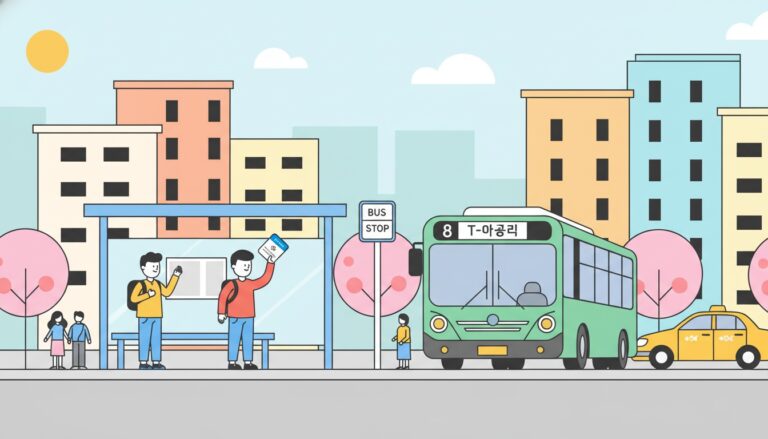
- Bus No. 8 = Pal-beon (8번)
3. 8번 버스를 타세요.
- Korean: 8번 버스를 타세요.
- Pronunciation: [Pal-beon beoseu-reul taseyo]
- English: Please take bus number 8.
- Detail:
- ‘Taseyo’ (타세요) is a polite way to say “please take” or “please ride”. You will hear this often when asking for directions!
💡 Pronunciation Tip (발음 꿀팁):
Let’s look at 8번 (Pal-beon).
The ‘L’ sound in ‘Pal’ (ㄹ) flows softly. Unlike the English ‘L’, keep your tongue touching the roof of your mouth a bit longer.
Also, when saying 십 (Sip) for 10, it sounds like a soft ‘sh’ sound, like ‘Ship’, but shorter!
🗣️ Real-Life Dialogue
Imagine you are at a bus stop in Hongdae asking a friendly local for help!
A (Tourist): 이태원에 어떻게 가요?
(Itaewon-e eotteoke gayo?)
How do I go to Itaewon?
B (Local): 저기서 버스를 타세요.
(Jeogiseo beoseu-reul taseyo.)
Please take the bus over there.
A (Tourist): 몇 번 버스예요?
(Myeot beon beoseu-yeyo?)
Which bus number is it?
B (Local): 8번 버스를 타세요.
(Pal-beon beoseu-reul taseyo.)
Please take bus number 8.
A (Tourist): 감사합니다!
(Gamsahamnida!)
Thank you!
🎭 Culture Tip & K-Drama Vibes
Did you know? The “T-Money” Card! 💳
In Korean dramas, you often see characters tapping a card with a “Beep!” sound when getting on the bus. That’s the T-Money card!
Unlike in some countries, you don’t usually pay with cash coins anymore. You can buy a T-Money card at any convenience store (CU, GS25, 7-Eleven) and use it for buses, subways, and even taxis!
Pro Tip: In Seoul, if you transfer from a bus to a subway within 30 minutes, it’s free or discounted! This is called Hwan-seung (환승 – Transfer). You must tap your card again when you get off the bus to get this discount! Don’t forget! 📢
📝 Wrap-up & Quiz
Today we learned how to identify bus numbers using Sino-Korean numbers! You are now ready to explore Seoul! 🏙️
Quiz Time! (Try without looking up!)
- How do you say “Number 5” in Korean?
(Hint: 5 is ‘O’) -> [ __________ ] -
Fill in the blank: “Please take bus number 2.”
-> 2번 버스를 [ __________ ]. -
(True/False) You should tap your card again when getting OFF the bus to get a transfer discount. [ O / X ]
Answers:
1. O-beon (오번)
2. taseyo (타세요)
3. O (True)
See you next time! Annyeong! (안녕!) 👋
Frequently Asked Questions (FAQ)
Q: What does "The Magic Numbers: 1 to 10" mean in Korean and how do you pronounce it?
A: In Korean, "The Magic Numbers: 1 to 10" is pronounced [Il, I, Sam, Sa, O, Yuk, Chil, Pal, Gu, Sip] and means: a key conversational Korean expression covered in this lesson.
Q: What does "...번 (...beon)" mean in Korean and how do you pronounce it?
A: In Korean, "...번 (...beon)" is pronounced [...beon] and means: a key conversational Korean expression covered in this lesson.
Q: What does "8번 버스를 타세요." mean in Korean and how do you pronounce it?
A: In Korean, "8번 버스를 타세요." is pronounced [Pal-beon beoseu-reul taseyo] and means: a key conversational Korean expression covered in this lesson.







