

2. Introduction
Hello, K-Culture fans! It’s your favorite Korean tutor, Daily Hangul (매일한글)! 👋✨
Have you ever watched a K-Drama where characters are watching the news and sighing, or having a heated discussion at a dinner table? Usually, they are talking about money or politics! 📺💬
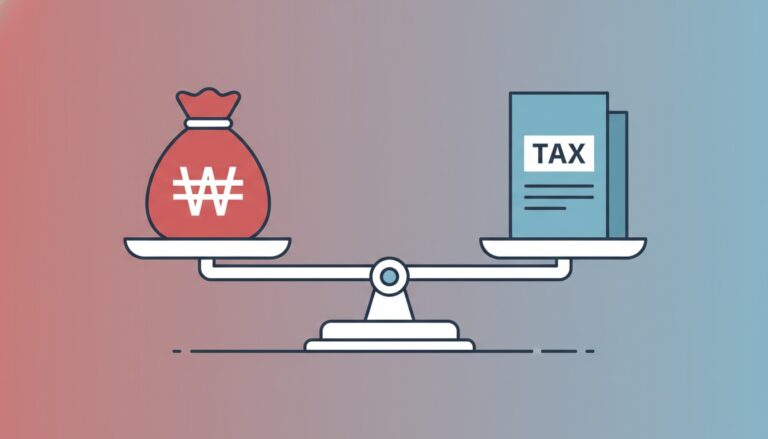
Today, we are going to learn how to express your opinion on a very “hot” topic: Taxes (Se-geum). Whether it’s a tax hike or a cut, knowing how to say “I agree” or “I disagree” will make you sound like a true local. Don’t worry, we’ll keep it super simple and fun! Let’s level up your Korean! 🚀
3. Key Expressions
Here are 4 essential expressions to survive a debate in Korean!
1️⃣ 세금 (Se-geum)
- Pronunciation: [Se-geum]
- English: Tax
- Explanation: This is the noun for “tax.” You hear this a lot in news scenes in dramas like Reborn Rich.
- 💡 Pronunciation Tip: Pronounce ‘Se’ like ‘Se’ in ‘Set’, and ‘geum’ like ‘gum’ but with a softer ‘g’. It’s flat and smooth! 👄
2️⃣ 올랐어요 (Ollasseoyo)
- Pronunciation: [Ol-la-sseo-yo]
- English: It went up / It rose
- Explanation: Used when prices or taxes increase. It’s the past tense of “오르다” (to go up).
- 💡 Pronunciation Tip: Linking Sound! The ‘ㄹ’ (l) sound carries over. So instead of ‘Ol-lat-eo-yo’, it sounds like [Ol-la-sseo-yo]. Say it like a wave going up! 🌊
3️⃣ 찬성해요 (Chanseong-haeyo)
- Pronunciation: [Chan-seong-hae-yo]
- English: I agree / I support
- Explanation: Use this when you vote “Yes” or support an idea. It’s polite and formal enough for discussions.
- 💡 Pronunciation Tip: ‘Chan’ sounds like ‘Chan’ in ‘Jackie Chan’. ‘Seong’ rhymes with ‘Song’.
4️⃣ 반대해요 (Bandae-haeyo)
- Pronunciation: [Ban-dae-hae-yo]
- English: I disagree / I oppose
- Explanation: The opposite of ‘Chanseong’. Use this when you are against a tax hike. You might see protesters in dramas shouting just “반대!” (Bandae!).
- 💡 Pronunciation Tip: ‘Ban’ is like ‘Bun’ in ‘Bunny’. ‘Dae’ sounds like ‘Day’.
4. Real-life Dialogue
Let’s see how Min-su and Sarah discuss the news at a café. ☕️📰
Min-su: 뉴스 봤어? 세금이 또 올랐어요. 😤
(Nyuseu bwasseo? Se-geumi tto ollasseoyo.)
Did you see the news? Taxes went up again.
Sarah: 정말요? 저는 세금 인상 반대해요. 🙅♀️
(Jeongmalyo? Jeoneun se-geum insang bandae-haeyo.)
Really? I disagree with the tax hike.
Min-su: 왜요? 저는 찬성해요. 나라에 돈이 필요하니까요.
(Waeyo? Jeoneun chanseong-haeyo. Nara-e don-i piryohanikkayo.)
Why? I agree. Because the country needs money.
Sarah: 하지만 월급은 안 올랐어요! 😭
(Hajiman wolgeubeun an ollasseoyo!)
But my salary didn’t go up!
5. Culture Tip & Drama Scene 🎬
🇰🇷 The “Soju & Politics” Culture
In Korea, it’s very common for friends or colleagues to discuss social issues like housing prices or taxes while drinking Soju and eating Samgyeopsal (pork belly). If you can simply say “Jeoneun Bandae-haeyo” (I disagree) during these chats, your Korean friends will be surprised and impressed! 😲👍
📺 Drama Scene:
Think of the drama Chief of Staff (보좌관). Characters are constantly debating policies. Next time you watch, listen for the words “Chanseong” (Agree) and “Bandae” (Disagree) during the meeting scenes!
6. Wrap-up & Quiz
Today we learned how to talk about taxes (Se-geum) and express our stance with Agree (Chanseong) and Disagree (Bandae). Now you are ready for a Korean debate! 💪
📝 Pop Quiz!
- Fill in the blank: “I agree with this idea.” -> “저는 _____ 해요.”
- What is the Korean word for “Tax”?
- (O/X) “Ollasseoyo” means “It went down.” ( )
Answers:
1. 찬성 (Chanseong)
2. 세금 (Se-geum)
3. X (It means “It went up”)







