

Hello! It’s [Daily Hangul]! 😊
Hello, everyone! Welcome back to Daily Hangul, your best friend for learning Korean! 👋
Have you ever imagined living in Korea for a month or studying abroad? One of the first things you’ll need to do is visit a bank (은행, Eunhaeng)!
Whether you need to exchange money for delicious street food teokbokki 🍢 or open an account to pay for your K-pop concert tickets, banking is essential. Don’t worry if you feel nervous! Today, I will teach you the simplest expressions to survive in a Korean bank. You’ll feel like a confident CEO in a K-drama! 💼✨
Let’s dive in!
3 Key Expressions for Banking 🔑
1. 통장을 만들고 싶어요.
- Pronunciation: [Tongjang-eul mandulgo sipeoyo]
- Meaning: I want to open a bank account (literally: make a bankbook).
- Explanation: In Korea, we say “make a bankbook” when opening an account. “Tongjang” (통장) is a physical bankbook, which is still very commonly used in Korea!
- 💡 Pronunciation Tip: When you say 통장을, the final consonant ‘ㅇ’ (ng) carries over to the next vowel. So it sounds smoother like [Tong-jang-eul].
2. 체크카드 주세요.
- Pronunciation: [Chekeu-kadeu juseyo]
- Meaning: Please give me a debit card.
- Explanation: In Korea, a “Debit Card” is called a “Check Card” (체크카드). If you say “Debit Card,” they might not understand immediately. This card is linked directly to your account. It’s a must-have item for your daily life in Korea!
- 💡 Pronunciation Tip: This is a Konglish (Korean + English) word! Pronounce every syllable clearly: Che-keu-ka-deu. Don’t rush it like in English!
3. 신분증 있어요?
- Pronunciation: [Sinbunjeung isseoyo?]
- Meaning: Do you have an ID card?
- Explanation: The bank teller will definitely ask you this. 신분증 (Sinbunjeung) means ID card. As a foreigner, your Passport (여권) or Alien Registration Card (외국인 등록증) works perfectly.
- 💡 Pronunciation Tip: ‘Sinbun’ means identity, and ‘jeung’ means certificate. Try to pronounce the ‘eu’ sound in ‘jeung’ by smiling widely! 😁
Real-life Dialogue 🗣️
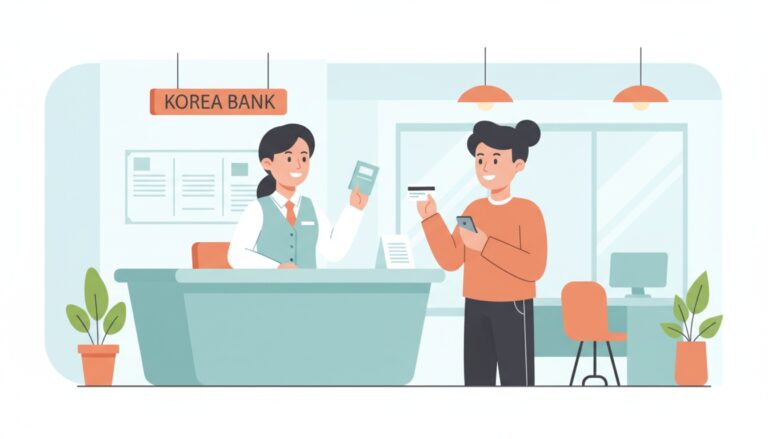
(At a bank counter inside a busy branch in Seoul)
Banker: 번호표 32번 고객님? 어서 오세요. (Customer number 32? Welcome.)
Me: 안녕하세요. 통장을 만들고 싶어요. (Hello. I want to open a bank account.)
Banker: 네, 알겠습니다. 신분증 있어요? (Okay, I see. Do you have an ID card?)
Me: 네, 여기 여권이에요. (Yes, here is my passport.)
Banker: 네. 체크카드도 필요하세요? (Okay. Do you need a check card too?)
Me: 네, 체크카드 주세요. (Yes, please give me a check card.)
Culture Tip & K-Drama Vibes 🎭
Did you know? You need a “Waiting Ticket” (번호표)!
In Korean dramas, have you seen people staring at a screen waiting for a “Ding-dong” sound? 🛎️ That’s the 번호표 (Beonhopyo) system!
When you walk into a Korean bank, you must go to the kiosk machine at the entrance first and pull a ticket. Usually, a friendly security guard (Cheongwon-gyeongchal) will ask you, “Musun eomu-ro osyeosseoyo?” (What business are you here for?). Just smile and say “Tongjang” (Bankbook), and they will help you get the right ticket!
Also, getting a cute character design on your Check Card (like Kakao Friends) is a popular trend! Try asking for a cute design! 🐻🐰
Review & Quiz 📝
Today we learned how to open an account and ask for a card. You are now ready to visit a Korean bank!
Let’s test your knowledge!
- What is the Korean word for “Debit Card”?
( Hint: C_ _ _ _ Card ) -
Fill in the blank: “I want to open an account.”
= _______을 만들고 싶어요. (Tongjang-eul mandulgo sipeoyo) -
(True/False) In Korea, you usually stand in line without taking a ticket number at the bank.
Good luck, and see you next time! Annyeong! 👋
Answers:
1. Check (체크)
2. 통장 (Tongjang)
3. False (You must take a 번호표/waiting ticket!)
Frequently Asked Questions (FAQ)
Q: What does "통장을 만들고 싶어요." mean in Korean and how do you pronounce it?
A: In Korean, "통장을 만들고 싶어요." is pronounced [Tongjang-eul mandulgo sipeoyo] and means: I want to open a bank account (literally: make a bankbook).
Q: What does "체크카드 주세요." mean in Korean and how do you pronounce it?
A: In Korean, "체크카드 주세요." is pronounced [Chekeu-kadeu juseyo] and means: Please give me a debit card.
Q: What does "신분증 있어요?" mean in Korean and how do you pronounce it?
A: In Korean, "신분증 있어요?" is pronounced [Sinbunjeung isseoyo?] and means: Do you have an ID card?







