

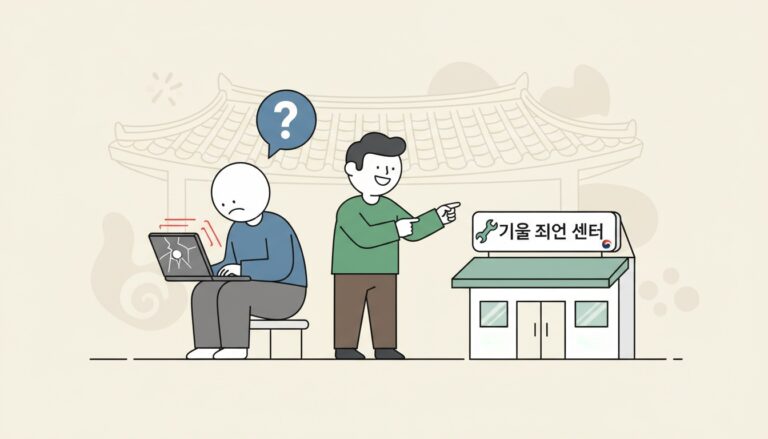
Hello! This is [Maeil Hangul], here to upgrade your Korean skills!
Have you ever had your phone, laptop, or any electronic device suddenly stop working? It’s a frustrating situation, especially when you’re in a foreign country. In today’s hyper-connected Korea, where everyone has the latest smart devices, knowing how to handle a broken appliance is an essential survival skill. Let’s learn some key phrases to ask for help like a local!
Key Expressions
Here are the essential phrases you need to know when your tech lets you down.
1. 고장 났어요 (Gojang nass-eoyo)
* Romanization: Gojang nass-eoyo
* English Meaning: It’s broken.
* Detailed Explanation: This is the most common and direct way to say something is broken. You can use it for almost any machine or electronic device, from your air conditioner to your smartphone. Just put the name of the item in front of the phrase. (e.g., 노트북이 고장 났어요 – My laptop is broken).
* 💡 Pronunciation Tip: The final ‘ㅅ’ (s) sound in ‘났’ (nass) moves over to the next syllable ‘어’ (eo). So, instead of saying “nat-eo-yo,” it flows together smoothly as [na-sseo-yo]. This is a very common Korean pronunciation rule called linking or ‘연음 (yeoneum)’.
2. 어떻게 해야 돼요? (Eotteoke haeya dwaeyo?)
* Romanization: Eotteoke haeya dwaeyo?
* English Meaning: What should I do?
* Detailed Explanation: This is a perfect phrase for asking for advice. It’s polite and can be used in many situations, not just for broken items. It literally means “How must I do?”
* 💡 Pronunciation Tip: The ‘ㅎ’ (h) sound in ‘해야’ (haeya) is very soft, almost silent, when spoken quickly. Focus on connecting the ‘어떻게’ and ‘해야’ parts smoothly: [어떠케 해야 돼요 (eotteoke-haeya-dwaeyo)].
3. A/S 센터에 전화해 보세요 (A/S senteo-e jeonhwahae boseyo)
* Romanization: A/S senteo-e jeonhwahae boseyo
* English Meaning: Try calling the service center.
* Detailed Explanation: ‘A/S 센터’ is a very common Konglish (Korean-style English) term for “After-sales Service Center” or customer support. The grammar ‘-아/어 보세요’ means “try doing (something),” which is a gentle way to give a suggestion or advice.
* 💡 Pronunciation Tip: The particle ‘에’ (e) attaches directly to the preceding word. So, you pronounce ‘센터에’ as [센테 (sente)]. It sounds like one word, not two separate ones.
Example Dialogue
Let’s see how these phrases work in a real conversation.
- A: 어떡해! 새로 산 스마트 스피커가 고장 났어요.
(Eotteokae! Saero san seumateu seupikeoga gojang nass-eoyo.)
Oh no! My new smart speaker is broken. - B: 정말? 그럼 어떻게 해야 돼요?
(Jeongmal? Geureom eotteoke haeya dwaeyo?)
Really? Then what should I do? - A: 음… A/S 센터에 전화해 보세요. 그게 제일 빠를 거예요.
(Eum… A/S senteo-e jeonhwahae boseyo. Geuge jeil ppareul kkeoyeyo.)
Hmm… Try calling the service center. That will probably be the fastest way.
Culture Tip & Trend Deep Dive
Korea’s “A/S” Culture & 빨리빨리 (ppalli-ppalli)!
In Korea, customer service, known as ‘A/S’, is famously fast and efficient. This is deeply connected to the Korean ‘빨리빨리’ (ppalli-ppalli), or “hurry, hurry,” culture. If your internet goes down or your washing machine breaks, you can often get a technician to your house on the very same day! So, when a Korean friend tells you to call the ‘A/S 센터’, they’re giving you the best and fastest solution. Knowing this term will make you sound much more fluent and culturally aware!
Wrap-up & Practice
Great job today! You’ve learned how to talk about a broken appliance and ask for advice using essential phrases like 고장 났어요, 어떻게 해야 돼요?, and A/S 센터에 전화해 보세요. Now you’re ready for any tech emergency in Korea!
Quick Quiz: Your friend’s phone isn’t turning on. How would you suggest they call the service center?
- “A/S 센터에 _______________. (Fill in the blank!)”
Try making your own sentence in the comments below! For example, “제 에어컨이 고장 났어요!” (My air conditioner is broken!). We’ll check it for you!
Frequently Asked Questions (FAQ)
Q: What does "'빨리빨리'" mean in Korean and how do you pronounce it?
A: In Korean, "'빨리빨리'" is pronounced [ppalli-ppalli] and means: , or "hurry, hurry," culture. If your internet goes down or your washing machine breaks, you can often get a technician to your house on the very same day! So, when a Korean friend tells you to call the 'A/S 센터', they're giving you the best and fastest solution. Knowing this term will make you sound much more fluent and culturally aware!







