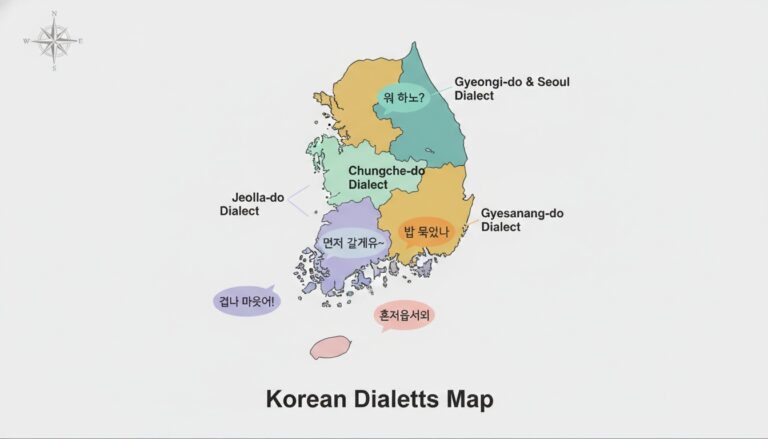
Hello! Welcome back to Maeil Hangeul, your key to upgrading your Korean skills!
Today, we’re moving beyond textbook Korean to explore something truly fascinating: sociolinguistics, or why Koreans from different places and social groups speak so differently. Ever watched a K-drama set in Busan and felt like you were hearing a whole new language? That’s what we’re talking about!
Lately in Korea, there’s been a huge boom in content that proudly showcases regional dialects, or 사투리 (Saturi). Dramas like the Reply series and global idols who use their hometown accents have made dialects cooler than ever. Understanding these variations isn’t just a language hack—it’s a window into the heart of Korean culture. Let’s dive in!
Core Expressions: From Standard to Local
Here are a few expressions that perfectly illustrate the rich diversity of the Korean language.
1. The Question of Questions: 뭐 해요? vs. 뭐 하노?
- Korean Expressions:
- Standard (표준어): 뭐 해요? (Mwo haeyo?)
- Gyeongsang-do Dialect (경상도 사투리): 뭐 하노? (Mwo hano?)
- English Meaning: What are you doing?
- Detailed Explanation: This is a classic example of grammatical variation. In Standard Korean, you use endings like
-어요/아요?or-ㅂ니까?for questions. However, in the Gyeongsang-do dialect (spoken in cities like Busan and Daegu), it’s common to use-나?or-노?for questions seeking new information. Using뭐 하노?instead of뭐 해요?instantly gives your Korean a distinct Busan flavor. - 💡 Pronunciation Tip: The magic of Gyeongsang saturi is in its pitch accent and intonation. It’s much more melodic than the Seoul dialect. For 뭐 하노? [mwo hano?], try saying it with a higher pitch on ‘하’ and a distinct falling tone on ‘노’. It’s this musicality that makes it so recognizable!
2. Leveling Up Your Adverbs: 정말 vs. 겁나
- Korean Expressions:
- Standard (표준어): 정말 (Jeongmal)
- Jeolla-do Dialect (전라도 사투리) / Youth Slang: 겁나 (Geomna)
- English Meaning: Really / Very / A lot
- Detailed Explanation: While
정말is the standard word for ‘really’, you’ll often hear겁나in casual conversations. It originated from the Jeolla-do dialect (Gwangju, Jeonju) but has been widely adopted by younger generations across Korea as popular slang. It adds a stronger, more emphatic nuance than정말. Another fun Jeolla-do word with a similar meaning is허벌나게 (heobeollage)! - 💡 Pronunciation Tip: Notice the sound change in 겁나 [geomna]. The final consonant
ㅂ(b)in겁comes before a nasal soundㄴ(n). In this situation, theㅂ(b)sound assimilates and becomes a nasalㅁ(m)sound. This is called 비음화 (bi-eum-hwa), or nasalization. So instead of a clunkygeop-na, it flows smoothly asgeom-na.
3. The Generational Divide: 대박!
- Korean Expression: 대박! (Daebak!)
- Romanization: Daebak!
- English Meaning: Awesome! / Whoa! / Amazing! / A jackpot!
- Detailed Explanation: This is a perfect example of a sociolect—language specific to a particular social group, in this case, a generation.
대박originally meant ‘a big hit’ or ‘jackpot’. Around the 2000s, it evolved into an exclamation used by young people to express shock or amazement. While it’s now so common that even older adults use it, its frequency and context of use can often signal the speaker’s age and how up-to-date they are with trends. - 💡 Pronunciation Tip: The key to a natural-sounding 대박 [daebak] is the emphasis. It’s an exclamation! Put a strong, clear stress on the first syllable, ‘대'[DAE], and make the second syllable, ‘박’, short and crisp. The feeling is one of genuine surprise: DAE-bak!
Example Dialogue
Let’s see how these expressions pop up in a real conversation.
- A: 너 어제 부산 배경인 그 영화 봤어? (Neo eoje Busan baegyeong-in geu yeonghwa bwasseo?)
Did you see that movie set in Busan yesterday? - B: 응! 배우들 연기 대박이더라. 특히 남자 주인공이 ‘뭐 하노?’ 할 때 진짜 현지인 같았어.
(Eung! Bae-udeul yeongi daebak-ideora. Teukhi namja ju-in-gong-i ‘Mwo hano?’ hal ttae jinjja hyeonji-in gat-asseo.)
Yeah! The actors’ performances were amazing. Especially when the main actor said, ‘Mwo hano?’, he sounded just like a local. - A: 맞아! 겁나 멋있었어. 나도 사투리 배우고 싶어졌어.
(Maja! Geomna meosisseosseo. Nado saturi bae-ugo sipeojyeosseo.)
I know! It was so cool. It makes me want to learn a dialect too.
Culture Tip: The ‘Saturi’ Boom
For a long time, the Seoul dialect (표준어, pyojun-eo) was the only acceptable form of Korean in media, and regional accents were often used for comedic effect. However, this has changed dramatically!
Today, K-Pop idols (like members of BTS and SEVENTEEN) proudly use their native saturi with fans, and hit dramas have shown that dialects can be charismatic, serious, and cool. This reflects a major cultural shift in Korea—a growing appreciation for regional diversity and identity. Recognizing and understanding saturi shows a much deeper engagement with Korean culture beyond the capital city.
Wrap-up & Practice
We’ve learned that Korean is a living language with incredible diversity. From the melodic Gyeongsang-do dialect to the emphatic slang of younger generations, these variations tell a story about who is speaking.
Your Turn!
- Imagine a friend from Seoul asks you,
"이거 왜 이렇게 비싸요?" (Igeo wae ireoke bissayo? - Why is this so expensive?). How might you rephrase this using겁나to sound more like a young, casual speaker?
Let us know your answer in the comments using the expressions we learned today!
Frequently Asked Questions (FAQ)
Q: What does "The Generational Divide: 대박!" mean in Korean and how do you pronounce it?
A: In Korean, "The Generational Divide: 대박!" is pronounced [Tip: The key to a natural-sounding 대박 [daebak] and means: Awesome! / Whoa! / Amazing! / A jackpot!