

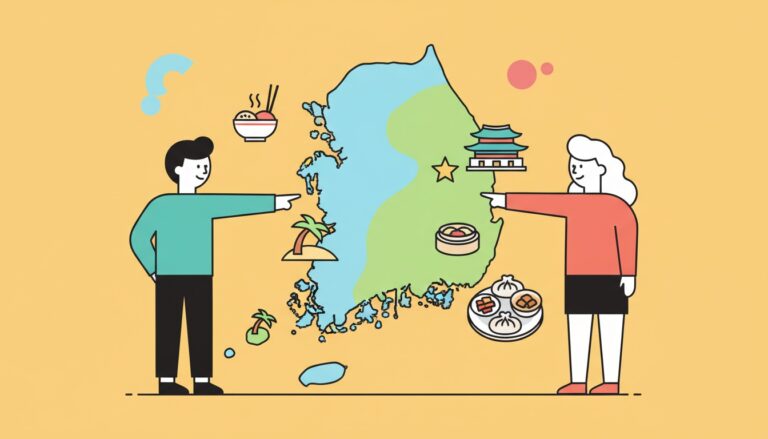
Hocance vs. Jeju? Plan Your Dream Korean Getaway!
Hello! It’s your favorite K-language guide, [Maeil Hangeul], here to upgrade your Korean skills!
Have you ever dreamed of planning a trip with your Korean friends? Today, we’ll learn the essential phrases for deciding on a vacation destination. Lately in Korea, travel is buzzing again! Everyone is talking about their plans, whether it’s a luxurious ‘Hocance’ (호캉스) or visiting a beautiful K-drama filming location. Let’s learn how to jump into that conversation!
Key Expressions for Trip Planning
Here are some must-know phrases to help you decide where to go.
1. 어디 갈까? (Eodi galkka?)
- Pronunciation [Romanized]: Eodi galkka?
- English Meaning: Where should we go?
- Detailed Explanation: This is the perfect, friendly way to start a discussion about plans. The grammar ending ‘-(으)ㄹ까?’ is used to make a suggestion or ask for someone’s opinion among friends. It’s like saying, “I wonder where we should go… what do you think?”
- 💡 Pronunciation Tip: The ‘ㄲ’ (kk) in ‘갈까?’ is a tensed consonant. It’s stronger and sharper than the regular ‘ㄱ’ (g/k). Make the sound at the back of your throat with a bit more force, without a puff of air. Think of the ‘g’ in ‘sky’.
2. 나는 [장소]에 가고 싶어. (Naneun [jangso]-e gago sipeo.)
- Pronunciation [Romanized]: Naneun [jangso]-e gago sipeo.
- English Meaning: I want to go to [place].
- Detailed Explanation: This is how you express your own preference. The pattern ‘-고 싶어’ (go sipeo) means “I want to…” and is attached to a verb stem (in this case, ‘가다’ – to go). Use this informal ending with friends. For a more polite version, you would say ‘-고 싶어요’ (go sipeoyo).
- 💡 Pronunciation Tip: In ‘싶어’ (sipeo), the ‘ㅍ’ (p) sound at the end of the first syllable ‘싶’ moves over to the next syllable because it’s followed by a vowel ‘어’. So, instead of a choppy ‘sip-eo’, it flows smoothly into [si-peo]. This is a common Korean pronunciation rule called ‘liaison’.
3. 거기 어때? (Geogi eottae?)
- Pronunciation [Romanized]: Geogi eottae?
- English Meaning: How about there?
- Detailed Explanation: Once someone suggests a place, you can use this phrase to ask for opinions. ‘거기’ means ‘there’, and ‘어때?’ is a super versatile question meaning “How is it?” or “What do you think?”. You can use it for food, movies, places, and more!
- 💡 Pronunciation Tip: The ‘ㄸ’ (tt) in ‘어때?’ is another tensed consonant, like ‘ㄲ’. It’s a strong ‘t’ sound with no air. It comes from the dictionary form ‘어떻다’ (eotteota). When conjugated, the ‘ㅎ’ and ‘ㄷ’ combine to create the strong ‘ㄸ’ sound, making it [eottae].
4. 좋았어, 거기로 정하자! (Joasseo, geogiro jeonghaja!)
- Pronunciation [Romanized]: Joasseo, geogiro jeonghaja!
- English Meaning: Great, let’s decide on that place!
- Detailed Explanation: You’ve reached an agreement! ‘좋았어’ is a casual way to say “Great!” or “Sounds good!”. The key part is ‘-자’ (ja), which is the ending for saying “Let’s…” among friends. ‘정하다’ (jeonghada) means ‘to decide’.
- 💡 Pronunciation Tip: The pronunciation of ‘좋았어’ is [jo-a-sseo]. The ‘ㅎ’ (h) sound in the first syllable is silent when followed by a vowel, so you don’t pronounce it. It just flows from ‘조’ to ‘아’.
Example Dialogue
Let’s see these phrases in a real conversation!
- A: 우리 이번 휴가 때 어디 갈까?
(Uri ibeon hyuga ttae eodi galkka?)
Where should we go for our vacation this time? - B: 음… 나는 제주도에 가고 싶어. 맛있는 흑돼지 먹고 싶다!
(Eum… Naneun Jejudo-e gago sipeo. Masinneun heukdwaeji meokgo sipda!)
Hmm… I want to go to Jeju Island. I want to eat delicious black pork! - A: 제주도? 와, 좋다! 거기 어때?
(Jejudo? Wa, jota! Geogi eottae?)
Jeju Island? Wow, nice! How about there? - B: 좋았어, 거기로 정하자! 비행기표 바로 알아보자!
(Joasseo, geogiro jeonghaja! Bihaenggipyo baro arabija!)
Great, let’s decide on that place! Let’s look up plane tickets right away!
Culture Tip & Trend Analysis
Have you heard of ‘호캉스’ (Hocance)? It’s a very popular trend in Korea, combining the words ‘호텔’ (hotel) and ‘바캉스’ (vacance – vacation in French). Instead of a busy sightseeing schedule, many Koreans, especially the MZ generation, prefer to spend their vacation relaxing in a nice hotel with a swimming pool, room service, and a beautiful view. It’s all about resting and recharging!
So, next time you’re planning a trip, you could suggest, “우리 호캉스 갈까?” (Uri hocance galkka? – Should we go for a hotel-vacation?). Knowing this word will make you sound like a true local!
Let’s Practice!
Time to check what you’ve learned. Fill in the blank with the correct phrase from today’s lesson!
- You want to suggest going to Busan with your friend. You say:
나는 부산에 __________.
Great job today! Now you’re ready to plan your next adventure in Korean.
Where do YOU want to go in Korea? Let us know in the comments using a phrase you learned today!
Frequently Asked Questions (FAQ)
Q: What does "어디 갈까? (Eodi galkka?)" mean in Korean and how do you pronounce it?
A: In Korean, "어디 갈까? (Eodi galkka?)" is pronounced [Romanized] and means: Where should we go?
Q: What does "나는 [장소]에 가고 싶어. (Naneun [jangso]-e gago sipeo.)" mean in Korean and how do you pronounce it?
A: In Korean, "나는 [장소]에 가고 싶어. (Naneun [jangso]-e gago sipeo.)" is pronounced [Romanized] and means: I want to go to [place].
Q: What does "거기 어때? (Geogi eottae?)" mean in Korean and how do you pronounce it?
A: In Korean, "거기 어때? (Geogi eottae?)" is pronounced [Romanized] and means: How about there?
Q: What does "좋았어, 거기로 정하자! (Joasseo, geogiro jeonghaja!)" mean in Korean and how do you pronounce it?
A: In Korean, "좋았어, 거기로 정하자! (Joasseo, geogiro jeonghaja!)" is pronounced [Romanized] and means: Great, let's decide on that place!







