

Hello! This is Maeil Hangeul, here to upgrade your Korean skills!
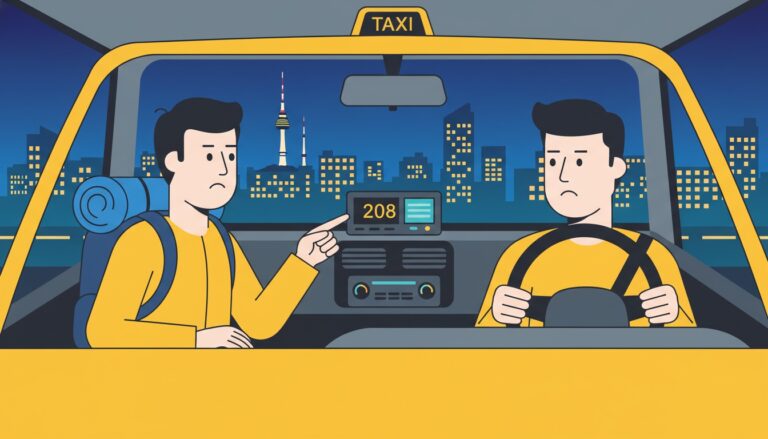
Have you ever been in a taxi in a foreign country and felt the fare was a little too high? It’s a tricky situation, but knowing what to say can make all the difference. Today, we’re going to learn some essential Korean phrases to confidently handle situations where you think a taxi fare might be unfair. While most taxi drivers in Korea are very honest, being prepared will help you travel with peace of mind. Let’s learn how to speak up politely and effectively!
Key Expressions for Taxi Troubles
Here are some phrases that will make you sound like a confident local.
1. 잠시만요 (Jamsimanyo)
* Pronunciation [Romanization]: Jam-si-man-yo
* English Meaning: “Wait a moment” or “Excuse me.”
* Detailed Explanation: This is your go-to phrase to politely get someone’s attention before you state your problem. It’s much softer and more common in this context than saying “저기요” (jeogiyo). Use it to pause the situation before paying.
* 💡 Pronunciation Tip: The syllable ‘잠’ (jam) is pronounced with lips closed at the end, like the ‘m’ in ‘jam’. ‘시’ (si) sounds like ‘she’ in English. Say it all together smoothly: Jam-she-man-yo.
2. 요금이 좀 이상한데요 (Yogeumi jom isanghandeyo)
* Pronunciation [Romanization]: Yo-geu-mi jom i-sang-han-de-yo
* English Meaning: “The fare seems a bit strange.”
* Detailed Explanation: This is a polite and indirect way to express that you think something is wrong with the fare. The ending ~ㄴ/는데요 is often used to soften a statement or introduce a contrasting situation, making you sound less confrontational. ‘좀’ (jom) means ‘a bit’ and also adds to the politeness.
* 💡 Pronunciation Tip: In ‘요금’ (yogeum), the ‘ㅇ’ at the beginning of ‘요’ is a silent placeholder. The word ‘좀’ (jom) is one syllable. It’s not ‘jo-muh’ but a quick ‘jom’, similar to the sound in ‘home’.
3. 미터기 켜주세요 (Miteogi kyeojuseyo)
* Pronunciation [Romanization]: Mi-teo-gi kyeo-ju-se-yo
* English Meaning: “Please turn on the meter.”
* Detailed Explanation: This is a preventative phrase. It’s best to say this at the beginning of your ride if you notice the meter isn’t on. It clearly communicates your expectation to be charged the official, metered fare. ‘미터기’ is the Korean word for a taxi meter, from the English word ‘meter’.
* 💡 Pronunciation Tip: The ‘켜’ (kyeo) sound can be tricky. It’s a combination of ‘k’ and ‘yeo’ (like the ‘yu’ in ‘yummy’). Practice saying ‘k-yeo’ quickly. The whole phrase has a nice rhythm: Mi-teo-gi kyeo-ju-se-yo.
Example Dialogue
Let’s see how these phrases work in a real conversation.
- A (Passenger): 기사님, 잠시만요. 계산하기 전에요. (Gisanim, jamsimanyo. Gyesanhagi jeoneyo.) – Driver, wait a moment. Before I pay.
- B (Driver): 네, 왜 그러세요? (Ne, wae geureoseyo?) – Yes, what is it?
- A (Passenger): 요금이 좀 이상한데요. 평소보다 너무 많이 나왔어요. (Yogeumi jom isanghandeyo. Pyeongsoboda neomu mani nawasseoyo.) – The fare seems a bit strange. It’s much more than usual.
- B (Driver): 아, 그래요? 어디 한번 봅시다. (A, geuraeyo? Eodi hanbeon bopsida.) – Oh, really? Let me see.
- A (Passenger): 네. 그리고 영수증 좀 주세요. (Ne. Geurigo yeongsujeung jom juseyo.) – Yes. And please give me the receipt.
Culture Tip & In-depth Trend Analysis
In Korea, it’s very common to pay for everything, including taxis, with a credit or debit card. This is actually a great tip for travelers! Paying by card automatically creates a record of the transaction (time, taxi number, and fare), which makes it much easier to report an issue if you need to.
If you find yourself in a serious dispute, you can call the Korea Travel Helpline at 1330. They offer multilingual support and can help you resolve issues. Knowing this number can give you an extra layer of confidence!
Also, be aware of different taxi types. Regular taxis are usually orange, white, or silver. There are also black ‘Mobeom’ (deluxe) taxis which have a higher base fare but are known for excellent service. Don’t be surprised if the fare in a black taxi is higher—it’s supposed to be!
Wrap-up and Practice!
Today we learned how to handle a common travel problem with confidence. You now know how to get the driver’s attention with 잠시만요, express your concern politely with 요금이 좀 이상한데요, and even ask for the meter to be turned on with 미터기 켜주세요.
Now, let’s test your knowledge!
- Fill in the blank: You get in a taxi and want to make sure the driver uses the meter. You should say: “__________ 켜주세요.” (Hint: What is the Korean word for ‘meter’?)
- Your Turn: How would you politely say, “Excuse me, the fare is a bit expensive”?
Great job today! Try leaving a comment below using one of the phrases we learned. We’d love to see you practice!







