

Hello! This is Maeil Hangul, here to upgrade your Korean skills!
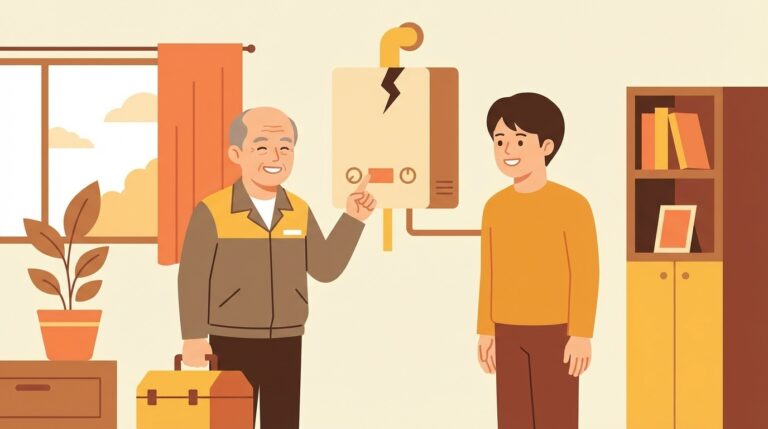
Ever lived in a Korean apartment and had the boiler suddenly stop working in the middle of winter? Or maybe the air conditioner gave up during a heatwave? It happens! Today, we’re going to learn some essential phrases for a very real-life situation: asking your landlord for repairs. With more and more people living and studying in Korea, knowing how to handle these small conflicts politely is a superpower. Let’s learn how to communicate your needs clearly and effectively!
Core Expressions You Must Know
Here are the key phrases to get that repairman to your door!
1. 고장 났어요 (gojang nass-eoyo)
* Pronunciation [Romanization]: go-jang nat-sseo-yo
* English Meaning: It’s broken.
* Detailed Explanation: This is the most direct and common way to say something is broken. It works for almost any machine or electronic device, from your TV to the water heater. It’s polite enough to use with your landlord. The base form is ‘고장 나다’ (gojang nada).
* 💡 Pronunciation Tip: The ‘ㅆ’ in ‘났어요’ (nass-eoyo) is a tensed consonant. Make the ‘s’ sound stronger and shorter than a regular ‘s’, almost like you’re forcefully pushing the air out. It’s not ‘nat-seo-yo’, but [nat-sseo-yo].
2. 수리(를) 좀 부탁드립니다 (suri(reul) jom butakdeurimnida)
* Pronunciation [Romanization]: su-ri(-reul) jom bu-tak-deu-rim-ni-da
* English Meaning: I’d like to request a repair, please. / Please take care of the repair.
* Detailed Explanation: This is a very polite and formal way to make your request. ‘수리’ (suri) means ‘repair’, and ‘부탁드립니다’ (butakdeurimnida) is a humble way of saying ‘I ask of you’. The word ‘좀’ (jom), meaning ‘a little’, is added to soften the request and make it sound less demanding.
* 💡 Pronunciation Tip: In ‘드립니다’ (deurimnida), the ‘ㅂ’ (b) sound is followed by a nasal ‘ㄴ’ (n) sound. Because of this, the ‘ㅂ’ often sounds like an ‘ㅁ’ (m). This is a pronunciation rule called ‘nasalization’. So, it sounds more natural as [deu-rim-ni-da].
3. 언제쯤 와주실 수 있으세요? (eonjejjeum wajusil su isseuseyo?)
* Pronunciation [Romanization]: eon-je-jjeum wa-ju-sil ssu i-sseu-se-yo?
* English Meaning: Around when would you be able to come?
* Detailed Explanation: This is a key follow-up question. ‘언제쯤’ (eonjejjeum) means ‘about when’. The rest of the phrase, ‘와주실 수 있으세요?’ (wajusil su isseuseyo?), is an extremely polite and honorific way to ask ‘Can you come?’. It shows great respect to the landlord.
* 💡 Pronunciation Tip: Notice the final consonant of a syllable often moves to the next syllable if it starts with a vowel. In ‘있으세요’ (isseuseyo), the ‘ㅆ’ (ss) sound from ‘있’ links to ‘으’, so you pronounce it as [이쓰세요/i-sseu-se-yo], not ‘it-euseyo’. This is called ‘linking’ or ‘연음 (yeoneum)’.
Example Dialogue
Let’s see how these phrases work in a text message conversation between a tenant (A) and a landlord (B).
- A (Tenant): 안녕하세요, 집주인님. 301호에 사는 김민지입니다. 다름이 아니라 보일러가 고장 났어요. (Annyeonghaseyo, jipjuinnim. 301ho-e saneun Kim Minji-imnida. Dareumi anira boilleo-ga gojang nass-eoyo.)
- Hello, landlord. This is Kim Minji from unit 301. The reason I’m contacting you is that the boiler is broken.
- B (Landlord): 아, 그래요? 알겠습니다. (A, geuraeyo? Algesseumnida.)
- Oh, really? I understand.
- A (Tenant): 네, 그래서 수리를 좀 부탁드립니다. (Ne, geuraeseo surireul jom butakdeurimnida.)
- Yes, so I’d like to request a repair, please.
- B (Landlord): 제가 내일 기사님 보내드릴게요. (Jega naeil gisanim bonaedeurilgeyo.)
- I will send a technician tomorrow.
- A (Tenant): 감사합니다! 혹시 기사님께서 언제쯤 와주실 수 있으세요? (Gamsahamnida! Hoksi gisanimkkeseo eonjejjeum wajusil su isseuseyo?)
- Thank you! By any chance, around when would the technician be able to come?
Culture Tip & Trend Analysis
In Korea, it’s very common to handle requests like this through text messages (SMS) or KakaoTalk rather than a phone call. It’s considered efficient and polite as it gives the landlord time to check their schedule before replying.
Pro-Tip: When you message your landlord about a broken item, it’s a great idea to send a photo or a short video along with your text! This helps them understand the problem immediately and can speed up the repair process. For example, sending a video of a leaking faucet is much more effective than just describing it. This is a common practice that shows you are being helpful and clear.
Let’s Review & Practice!
We’ve learned how to report a problem, politely ask for a repair, and schedule a visit. These are essential skills for living in Korea!
Practice Question: Your kitchen sink is clogged. How would you write the first sentence to your landlord? (Hint: ‘Kitchen sink’ is ‘주방 싱크대 – jubang singkeudae’).
Fill in the blank: 주방 싱크대가 ______.
Leave your answer in the comments using the expressions we learned today! Fighting!







