

Hello! This is [Daily Hangul], here to upgrade your Korean skills!
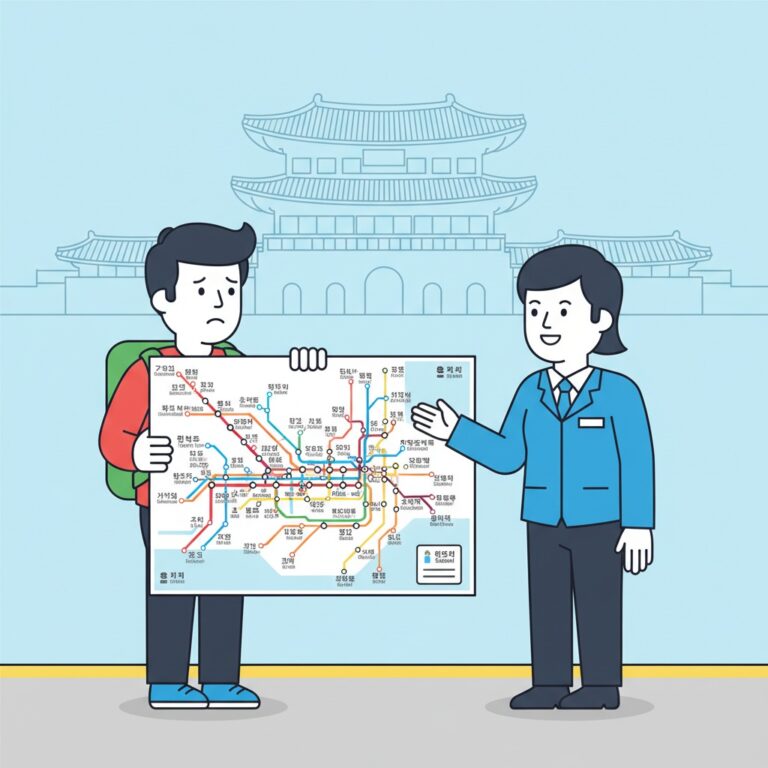
Ever felt a little lost in the maze of the Korean subway? It’s one of the best in the world, but it can be tricky for first-timers. Especially these days in Korea, with so many K-pop concerts and fan events happening all over the city, knowing how to navigate the subway is a superpower! But what happens when you take the wrong turn? Don’t panic! Today, we’ll learn some essential Korean phrases to confidently ask for help from a station attendant. Let’s get you ready to travel like a local!
Your Lifesaving Phrases! (3 Key Expressions)
Here are the top three phrases you need to know when you’re feeling lost in the station.
1. Excuse me… (To get attention)
- Korean Expression: 실례합니다 (Sillyehamnida)
- Pronunciation [Romanization]: [Sil-lye-ham-ni-da]
- English Meaning: Excuse me.
- Detailed Explanation: This is the most polite and standard way to get someone’s attention, whether it’s a station employee or just someone you need to pass by. It’s the perfect way to start any conversation when you need help. Always use this before asking a question to a stranger.
- 💡 Pronunciation Tip:
The magic here happens with the consonants. The ‘ㄹ(l)’ sound in ‘실’ and the ‘ㅎ(h)’ sound in ‘례’ blend together, so it sounds more like [Sillye] than “Sil-he.” Also, when the consonant ‘ㅂ(b)’ is followed by ‘ㄴ(n)’, it changes to an ‘ㅁ(m)’ sound. That’s why 합니다 is pronounced [hamnida], not “hapnida.” It’s a rule called nasalization, and it makes the word flow much more smoothly!
2. I’m lost. (To state your problem)
- Korean Expression: 길을 잃었어요 (Gireul ireosseoyo)
- Pronunciation [Romanization]: [Gi-reul i-reo-sseo-yo]
- English Meaning: I’m lost / I’ve lost my way.
- Detailed Explanation: This is a direct and clear way to explain your situation. As soon as you say this, people will understand you need directions. It’s a very useful phrase for any traveler.
- 💡 Pronunciation Tip:
Notice the first word, ‘길을’. The final consonant ‘ㄹ(l)’ from ‘길(gil)’ moves over to the next syllable ‘을(eul)’, making it sound like [gireul]. This is a very common Korean pronunciation rule called liaison (or 연음, yeoneum). It connects words and makes them sound more natural. So instead of “gil-eul,” think “gi-reul.”
3. Where do I go to get to [Place]?
- Korean Expression: [장소]에 가려면 어디로 가야 돼요? ([Jangso]-e garyeomyeon eodiro gaya dwaeyo?)
- Pronunciation [Romanization]: [[Place]-e ga-ryeo-myeon eo-di-ro ga-ya dwae-yo?]
- English Meaning: Where do I have to go to get to [Place]?
- Detailed Explanation: This is your golden ticket! Just insert the name of your destination into the
[장소](jangso) part. You can show the name written on your phone if you’re unsure how to pronounce it. - 💡 Pronunciation Tip:
The part ‘가야 돼요’ [ga-ya dwae-yo] can be a bit tricky. The syllable ‘돼’ (dwae) is a combination of the ‘ㅗ(o)’ and ‘ㅐ(ae)’ vowels, creating a ‘wae’ sound, similar to the sound in the English word “wet.” Practice saying “dwae-yo” a few times. It’s a very common ending for questions about what one should do.
Example Dialogue in Action!
Let’s see how these phrases work in a real conversation. Imagine a tourist (A) trying to get to a K-pop concert at the Jamsil Sports Complex.
- A (Tourist): 실례합니다.
- (Sillyehamnida.)
- Excuse me.
- B (Station Staff): 네, 무엇을 도와드릴까요?
- (Ne, mueoseul dowadeurilkkayo?)
- Yes, how may I help you?
- A (Tourist): 길을 잃었어요. 잠실종합운동장에 가려면 어디로 가야 돼요?
- (Gireul ireosseoyo. Jamsiljonghapundongjang-e garyeomyeon eodiro gaya dwaeyo?)
- I’m lost. Where do I have to go to get to Jamsil Sports Complex?
- B (Station Staff): 아, 2호선으로 갈아타셔야 해요. 저쪽으로 가세요.
- (A, ihoseoneuro garatasyeoya haeyo. Jeojjogeuro gaseyo.)
- Ah, you need to transfer to Line 2. Please go that way.
- A (Tourist): 감사합니다!
- (Gamsahamnida!)
- Thank you!
Culture Tip & K-Trend Deep Dive
Your Smartphone is Your Best Friend!
In Korea, station staff are incredibly helpful, but sometimes there’s a language barrier. A fantastic tip is to have your destination’s name written in Korean (Hangul) on your phone.
K-Pop Trend Alert: Recently, “subway ad tours” have become a huge trend among K-pop fans. Fans celebrate their favorite idol’s birthday by placing large advertisements in major subway stations like Samseong, Gangnam, or Hongik University. If you’re hunting for one of these ads and can’t find it, you can use our key phrase! Just show a picture of the ad to the station staff and ask, “이거에 가려면 어디로 가야 돼요?” (Igeo-e garyeomyeon eodiro gaya dwaeyo? – Where do I go to get to this?). They’ll know exactly what you mean!
Let’s Review & Practice!
Great job today! You’ve learned how to get attention politely (실례합니다), explain that you’re lost (길을 잃었어요), and ask for directions to a specific place ([장소]에 가려면 어디로 가야 돼요?).
Now, it’s your turn to practice!
- Fill in the Blank: You want to go to Myeongdong Station. What do you ask the station staff?
____________에 가려면 어디로 가야 돼요?
- Quick Quiz (O/X): If you need help, it’s okay to just tap someone on the shoulder and start asking your question immediately. (Answer: X! You should always say
실례합니다first!)
You’re now ready to conquer the Korean subway! Try using one of these phrases in the comments below. Tell us where you want to go in Korea! For example: “저는 홍대에 가고 싶어요!” (I want to go to Hongdae!).







