

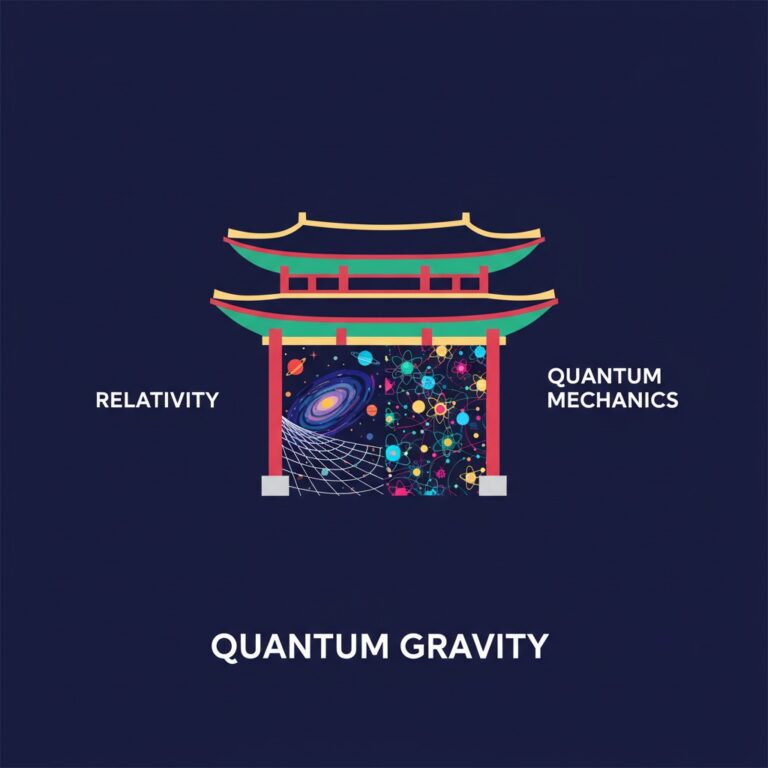
The Universe’s Ultimate Question: The Theory of Quantum Gravity
Hello! It’s Maeil Hangeul, here to upgrade your Korean skills to a cosmic level!
Today, we’re venturing into the deepest questions of physics. Have you ever wondered what happens inside a black hole, or how the universe began? To answer these, scientists are on a quest for the “Theory of Quantum Gravity.” Recently in Korea, complex scientific ideas are no longer just for academics; they’re popping up in popular sci-fi movies, webtoons, and intellectual talk shows, sparking a lot of curiosity. Let’s learn the advanced Korean vocabulary you need to join this fascinating conversation!
Core Expressions
Here are some key terms to help you discuss the frontiers of physics like a pro.
1. 상대성 이론 (Sangdaeseong Iron)
- Romanization: [Sang-dae-seong i-ron]
- English Meaning: Theory of Relativity
- Detailed Explanation: This refers to Albert Einstein’s famous theories. 일반 상대성 이론 (Ilban Sangdaeseong Iron), or General Relativity, describes gravity and the universe on a large scale (planets, galaxies). 특수 상대성 이론 (Teuksu Sangdaeseong Iron), or Special Relativity, deals with space, time, and motion. This term is fundamental in any discussion about modern physics.
- 💡 Pronunciation Tip:
When a noun ending in a consonant like ‘성 (seong)’ is followed by ‘이론 (iron)’, the final consonant sound can sometimes link to the next syllable in casual, fast speech, though keeping them distinct is also correct in formal contexts. Focus on pronouncing each syllable clearly: 상-대-성-이-론.
2. 양자 역학 (Yangja Yeokhak)
- Romanization: [Yang-ja yeo-kak]
- English Meaning: Quantum Mechanics
- Detailed Explanation: This is the theory that describes the bizarre and fascinating world of the very small—atoms and subatomic particles. It’s the other pillar of modern physics alongside relativity. The core idea is that energy and matter exist in discrete units called ‘quanta’.
- 💡 Pronunciation Tip:
The final ‘ㄱ(k)’ in ‘역(yeok)’ is an unreleased stop sound. This means you form the ‘k’ sound at the back of your throat but don’t release the puff of air. It’s a subtle but crucial difference that makes your pronunciation sound more native. Try saying ‘역’ and stopping the sound right at the end. It’s [yeokak], not ‘yeo-k-hak’.
3. 통합 이론 (Tonghap Iron)
- Romanization: [Tong-hap i-ron]
- English Meaning: Unified Theory
- Detailed Explanation: This is the “holy grail” of physics. It refers to a hypothetical single theoretical framework that can fully explain and link together all physical aspects of the universe. A theory of quantum gravity would be a type of 통합 이론. It’s often used interchangeably with 만물 이론 (Manmul Iron), the “Theory of Everything.”
- 💡 Pronunciation Tip:
The Hangul is ‘통합’, but the ‘ㅎ(h)’ sound often weakens or disappears when it’s between voiced sounds. However, in this academic term, it’s often pronounced more clearly. The key is the ‘ㅂ(b)’ sound in ‘합’. It’s an unaspirated ‘p’ sound, softer than the English ‘p’ in ‘pie’. It’s pronounced [tonghap].
4. 모순되다 (Mosundoeda)
- Romanization: [Mo-sun-doe-da]
- English Meaning: To be contradictory; to conflict with
- Detailed Explanation: This verb is perfect for describing the central problem that quantum gravity tries to solve. On their own, Relativity and Quantum Mechanics work perfectly. But when you try to apply them to situations where both extreme gravity and tiny scales are involved (like a black hole’s singularity), their predictions 모순돼요 (mosundoeyo)—they contradict each other.
- 💡 Pronunciation Tip:
The vowel ‘ㅚ(oe)’ can be tricky. It’s pronounced like a quick glide from ‘w’ to ‘e’ ([we]). So, ‘되다’ is pronounced [doeda], not ‘doh-da’. Practice saying “dwe” to get the sound right.
Example Dialogue
Let’s see how these terms are used in a conversation between two university students after a physics lecture.
A: 오늘 양자 중력 강의, 정말 흥미로웠지만 너무 어렵지 않았어?
(Oneul yangja jungnyeok gangui, jeongmal heungmirowotjiman neomu eoryeopji anasseo?)
Today’s quantum gravity lecture was fascinating, but wasn’t it incredibly difficult?
B: 맞아. 특히 거시 세계를 설명하는 상대성 이론과 미시 세계의 양자 역학이 블랙홀 특이점에서는 서로 모순된다는 점이 소름 돋았어.
(Maja. Teuki geosi segyereul seolmyeonghaneun sangdaeseong iron-gwa misi segye-ui yangja yeokhak-i beullaekhol teugijeom-eseoneun seoro mosundoenda-neun jeomi soreum dodatseo.)
I know. It was especially mind-blowing that the Theory of Relativity, which explains the macro world, and Quantum Mechanics for the micro world, contradict each other at a black hole’s singularity.
A: 그러니까 물리학자들이 그 두 이론을 합칠 통합 이론을 만들려고 그렇게 애쓰는 거겠지.
(Geureonikka mullihakjadeuri geu du ironeul hapchil tonghap iron-eul mandeullyeogo geureoke aesseuneun geogetji.)
Exactly. That must be why physicists are trying so hard to create a Unified Theory that combines the two.
B: 우리 교수님께서 다음 논문에서 새로운 가설을 세우실 거래. 정말 기대돼.
(Uri gyosunimkkeseo daeum nonmuneseo saeroun gaseoreul seusil georae. Jeongmal gidaedwae.)
I heard our professor is going to formulate a new hypothesis in his next paper. I’m really looking forward to it.
Culture Tip & Trend Analysis
In Korea, there’s a huge respect for science and academia. Concepts like quantum physics are not just confined to university halls. They are a source of national pride when Korean scientists make breakthroughs and a popular motif in high-concept entertainment.
- Sci-Fi as a Mainstream Genre: Korean films like Space Sweepers (승리호) and dramas like Sisyphus: The Myth (시지프스) often use advanced scientific concepts as central plot devices. When you’re discussing these shows with Korean friends, being able to use terms like 양자 역학 or 상대성 이론 will show your deep understanding not just of the language, but of the cultural context.
- Impressing the Intellectuals: Using a word like 모순되다 to describe a logical conflict or 통합 이론 to talk about a grand idea will make you sound incredibly articulate and intelligent in any formal or academic discussion. It shows you can handle abstract and complex topics in Korean.
Wrap-up & Practice!
Great job navigating the universe of Korean physics vocabulary today! We learned how to talk about the 상대성 이론 (Theory of Relativity) and 양자 역학 (Quantum Mechanics), the way they can 모순되다 (be contradictory), and the ultimate goal of a 통합 이론 (Unified Theory).
Now, let’s test your knowledge!
- Fill in the blank: A theory that attempts to unify all fundamental forces of nature is called a ______ in Korean.
- Create a sentence: Try to make a short sentence using the verb 모순되다. (For example: “His actions and words are contradictory.”)
Leave your answers in the comments below! What other complex topics would you like to discuss in Korean? Let me know
Frequently Asked Questions (FAQ)
Q: What does "일반 상대성 이론" mean in Korean and how do you pronounce it?
A: In Korean, "일반 상대성 이론" is pronounced [Ilban Sangdaeseong Iron] and means: , or General Relativity, describes gravity and the universe on a large scale (planets, galaxies).
Q: What does "특수 상대성 이론" mean in Korean and how do you pronounce it?
A: In Korean, "특수 상대성 이론" is pronounced [Teuksu Sangdaeseong Iron] and means: , or Special Relativity, deals with space, time, and motion. This term is fundamental in any discussion about modern physics.
Q: What does "만물 이론" mean in Korean and how do you pronounce it?
A: In Korean, "만물 이론" is pronounced [Manmul Iron] and means: , the "Theory of Everything."
Q: What does "모순돼요" mean in Korean and how do you pronounce it?
A: In Korean, "모순돼요" is pronounced [mosundoeyo] and means: —they contradict each other.







