

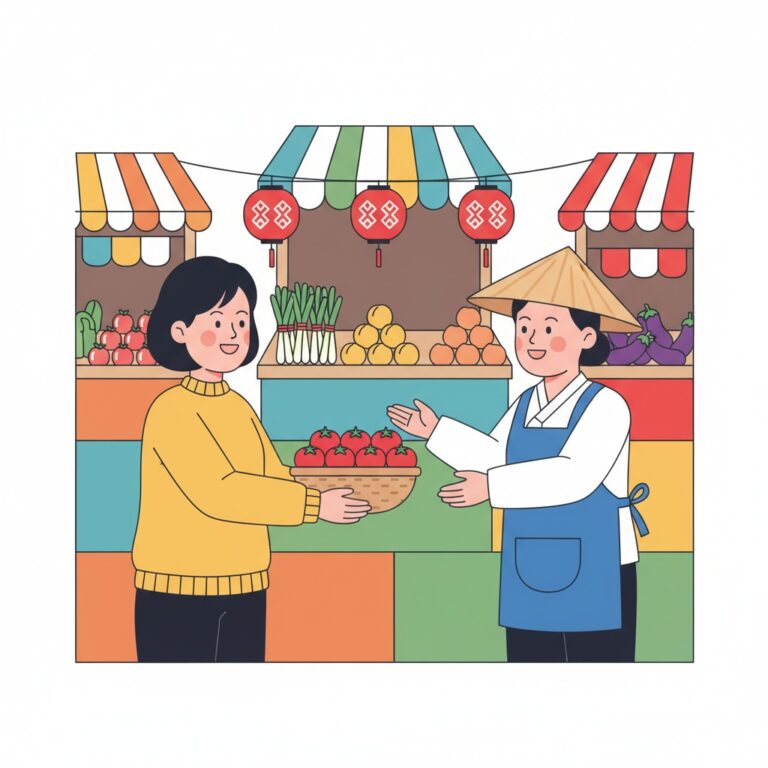
이 토마토 얼마예요? Your Ultimate Guide to Korean Market Shopping!
Hello! This is [Daily Hangul], here to upgrade your Korean skills!
Have you ever walked through a bustling Korean traditional market (시장, sijang), mesmerized by the vibrant colors of fresh fruits and vegetables, but felt too shy to ask for the price? Don’t worry, we’ve all been there!
Today, we’re going to learn the essential phrases you need to shop like a local. And we’ll do it with a fun, trendy twist! Lately in Korea, everyone is obsessed with making homemade Tanghulu (탕후루), a candied fruit snack. A popular and healthier version is “Tomato Tanghulu”! So, let’s imagine we’re at the market to buy some fresh tomatoes. By the end of this lesson, you’ll be able to confidently ask for prices and buy anything you want!
Ready? Let’s go! (갑시다! gapsida!)
Core Expressions You MUST Know
Here are three simple but powerful expressions for your market adventure.
1. 이거 (igeo) – This one
- Korean: 이거
- Pronunciation [Romanization]: Igeo
- English Meaning: This / This one
- Detailed Explanation: This is your magic wand at the market! When you don’t know the name of something, you can simply point at it and use 이거. It’s a casual and super common way to refer to something right in front of you. It’s short for 이것 (igeot).
- 💡 Pronunciation Tip:
Even though it’s spelled ‘igeot’ (이것), you’ll almost always hear it pronounced as [igeo] in conversation. The final ‘ㅅ(t)’ sound is often dropped to make it flow more smoothly. So, instead of a hard ‘t’ sound at the end, just say ‘ee-guh’.
2. 얼마예요? (eolmayeyo?) – How much is it?
- Korean: 얼마예요?
- Pronunciation [Romanization]: Eolmayeyo?
- English Meaning: How much is it?
- Detailed Explanation: This is the golden question! You can combine it with 이거 to ask, “이거 얼마예요?” (Igeo eolmayeyo?), which means “How much is this?” The -예요 (-yeyo) ending makes the question polite and friendly, perfect for talking to shopkeepers.
- 💡 Pronunciation Tip:
Listen closely to the sound! It’s not ‘eol-ma-ye-yo’ said separately. In Korean, sounds often link together. The ‘ㅁ(m)’ sound from ‘얼마’ (eolma) smoothly connects to ‘예요’ (yeyo), so it sounds like one fluid word: [얼마예요 / eolmayeyo]. Practice saying it quickly to sound more natural!
3. 주세요 (juseyo) – Please give me…
- Korean: 주세요
- Pronunciation [Romanization]: Juseyo
- English Meaning: Please give me…
- Detailed Explanation: After you know the price and want to buy it, use 주세요. You can put the item you want before it. For example, “이거 주세요” (Igeo juseyo) means “Please give me this one.” It’s a polite and essential phrase for buying anything, from coffee to clothes!
- 💡 Pronunciation Tip:
The ‘주 (ju)’ sound is similar to the ‘ju’ in ‘juice’. The ‘세 (se)’ is a soft ‘s’ sound, like in ‘say’. And remember the polite 요 (yo) at the end! This little syllable is key to being polite in Korean.
Example Dialogue at the Market
Let’s see these phrases in action! Imagine you (A) are talking to a friendly market vendor (B) to buy tomatoes for your Tanghulu.
A: 안녕하세요! 이 토마토 싱싱해 보여요.
(Annyeonghaseyo! I tomato singsinghae boyeoyo.)
Hello! These tomatoes look fresh.
B: 어서 오세요! 네, 오늘 아침에 바로 딴 거예요.
(Eoseo oseyo! Ne, oneul achime baro ttan geoyeyo.)
Welcome! Yes, they were picked just this morning.
A: 와! 이거 얼마예요?
(Wa! Igeo eolmayeyo?)
Wow! How much is this?
B: 한 바구니에 5,000원이에요.
(Han bagunie ocheon-wonieyo.)
It’s 5,000 won for one basket.
A: 좋아요. 한 바구니 주세요.
(Joayo. Han baguni juseyo.)
Great. Please give me one basket.
See? Simple and effective!
Culture Tip & Trend Deep Dive
- The Tanghulu Craze: In Korea right now, you can’t scroll through Instagram or TikTok without seeing someone eating or making Tanghulu. While the classic is strawberry or grape, creative homemade versions like Tomato or Shine Muscat Tanghulu are huge! Knowing how to buy fruit at a market means you can join in on this delicious trend. Next time you see cherry tomatoes, you can confidently ask, “이 방울토마토 얼마예요?” (I bangul-tomato eolmayeyo? – How much are these cherry tomatoes?).
-
The Charm of Sijang (시장): Shopping at a traditional Korean market is a unique experience. Unlike supermarkets, you can often get a little extra service, called 덤 (deom). If you buy a basket of tomatoes, the kind vendor might throw in a few extra for free! Being polite and using phrases like 주세요 (juseyo) can sometimes earn you a little deom!
Let’s Review and Practice!
Great job today! We learned three key phrases for shopping in Korea:
* 이거 (This one)
* 얼마예요? (How much is it?)
* 주세요 (Please give me…)
Now, let’s test your knowledge!
1. Fill in the blank: You are at the market and want to buy a watermelon (수박, subak). You point at it and ask:
“이 ______ 얼마예요?” (I ______ eolmayeyo?)
2. Make a sentence: You’ve decided to buy the watermelon. How do you politely ask the vendor to give you one?
(Hint: Use the word for watermelon and the “please give me” phrase!)
Leave your answers in the comments below! You can also practice by writing what you would want to buy at a Korean market using the phrases we learned today.
Happy learning! 다음에 또 만나요! (Daeume tto mannayo! – See you next time!)
Frequently Asked Questions (FAQ)
Q: What does "-예요" mean in Korean and how do you pronounce it?
A: In Korean, "-예요" is pronounced [-yeyo] and means: ending makes the question polite and friendly, perfect for talking to shopkeepers.
Q: What does "덤" mean in Korean and how do you pronounce it?
A: In Korean, "덤" is pronounced [deom] and means: . If you buy a basket of tomatoes, the kind vendor might throw in a few extra for free! Being polite and using phrases like







