

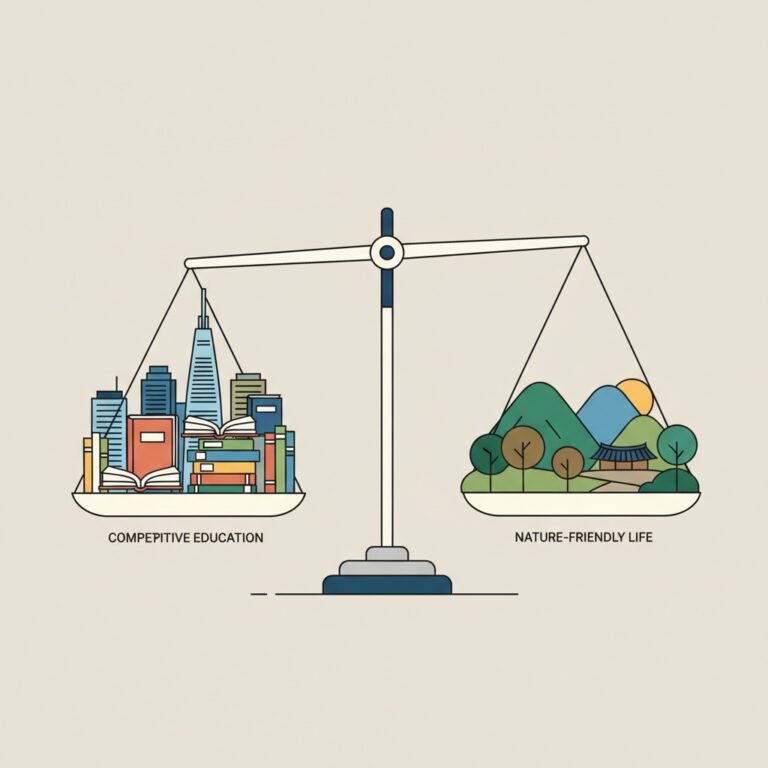
Korea’s Big Debate: City vs. Country for Your Child’s Education?
Hello! Welcome to Maeil Hangeul (매일한글), here to upgrade your Korean skills! 😊
Have you ever wondered what life is like outside of the bustling city of Seoul? Today, we’re diving into a topic that many Koreans think about deeply: where is the best place to raise children? In the competitive city or the peaceful countryside?
Lately in Korea (요즘 한국에서는), you’ll see this theme everywhere, from popular K-dramas where families escape to Jeju Island, to reality shows featuring celebrities enjoying a slower pace of life. This isn’t just for TV—it’s a real conversation happening in many Korean homes. Let’s learn the key phrases you need to join in!
Core Expressions You Need to Know!
Here are some essential expressions to discuss this popular topic.
1. 교육 환경 (Gyoyuk hwangyeong)
- Pronunciation [Romanization]: Gyo-yuk hwan-gyeong
- English Meaning: Educational Environment
- Detailed Explanation: This is a crucial term that combines 교육 (gyoyuk), meaning ‘education’, and 환경 (hwangyeong), meaning ‘environment’. Koreans place a huge emphasis on the conditions for learning, which includes schools, private academies (hagwons), and even the general atmosphere of the neighborhood. When people discuss moving, the 교육 환경 is often the number one reason!
-
💡 Pronunciation Tip:
The word 환경 is pronounced [hwangyeong]. Notice how the final consonant ‘ㄴ’ (n) in ‘환’ (hwan) and the first consonant ‘ㄱ’ (g) in ‘경’ (gyeong) blend together. The ‘ㄴ’ sound slightly changes to sound more like ‘ㅇ’ (ng) right before the ‘ㄱ’ sound. This makes the pronunciation flow smoothly from one syllable to the next.
2. 경쟁이 치열하다 (Gyeongjaeng-i chiyeolhada)
- Pronunciation [Romanization]: Gyeong-jaeng-i chi-yeol-ha-da
- English Meaning: The competition is fierce.
-
Detailed Explanation: This phrase perfectly describes the high-pressure atmosphere often found in big cities like Seoul, especially regarding school admissions and jobs. 경쟁 (gyeongjaeng) means ‘competition’, and 치열하다 (chiyeolhada) is a powerful adjective meaning ‘fierce’ or ‘intense’. You’ll hear this a lot when people talk about the downsides of city life for kids.
-
💡 Pronunciation Tip:
Pay attention to the first sound in 치열하다 [chiyeolhada]. The consonant ‘ㅊ’ (ch) is an aspirated sound. This means you should release a strong puff of air when you say it, like the ‘ch’ in “chair.” It’s much stronger than the Korean ‘ㅈ’ (j), which has no air puff. Try holding a piece of paper in front of your mouth—it should flutter when you say 치 (chi) correctly!
3. 자연 친화적이다 (Jayeon chinhwajeogida)
- Pronunciation [Romanization]: Ja-yeon chin-hwa-jeo-gi-da
- English Meaning: To be nature-friendly / close to nature.
-
Detailed Explanation: This is the biggest selling point for countryside living! 자연 (jayeon) means ‘nature’, and 친화적이다 (chinhwajeogida) means ‘to be friendly towards’ or ‘compatible with’. It describes an environment where kids can play outdoors, breathe fresh air, and learn from nature directly. It paints a beautiful, peaceful picture.
-
💡 Pronunciation Tip:
This phrase demonstrates a very common Korean pronunciation rule called linking sound (연음 – yeoneum). The word 친화적 (chinhwajeok) ends with a ‘ㄱ’ (k) consonant, and the next part, 이다 (ida), starts with a vowel. In this case, the ‘ㄱ’ sound “moves over” or “links” to the next syllable. So, instead of a choppy [chinhwajeok-ida], it flows smoothly as [chinhwajeogida].
Example Conversation
Let’s see how these phrases work in a real chat between two friends, Minjun and Sora.
A: 민준 (Minjun): 우리 아이 때문에 서울을 떠날까 생각 중이야.
(Uri ae ttaemune seour-eul tteonalkka saenggak jung-iya.)
I’m thinking of leaving Seoul because of our child.
B: 소라 (Sora): 정말? 서울이 교육 환경은 더 좋지 않아?
(Jeongmal? Seour-i gyoyuk hwangyeong-eun deo jochi ana?)
Really? Isn’t the educational environment better in Seoul?
A: 민준 (Minjun): 좋긴 한데, 경쟁이 너무 치열해서 아이가 스트레스 받을까 봐 걱정돼.
(Jokin hande, gyeongjaeng-i neomu chiyeolhaeseo aiga seuteureseu badeulkka bwa geokjeongdwae.)
It is good, but I’m worried my child will be stressed because the competition is so fierce.
B: 소라 (Sora): 하긴, 시골은 더 자연 친화적이라서 아이들 정서에는 좋겠네. 각각 장단점이 있구나.
(Hagin, sigor-eun deo jayeon chinhwajeogiraseo aideul jeongseo-eneun jokenne. Gakgak jangdanjeom-i itguna.)
That’s true. The countryside is more nature-friendly, so it would be good for a child’s emotional well-being. Each has its pros and cons.
Culture Tip & Trend Deep Dive
This debate isn’t just about personal choice; it reflects a major shift in Korean values.
For decades, success was defined by graduating from a top university and getting a job at a big company, a path that almost required living in Seoul. Areas like Daechi-dong (대치동) in Gangnam became famous as the “mecca of private education,” symbolizing the intense 경쟁이 치열하다 culture.
However, a new trend called 귀촌 (gwichon), or “returning to the countryside,” is gaining popularity, especially among the younger generation and families. They are prioritizing work-life balance, mental health, and a 자연 친화적이다 lifestyle over the traditional definition of success. K-dramas like “Hometown Cha-Cha-Cha” and reality shows like “Little Forest” showcase this ideal, making countryside living look very appealing!
So, when you use these phrases, you’re not just speaking Korean—you’re tapping into a modern cultural conversation about what it means to live a good life in Korea today.
Let’s Practice!
Ready to test your knowledge?
- If you want to say the competition in Daechi-dong is intense, you would say:
“대치동은 ________이/가 정말 치열해요.” (Hint: The word for ‘competition’) - Your friend wants to move to Jeju Island so their kids can play outside more. What kind of environment are they looking for? (Fill in the blank with the Korean term).
“They are looking for a more ___________ environment.”
Great job today! You’ve learned some key vocabulary to discuss a really interesting and relevant topic in Korea.
Now it’s your turn! Which do you prefer, city life or country life? Try to answer using one of the expressions we learned today in the comments below! 👇
Frequently Asked Questions (FAQ)
Q: What does "교육" mean in Korean and how do you pronounce it?
A: In Korean, "교육" is pronounced [gyoyuk] and means: , meaning 'education', and
Q: What does "환경" mean in Korean and how do you pronounce it?
A: In Korean, "환경" is pronounced [hwangyeong] and means: , meaning 'environment'. Koreans place a huge emphasis on the
Q: What does "경쟁" mean in Korean and how do you pronounce it?
A: In Korean, "경쟁" is pronounced [gyeongjaeng] and means: means 'competition', and
Q: What does "치열하다" mean in Korean and how do you pronounce it?
A: In Korean, "치열하다" is pronounced [chiyeolhada] and means: is a powerful adjective meaning 'fierce' or 'intense'. You'll hear this a lot when people talk about the downsides of city life for kids.







