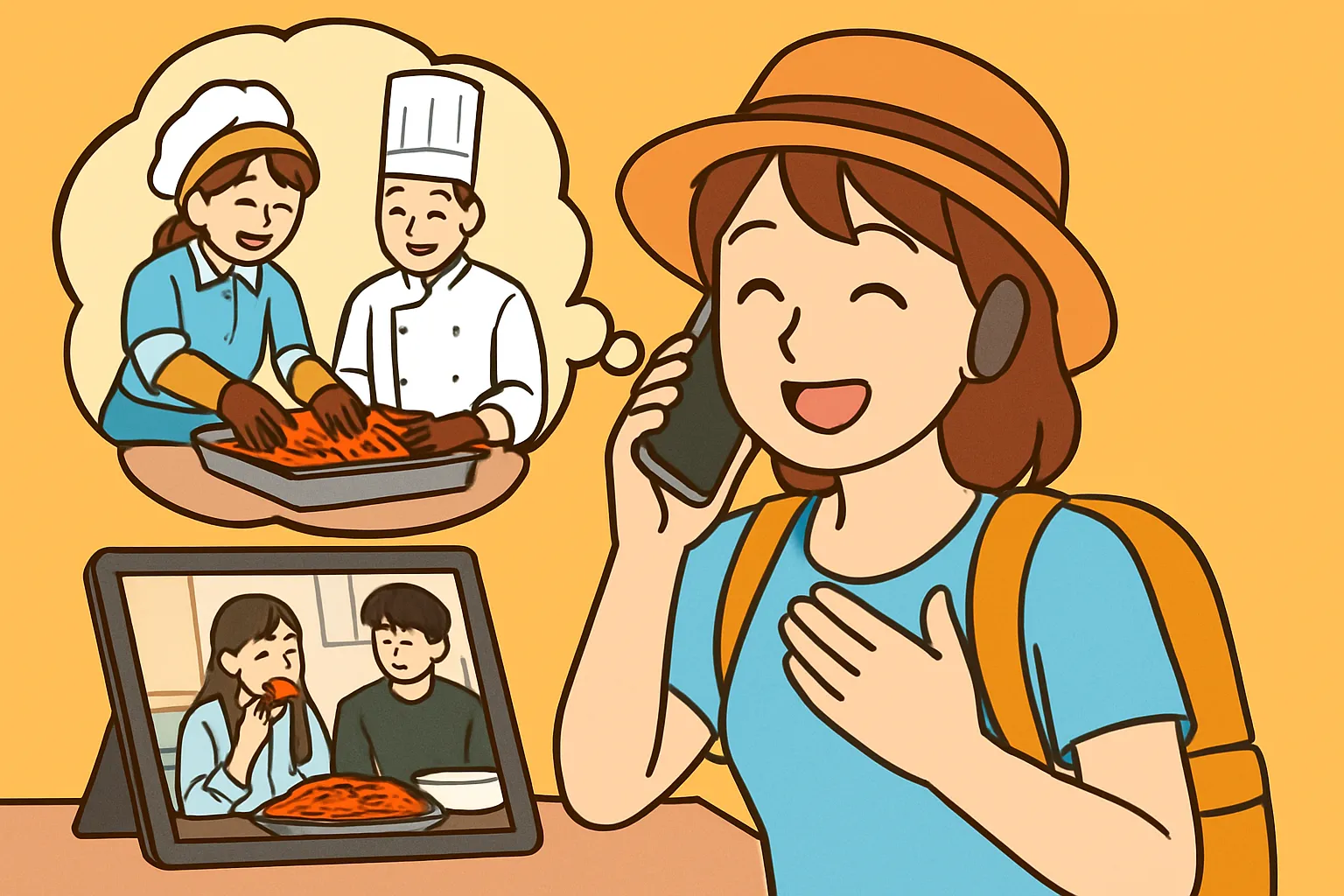

My Korean Exchange: The Good, the Bad, and the Unforgettable!
Hello! This is Maeil Hangeul (매일한글), here to upgrade your Korean skills!
Have you ever studied abroad, traveled to a new country, or worked with people from different backgrounds? Sharing those experiences is a great way to connect with others. Today, we’re going to learn how to talk about the amazing, challenging, and eye-opening moments of cultural exchange in Korean.
Nowadays in Korea, with K-culture booming globally, there’s more interest than ever in international experiences. Whether you’re sharing your story with a Korean friend or even in a job interview, these expressions will help you sound natural and thoughtful. Let’s dive in!
Core Expressions for Your Story
Here are three essential phrases to describe your cultural exchange journey.
1. 잊지 못할 경험 (Itji motal gyeongheom)
- English Meaning: An unforgettable experience
- Detailed Explanation: This is a powerful and positive phrase you use for a memory that has left a deep impression on you. It’s perfect for describing the highlight of your trip, a special person you met, or a moment you’ll cherish forever. The grammar
-(으)ㄹ/를 못하다means “to be unable to do something,” so잊지 못하다literally means “to be unable to forget.” - 💡 Pronunciation Tip:
The pronunciation of 못할 is notmot-hal, but [моталь | motal]. The final consonant ‘ㅅ’ in못is pronounced as a ‘ㄷ’ [t] sound. When this ‘ㄷ’ sound meets the ‘ㅎ’ [h] in할, they combine to create an aspirated ‘ㅌ’ [tʰ] sound. It’s a common phonetic rule in Korean that makes your speech flow much more smoothly!
2. 문화 충격을 받다 (Munhwa chunggyeogeul batda)
- English Meaning: To experience culture shock
- Detailed Explanation: This phrase literally translates to “receive a culture shock.” It’s the go-to expression for describing that feeling of surprise or disorientation when you encounter a culture very different from your own. It doesn’t always have to be negative! You can experience culture shock from positive things too, like how incredibly safe and convenient the subways are in Seoul.
- 💡 Pronunciation Tip:
In 충격을 [chunggyeogeul], notice how the final ‘ㄱ’ [g] sound of충격links directly to the을particle. Instead of sayingchunggyeokand then a separateeul, the ‘ㄱ’ sound “moves over” to the next syllable, becoming [충겨글 | chunggyeogeul]. This is called linking, or 연음 (yeoneum), and it’s key to sounding natural.
3. 시야가 넓어지다 (Siyaga neolbeojida)
- English Meaning: To broaden one’s horizons/perspective
- Detailed Explanation: This is a beautiful, metaphorical expression.
시야(siya) means “field of vision,” and넓어지다(neolbeojida) means “to become wider.” So, you’re literally saying “my field of vision became wider.” It’s the perfect phrase to summarize the positive personal growth you gained from your experience—learning new ways of thinking and seeing the world differently. - 💡 Pronunciation Tip:
The word 넓어지다 looks tricky because of theㄼdouble consonant. In this case, you only pronounce the ‘ㅂ’ [b] sound, so it sounds like[널버지다 | neolbeojida]. The ‘ㅂ’ sound then links to the following vowel ‘어’, making the pronunciation smooth. Don’t try to pronounce both the ‘ㄹ’ and ‘ㅂ’!
Example Dialogue
Let’s see how these expressions work in a real conversation!
A: 소희 씨, 서울에서 교환학생 했던 경험 어땠어요?
(Sohui, how was your experience as an exchange student in Seoul?)
B: 정말 잊지 못할 경험이었어요! 처음에는 음식도 다르고 생활 방식도 너무 달라서 문화 충격을 좀 받았지만, 금방 적응했어요.
(It was truly an unforgettable experience! At first, the food and lifestyle were so different that I experienced some culture shock, but I adapted quickly.)
A: 와, 고생했네요. 그래도 많이 배웠겠어요.
(Wow, that must have been tough. But I bet you learned a lot.)
B: 네, 맞아요. 다양한 나라에서 온 친구들을 만나면서 시야가 넓어진 것 같아요. 정말 소중한 시간이었어요.
(Yes, exactly. Meeting friends from various countries really helped broaden my perspective. It was such a precious time.)
Culture Deep Dive: Sounding Like a Pro
In Korea, international experience is highly valued. When Koreans talk about their time abroad, they often use these phrases to reflect on their personal growth.
- You’ll hear these expressions constantly in Korean travel vlogs on YouTube when the creator reflects on their journey.
- On TV shows featuring foreigners in Korea (like Welcome, First Time in Korea?), the hosts and guests often use
문화 충격to discuss cultural differences in a fun and engaging way. - If you’re ever in a job interview in Korea and are asked about your time abroad, using a phrase like
시야가 넓어지는 계기가 되었습니다(It became an opportunity to broaden my horizons) will make you sound fluent, thoughtful, and professional.
Let’s Practice & Wrap-Up!
Today, we learned three fantastic expressions to share your cultural exchange experiences:
- 잊지 못할 경험 (an unforgettable experience)
- 문화 충격을 받다 (to experience culture shock)
- 시야가 넓어지다 (to broaden one’s horizons)
Now, it’s your turn! Fill in the blank with the most appropriate phrase from today’s lesson.
Quiz:
여행 중에 새로운 가치관을 배우면서 제 ________________ 것 같아요.
(During my trip, I learned new values and I think my ________________.)
What’s the answer? And what about you? Tell us about an unforgettable experience you’ve had! Leave a comment below using one of the expressions you learned today! We can’t wait to read your stories.