

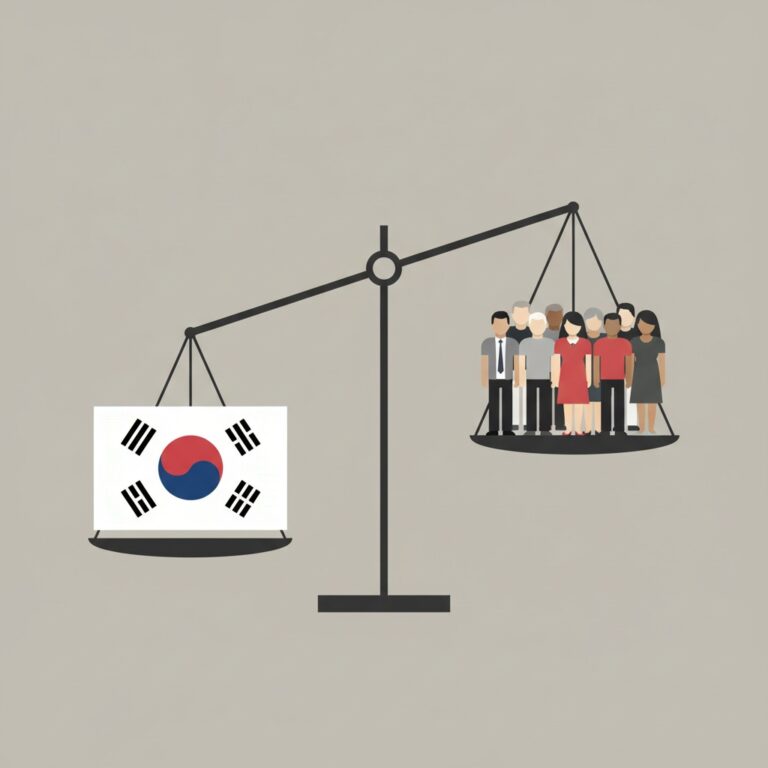
Beyond “Help”: Debating Humanitarian Intervention in Korean
Hello! Welcome back to [Maeil Hangeul], your go-to blog for upgrading your Korean skills to the next level!
Today, we’re diving deep into a topic that requires linguistic precision and a nuanced understanding of vocabulary: discussing the ethical dilemmas of humanitarian intervention. This might sound complex, but it’s exactly the kind of conversation you’ll encounter in academic settings, professional environments, or when reading in-depth news articles in Korean.
Lately in Korea, as the nation’s global standing grows, discussions about international responsibility, human rights, and foreign policy are becoming more and more common in the public sphere. Mastering the vocabulary for these debates is essential for any advanced learner who wants to engage in truly meaningful conversations. Let’s get started!
Core Expressions for the Debate
Here are four key terms you absolutely need to know to discuss this topic like an expert.
1. 개입 (gaeip)
- Pronunciation [Romanization]: [gaeip]
- English Meaning: Intervention
- Detailed Explanation: This is a formal, neutral term derived from Hanja (介入), literally meaning “to step in between.” It’s the standard word for any kind of intervention, from economic to military. You’ll often see it paired with other words, like 인도주의적 개입 (indojeok gaeip) for “humanitarian intervention” or 군사 개입 (gunsa gaeip) for “military intervention.” It’s a crucial, non-emotional term for formal discussions.
- 💡 Pronunciation Tip: This word is pronounced exactly as it’s written. Be sure to articulate the two syllables clearly: [gae-ip]. Avoid slurring them together. The clear separation of syllables is a hallmark of many formal, Hanja-based words in Korean.
2. 주권 (jukkwon)
- Pronunciation [Romanization]: [jukkwon]
- English Meaning: Sovereignty
- Detailed Explanation: This is the heart of the debate. 주권 (主權) refers to a nation’s right to govern itself without outside interference. The potential violation of sovereignty, or 주권 침해 (jukkwon chimhae), is the primary argument against intervention. Understanding this concept is fundamental to discussing international relations in Korean.
- 💡 Pronunciation Tip: Notice how the actual sound is closer to [주꿘/jukkwon] than [jugwon]. This is a common pronunciation rule called 경음화 (gyeongeumhwa), or “tensification.” When a consonant like ‘ㄱ’ follows another stop consonant (like the ‘ㄱ’ in ‘주ㄱ‘), it becomes a “tense” sound, like ‘ㄲ’. So, you pronounce ‘권’ with a stronger, sharper ‘kk’ sound.
3. 딜레마에 빠지다 (dillema-e ppajida)
- Pronunciation [Romanization]: [dillema-e ppajida]
- English Meaning: To be in a dilemma / to face a dilemma
- Detailed Explanation: This is a fantastic, common phrase. 딜레마 (dillema) is a loanword from English. The verb 빠지다 (ppajida) literally means “to fall into.” So, the expression creates a vivid image of “falling into a dilemma.” It perfectly captures the feeling of being stuck between two difficult choices, which is the essence of this ethical debate.
- 💡 Pronunciation Tip: Listen for the 연음 (yeoneum), or “linking” sound. The final vowel of ‘딜레마’ links smoothly to the ‘에’ particle, so it sounds like one word: [딜레마에/dillema-e]. Also, note the tense ‘ㅃ’ (pp) sound in 빠지다. It requires more force in your lips than the regular ‘ㅂ’ (b/p) sound.
4. 정당화되다 (jeongdanghwadoeda)
- Pronunciation [Romanization]: [jeongdanghwadoeda]
- English Meaning: To be justified
- Detailed Explanation: This is an essential verb for any ethical argument. Let’s break it down: 정당 (jeongdang) means “just” or “right.” The suffix -화되다 (-hwadoeda) is a passive verb ending that means “to be made into” or “to become.” So, 정당화되다 literally means “to be made just” — in other words, to be justified. You can ask, “어떤 조건에서 개입이 정당화될 수 있을까요?” (Under what conditions can intervention be justified?).
- 💡 Pronunciation Tip: The ‘ㅚ’ vowel in 되다 (doeda) is technically a monophthong. For the most natural pronunciation, try to say “oe” without your lips moving from an “o” to an “e” sound. It should be one clean sound: [doeda].
Example Dialogue
Here’s how these expressions might be used by two university students, Min-jun and Ji-hye, discussing a case for their international law class.
A (민준): 최근 A국에서 벌어지고 있는 인권 탄압 문제를 보면, 국제 사회의 적극적인 개입이 필요하다고 생각해.
(Min-jun: Looking at the recent human rights oppression in Country A, I think active intervention by the international community is necessary.)
B (지혜): 물론 인도주의적 관점에서는 맞는 말이지만, 자칫하면 그 나라의 주권을 침해할 수도 있다는 게 문제지. 정말 딜레마에 빠지게 돼.
(Ji-hye: Of course, that’s true from a humanitarian perspective, but the problem is that it could easily violate that country’s sovereignty. We really fall into a dilemma.)
A (민준): 맞아. 대규모 비인도적 범죄가 발생하고 있을 때, 외부의 개입은 과연 정당화될 수 있을까? 그 기준이 항상 모호한 것 같아.
(Min-jun: Exactly. When large-scale crimes against humanity are occurring, can external intervention truly be justified? The criteria always seem so ambiguous.)
B (지혜): 그래서 ‘보호책임(R2P)’ 원칙이 나온 거겠지. 하지만 그 원칙이 강대국에 의해 남용될 수 있다는 비판도 있고… 정말 어려운 문제야.
(Ji-hye: I guess that’s why the ‘Responsibility to Protect (R2P)’ principle emerged. But there’s also criticism that it can be abused by powerful nations… It’s a truly difficult issue.)
Cultural Tip & Deeper Dive
In Korea, a nation with a profound and often painful history related to its own sovereignty (주권), discussions about international intervention carry a unique weight. Having experienced colonialism and the division of the peninsula influenced by foreign powers, Koreans are often highly sensitive to issues of national autonomy.
Therefore, when you engage in this topic in Korean, showing an understanding of this historical context will make your arguments more compelling. You’ll notice that editorials (사설) and in-depth reports (심층 보도) in major Korean newspapers frequently frame global events through this lens of sovereignty vs. international responsibility. Using today’s vocabulary will allow you to read and understand these high-level materials, and even participate in the discussion yourself.
Wrap-up & Practice!
Today, we learned four essential expressions for discussing the complex ethics of humanitarian intervention: 개입 (intervention), 주권 (sovereignty), 딜레마에 빠지다 (to be in a dilemma), and 정당화되다 (to be justified).
Now, it’s your turn to practice!
- Fill in the blank:
국제 사회는 한 국가의 심각한 인권 문제에 _______해야 할지, 아니면 그 국가의 _______을/를 존중해야 할지 윤리적 _______에 빠졌다.
(The international community fell into an ethical ______: whether it should ______ in a country’s serious human rights issues, or respect that country’s ______.) -
Your Turn: Using the phrase 정당화될 수 있다 (can be justified), write a short sentence in Korean expressing your opinion on when humanitarian intervention might be acceptable.
Share your answers and your thoughts on this topic in the comments below using the vocabulary we learned today! We’d love to hear your perspective.
Frequently Asked Questions (FAQ)
Q: What does "인도주의적 개입" mean in Korean and how do you pronounce it?
A: In Korean, "인도주의적 개입" is pronounced [indojeok gaeip] and means: for "humanitarian intervention" or
Q: What does "군사 개입" mean in Korean and how do you pronounce it?
A: In Korean, "군사 개입" is pronounced [gunsa gaeip] and means: for "military intervention." It’s a crucial, non-emotional term for formal discussions.
Q: What does "주권" mean in Korean and how do you pronounce it?
A: In Korean, "주권" is pronounced [主權] and means: refers to a nation's right to govern itself without outside interference. The potential violation of sovereignty, or
Q: What does "주권 침해" mean in Korean and how do you pronounce it?
A: In Korean, "주권 침해" is pronounced [jukkwon chimhae] and means: , is the primary argument against intervention. Understanding this concept is fundamental to discussing international relations in Korean.







