

학습 블로그 내용
Korea’s Government: Who Does What?
Introduction
Hello! It’s [Daily Korean] here to upgrade your Korean skills! 👋
Today, we are diving into a slightly more advanced but incredibly useful topic: The Political System and Executive Ministries (행정부의 주요 부처).
You might think politics is boring, but wait! These days in Korea, understanding which ministry does what is essential. With the global explosion of K-Content (dramas, K-Pop) and the recent focus on public safety and health, specific government departments are constantly in the news.
Whether you are reading a news article about a new visa policy or discussing the latest government announcement with your co-workers, today’s expressions will make you sound like a true intellectual! Let’s get started! 🚀
Key Expressions (3~5)
Here are the essential terms to discuss government functions.
1. 담당하다 (To be in charge of / To handle)
- Pronunciation: [Dam-dang-ha-da]
- English Meaning: To be in charge of; to take responsibility for
- Detail: This is a crucial B2-level verb used in workplace and formal settings. It describes which department or person handles a specific duty.
- Example: “Who is in charge of this project?” (이 프로젝트는 누가 담당해요?)
- 💡 Pronunciation Tip:
- When the final consonant ‘ㅇ(ng)’ meets the initial ‘ㅎ(h)’, the ‘ㅎ’ sound often becomes weak in rapid speech.
- However, try to enunciate clearly: [Dam-dang-ha-da].
2. 정책을 수립하다 (To establish a policy)
- Pronunciation: [Jeong-chae-geul su-ri-pa-da]
- English Meaning: To establish/formulate a policy
- Detail: ‘만들다’ (to make) is too simple! In a political or business context, use 수립하다 (to establish/set up). It sounds much more professional.
- 💡 Pronunciation Tip:
- Linking (Liaison): Look at 수립하다. The 받침 ‘ㅂ(p)’ in ‘립’ moves over to ‘하’.
- Wait! In standard pronunciation, ‘ㅂ’ followed by ‘ㅎ’ creates an aspirated sound ‘ㅍ(pʰ)’.
- So, it sounds like [수리파다 (Su-ri-pa-da)]. This makes your speaking flow much smoother!
3. 협력하다 (To cooperate)
- Pronunciation: [Hyeom-nyeok-ha-da]
- English Meaning: To cooperate
- Detail: Ministries often have to work together. This word is essential when talking about teamwork or international relations.
- 💡 Pronunciation Tip:
- Nasalization: This is tricky! You might want to say “Hyeop-ryeok,” but that’s hard to say.
- Rule: When a stop sound like ‘ㅂ(p)’ meets a liquid sound ‘ㄹ(r)’, they both change. ‘ㅂ’ becomes ‘ㅁ(m)’ and ‘ㄹ’ becomes ‘ㄴ(n)’.
- 협력 -> [혐녁 (Hyeom-nyeok)].
- Memorize this pattern! It makes you sound like a native immediately.
4. 문화체육관광부 (Ministry of Culture, Sports and Tourism)
- Pronunciation: [Mun-hwa-che-yuk-gwan-gwang-bu]
- English Meaning: Ministry of Culture, Sports and Tourism
- Detail: Often shortened to 문체부 (Mun-che-bu) in the news. This ministry is very popular these days because they support the K-Wave (Hallyu).
Example Dialogue
Let’s see how these words are used in a conversation about current trends.
(Situation: Mark and Minji are talking about the recent boom in tourists visiting Korea.)
Mark: 요즘 한국에 여행 오는 외국인이 정말 많아진 것 같아요.
(There seem to be so many foreigners traveling to Korea these days.)Minji: 맞아요. K-Pop이랑 드라마 덕분이죠. 이런 일은 주로 문화체육관광부에서 담당해요.
(That’s right. It’s thanks to K-Pop and dramas. The Ministry of Culture, Sports and Tourism usually handles these matters.)Mark: 아, 그렇군요! 그럼 비자 문제는 어디랑 협력해야 하나요?
(Ah, I see! Then, who do they need to cooperate with for visa issues?)Minji: 비자는 법무부 소관이라서, 두 부처가 같이 정책을 수립하는 경우가 많아요.
(Visas are under the Ministry of Justice, so the two ministries often establish policies together.)
Culture Tip & Trend Analysis 🇰🇷
“Who is the busiest Ministry in Korea right now?”
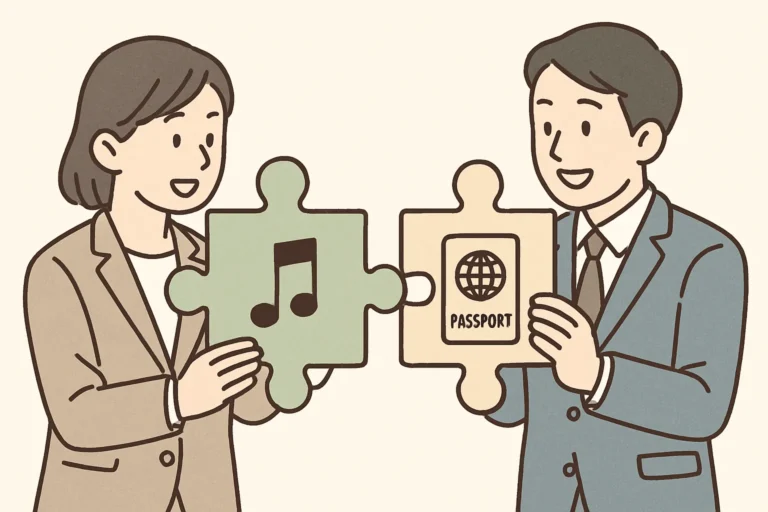
Recently, the Ministry of Culture, Sports and Tourism (문체부) has been in the spotlight. Why? Because the Korean government is actively trying to attract 30 million tourists! They are working hard to export “K-Culture” to the world.
However, creating a good environment isn’t a one-man job.
* Ministry of Justice (법무부): Handles visas (like the new “Digital Nomad Visa”).
* Ministry of Foreign Affairs (외교부): Handles diplomatic relations.
In Korean news, you will often hear phrases like: “Relevant ministries decided to cooperate (협력하다) to establish policies (정책을 수립하다) for global safety.”
Understanding these connections helps you understand the “System” of Korean society!
Wrap-up & Quiz 📝
Today, we learned how to talk about the Executive Branch and its functions. These expressions are perfect for discussing news, society, and workplace structures.
Let’s practice! Fill in the blanks.
- This project is __________ by the Marketing Team.
(이 프로젝트는 마케팅 팀에서 [ d _ _ d _ _ g ] 해요.) -
The two countries decided to __________ for peace.
(두 나라는 평화를 위해 [ h _ _ m n _ _ k ] 하기로 했어요.)
Did you get the answers? (Answers: 1. 담당, 2. 협력)
Please leave a comment below using “담당하다” (to be in charge of)!
* Example: 저는 집에서 요리를 담당해요. (I am in charge of cooking at home.)
See you in the next lesson! Annyeong! 👋
Frequently Asked Questions (FAQ)
Q: What does "문체부" mean in Korean and how do you pronounce it?
A: In Korean, "문체부" is pronounced [Mun-che-bu] and means: in the news. This ministry is very popular these days because they support the K-Wave (Hallyu).







