

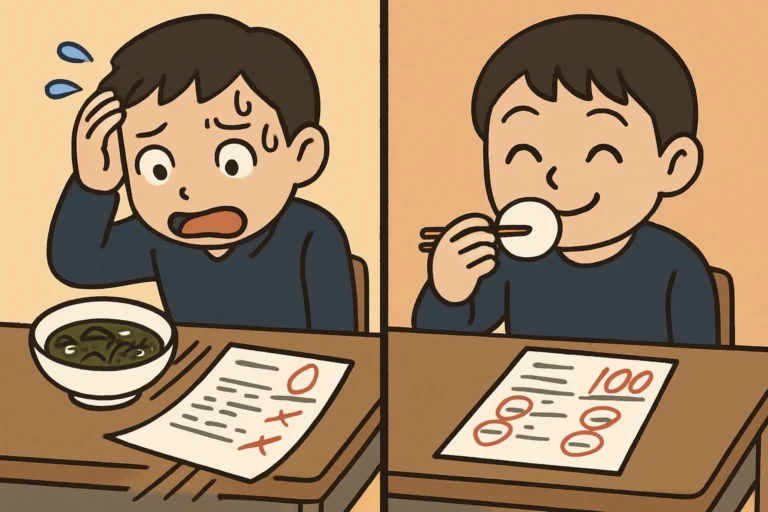
Korean Superstition: Don’t Eat This Soup Before a Test!
Hello! Welcome to Everyday Korean, the place to upgrade your Korean skills!
Have you ever wondered if certain foods can bring you good or bad luck? In Korea, there’s one dish you should absolutely avoid before a big exam or interview. Today, we’re diving into a fun and fascinating Korean superstition that you’ll often see in K-dramas and movies.
Lately in Korea, as students gear up for important exams like the national college entrance exam (수능), you’ll see a lot of talk about “lucky” and “unlucky” foods. Let’s learn why you should never, ever eat seaweed soup before a test, and what you should eat instead!
Core Expressions You Need to Know
Here are three key phrases to help you understand and talk about this unique custom.
1. 미역국을 먹다 (Miyeokguk-eul meokda)
- Pronunciation [Romanization]: Mi-yeok-guk-eul meok-da
- English Meaning: To eat seaweed soup.
- Detailed Explanation: This phrase has two very different meanings! Normally, Koreans eat seaweed soup on their birthdays to honor their mothers. However, it also has a slang meaning: “to fail a test” or “to be fired from a job.” Why? Because seaweed (미역) is slippery (미끄럽다)! The idea is that if you eat it, you might “slip” and fail. So, if a friend says “나 미역국 먹었어” (Na miyeokguk meogeosseo) after a job interview, they’re not talking about their lunch!
- 💡 Pronunciation Tip: The final consonant in
국(guk) isㄱ(k). When it’s followed by the particle을(eul), which starts with a vowel, the sound links. So, instead ofguk / eul, you pronounce it smoothly as [gu-geul]. Try saying미역구글 먹다(mi-yeok-gu-geul meok-da). It sounds much more natural!
2. 시험에 떨어지다 (Siheom-e tteoreojida)
- Pronunciation [Romanization]: Si-heom-e tteo-reo-ji-da
- English Meaning: To fail an exam.
- Detailed Explanation: This is the most common way to say you failed a test. The verb
떨어지다literally means “to fall” or “to drop.” So, you are “falling from the exam.” This directly connects to the slippery seaweed superstition—you don’t want to fall! - 💡 Pronunciation Tip: The word
시험에(siheom-e) is pronounced by linking the finalㅁ(m) sound of시험to the에(e). So, it sounds like [시허메/si-heo-me]. Practice saying it smoothly:[siheome tteoreojida].
3. 찰싹 붙다 (Chalssak butda)
- Pronunciation [Romanization]: Chal-ssak but-da
- English Meaning: To pass an exam (literally: to stick to it).
- Detailed Explanation: This is the opposite of failing!
붙다means “to stick,” and찰싹is an onomatopoeia that describes the sound of something sticking firmly. When you pass an exam, you “stick” to the school or company you applied for. This is why Koreans eat sticky foods like Korean taffy (엿) or sticky rice cakes (찹쌀떡) for good luck before a test! - 💡 Pronunciation Tip: The final consonant in
붙isㅌ(t), but when it’s followed by a consonant like in붙다(but-da), it’s pronounced like aㄷ(d). And because of a rule called ‘tensing’, thisㄷmakes the nextㄷsound stronger. The result is that붙다is pronounced like [붇따/but-tta]. It’s a strong, confident sound, perfect for passing an exam!
Example Dialogue
Let’s see how these expressions are used in a real conversation between two friends.
A: 나 내일 드디어 토픽(TOPIK) 시험 봐. 너무 떨려.
(Na nae-il deudi-eo TOPIK siheom bwa. Neomu tteollyeo.)
I’m finally taking the TOPIK exam tomorrow. I’m so nervous.
B: 진짜? 저녁 뭐 먹었어? 설마 미역국을 먹은 건 아니지?
(Jinjja? Jeonyeok mwo meogeosseo? Seolma miyeokgug-eul meogeun geon aniji?)
Really? What did you have for dinner? Don’t tell me you ate seaweed soup?
A: 당연하지! 시험에 떨어지기 싫어. 대신 찹쌀떡 먹었어.
(Dangyeonhaji! Siheom-e tteoreojigi silh-eo. Daesin chapssaltteok meogeosseo.)
Of course not! I don’t want to fail the exam. I ate sticky rice cakes instead.
B: 잘했네! 시험에 찰싹 붙을 거야. 파이팅!
(Jalhaessne! Siheom-e chalssak but-eul geo-ya. Paiting!)
Good choice! You’re going to ace that exam (stick to it). Good luck!
Culture Tip & Trend Deep Dive
This superstition is a huge part of Korean exam culture. The biggest exam of all is the 수능 (Suneung), the national college entrance exam. On this day, the entire country seems to hold its breath. You’ll see news reports of junior students cheering for their seniors outside of test centers, and parents praying at temples.
- K-Drama Connection: You’ve probably seen this in a drama! A character’s rival might jokingly offer them seaweed soup before a big presentation, or a loving mom will pack her child a lunch full of sticky rice cakes and yeot (엿).
- Modern Good-Luck Charms: Today, it’s not just about food. Friends will gift each other forks (because you can 찍다 [jjikda], which means both “to poke with a fork” and “to guess the answer”) or even toilet paper (because it unrolls smoothly, symbolizing solving problems easily). If you give a Korean friend a gift of sticky rice cakes before their exam, they will know you’ve really done your homework on Korean culture!
Let’s Review and Practice!
Great job today! You learned that in Korea, 미역국을 먹다 can mean to fail, so you should eat sticky foods to 찰싹 붙다 and avoid 시험에 떨어지다.
Now, let’s test your knowledge!
- Fill in the blank:
Before my interview, my friend gave me some 찹쌀떡 (sticky rice cakes) so I would ________ to the company.
(Hint: The “sticking” phrase!) -
O / X Quiz:
A Korean student would be very happy if their mom made them seaweed soup for breakfast on the day of their big exam. (O or X?)
Leave your answers in the comments below! And tell us, what good luck traditions do you have in your country? I’d love to hear them
Frequently Asked Questions (FAQ)
Q: What does "수능" mean in Korean and how do you pronounce it?
A: In Korean, "수능" is pronounced [Suneung] and means: , the national college entrance exam. On this day, the entire country seems to hold its breath. You'll see news reports of junior students cheering for their seniors outside of test centers, and parents praying at temples.
Q: What does "찍다" mean in Korean and how do you pronounce it?
A: In Korean, "찍다" is pronounced [jjikda] and means: , which means both "to poke with a fork" and "to guess the answer") or even toilet paper (because it unrolls smoothly, symbolizing solving problems easily). If you give a Korean friend a gift of sticky rice cakes before their exam, they will know you've really done your homework on Korean culture!







