

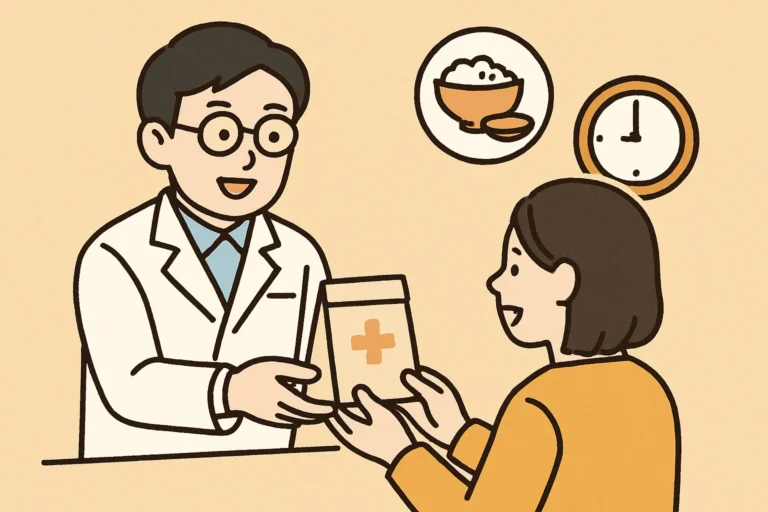
K-Pharmacy 101: Understanding Medicine Instructions!
Intro
Hello! This is [Maeil Hangul], here to upgrade your Korean skills! 👋
Have you ever gotten sick while traveling or living in Korea? Going to a pharmacy (약국, Yakguk) can be scary if you don’t understand the instructions. But don’t worry! Today, we will learn how to understand essential advice when taking medicine.
Trend Alert! 🚨 Nowadays in Korea, the “Nutritional Supplement” (영양제, Yeongyangje) craze is huge among the Z generation! Everyone is taking care of their health. Also, in popular K-Dramas like “Hospital Playlist,” you often see characters caring for each other by reminding them when to take their meds.
Let’s learn the expressions you need to stay healthy and understand your pharmacist perfectly! 💊
Key Expressions
Here are 3 essential phrases you will hear at a Korean pharmacy.
1. 식후 30분에 드세요.
- Pronunciation: [Siku samsippune deuseyo]
- English Meaning: Please take it 30 minutes after a meal.
- Details: This is the most common instruction in Korea. ‘식후’ (Sikhu) means “after a meal.” The pharmacist uses ‘드세요’ (deuseyo), which is the honorific (polite) version of “to eat/take.”
- 💡 Pronunciation Tip:
- Look at ‘식후’ (Sikhu). When the letter ‘ㄱ’ (k) meets ‘ㅎ’ (h), they combine to make a strong ‘ㅋ’ (k) sound.
- So, it is not pronounced [sik-hu], but [siku]. This represents the “Aspiration” rule. It makes the sound airier and easier to say!
2. 하루에 세 번 드세요.
- Pronunciation: [Harue se beon deuseyo]
- English Meaning: Please take it three times a day.
- Details:
- 하루 (Haru): One day
- 세 번 (Se beon): Three times
- You can change the number depending on the prescription (e.g., 두 번 Du beon = twice).
- 💡 Pronunciation Tip:
- In Korean, when a syllable ends with a consonant and the next starts with a vowel (like ‘ㅇ’), the sound carries over.
- However, here let’s focus on flow. Try to say “Haru-e” smoothly.
- Also, ‘번’ (Beon) is a counter for frequency. Make sure to use Native Korean numbers (Hana, Dul, Set…) with it! So it is “Se-beon”, not “Sam-beon”.
3. 졸릴 수 있어요.
- Pronunciation: [Jollil su isseoyo]
- English Meaning: You might get sleepy.
- Details: This is a warning about side effects. ‘~ㄹ 수 있어요’ means “it is possible that…” or “might.” It is very useful when listening to precautions!
- 💡 Pronunciation Tip:
- Look at ‘졸릴’ (Jollil). It comes from ‘졸리다’ (to be sleepy).
- Notice the double ‘ㄹ’ sound? When you see ‘ㄹ’ at the bottom (batchim) followed by another ‘ㄹ’, you hold the ‘L’ sound longer, like the ‘ll’ in the English word “Willy”.
- It sounds much softer and natural than saying [Jol-il].
Real-Life Conversation
Let’s see how these are used! Imagine you are buying cold medicine.
(At a Pharmacy)
- Pharmacist (A): 감기약입니다. 하루에 세 번, 식후 30분에 드세요.
(Here is your cold medicine. Please take it three times a day, 30 minutes after a meal.) - Customer (B): 네, 알겠습니다. 혹시 부작용이 있나요?
(Okay, I understand. Are there any side effects?) - Pharmacist (A): 약을 먹으면 조금 졸릴 수 있어요. 운전은 하지 마세요.
(You might get a little sleepy after taking the medicine. Please do not drive.) - Customer (B): 네, 감사합니다!
(Okay, thank you!)
Culture Tip & Trend Analysis 🇰🇷
💊 The “Sikhu 30-bun” (식후 30분) Rule
Why do Koreans always say “30 minutes after a meal”?
In Korea, this phrase is almost like a national rule! It’s designed to make sure you don’t forget to take your medicine (since you eat regularly) and to protect your stomach.
Trend Insight:
Recently, young Korean pharmacists on YouTube and Instagram are explaining that for many modern medicines, you don’t strictly need to wait 30 minutes—taking it right after eating is often fine! However, the phrase “식후 30분” is so deeply stick in Korean culture that it’s still the standard greeting you’ll hear at every pharmacy counter.
Also, if you receive a small bottle of drink (like Vita500) from a pharmacist, don’t be surprised! It’s a small act of “Jeong” (affection/service) often given to tired customers.
Wrap-up & Quiz
Today we learned how to understand instructions at a Korean pharmacy. Now you don’t have to be nervous when buying medicine!
📝 Mini Quiz
Fill in the blank to complete the sentence!
“Please take it after a meal.”
= _______ 드세요. (Hint: After meal)
- 식전 (Sikjeon)
- 식후 (Sikhu)
Answer: (Check the comment section for the answer!)
If you found this helpful, please leave a comment below! Stay healthy and see you next time! 💪✨
Frequently Asked Questions (FAQ)
Q: What does "'식후'" mean in Korean and how do you pronounce it?
A: In Korean, "'식후'" is pronounced [Sikhu] and means: means "after a meal." The pharmacist uses
Q: What does "'드세요'" mean in Korean and how do you pronounce it?
A: In Korean, "'드세요'" is pronounced [deuseyo] and means: , which is the honorific (polite) version of "to eat/take."
Q: What does "'식후'" mean in Korean and how do you pronounce it?
A: In Korean, "'식후'" is pronounced [Sikhu] and means: . When the letter
Q: What does "하루" mean in Korean and how do you pronounce it?
A: In Korean, "하루" is pronounced [Haru] and means: One day







