

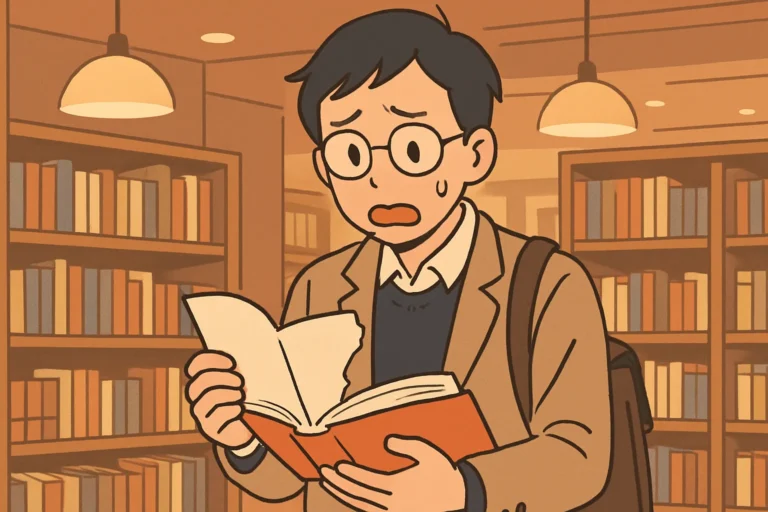
Oops! I Ripped a Book: Korean Library Tips
Introduction
Hello! This is [Daily Korean], here to upgrade your Korean skills! 👋
Are you enjoying the “Text Hip” (텍스트 힙) trend lately? In Korea right now, reading books—and posting cool photos of them on Instagram—is incredibly popular among Gen Z. It’s become “hip” to read! 📚✨
Because of this, many people are visiting libraries to borrow the latest novels. But… oh no! 😱 What happens if you accidentally rip a page while reading excitedly? Don’t panic and hide it!
Today, we will learn how to report a damaged book at the library politely and responsibly. Let’s learn how to handle this tricky situation like a pro!
Key Expressions
Here are 3 essential expressions to help you apologize and solve the problem.
1. 책이 찢어졌어요.
- Pronunciation: [Chaeg-i jjijeojyeosseoyo!]
- English Meaning: The book is torn / I ripped the book.
- Details: This is the most direct way to explain the situation. You use the passive form “찢어지다” (to get torn) to describe the state of the book.
- 💡 Pronunciation Tip (Liason):
- When the final consonant ‘ㄱ(k)’ in ‘책’ meets the vowel ‘이(i)’, the sound carries over.
- Also, in ‘찢어’, the ‘ㅈ(j)’ moves to the next block.
- So, don’t say ‘Chaek… i… jjij… eo…’, say it smoothly like [Chaegi jjijeo…]!
2. 실수로 그랬어요.
- Pronunciation: [Silsuro geuraesseoyo.]
- English Meaning: I did it by mistake / It was an accident.
- Details: It is important to emphasize that you didn’t do it on purpose. ‘실수’ means ‘mistake’. Adding this phrase makes you sound sincere and polite.
- 💡 Pronunciation Tip:
- ‘실수’ is pronounced [silssu]. The ‘s’ sound becomes stronger (tensed) after the ‘l’ sound.
3. 변상해야 하나요?
- Pronunciation: [Byeonsanghaeya hanayo?]
- English Meaning: Do I have to compensate (pay) for it?
- Details: ‘변상하다’ is a slightly formal word meaning ‘to compensate’ or ‘reimburse’ for damage. Asking this shows you are responsible, and often, librarians will appreciate your honesty and might say no!
- 💡 Pronunciation Tip (Relaxation):
- The ‘h’ sound in ‘해’ is weak. You can pronounce it softly.
Example Dialogue
Let’s see how these expressions work in real life. Min-su is returning a popular book to the Librarian.
(At the library desk)
- Librarian: 어서 오세요. 반납하시겠어요?
- (Welcome. Would you like to return this?)
- Min-su: 네, 그런데 죄송해요. 책이 조금 찢어졌어요.
- (Yes, but I’m sorry. The book is torn a little.)
- Librarian: 아, 어디 좀 볼까요? (살펴보며) 아, 이 정도는 괜찮아요.
- (Oh, let me see. [Checks book] Ah, this amount is okay.)
- Min-su: 정말요? 실수로 그랬어요. 혹시 변상해야 하나요?
- (Really? I did it by mistake. Do I have to pay for it?)
- Librarian: 아니요. 저희가 수리할 수 있어요. 솔직하게 말해 주셔서 감사합니다!
- (No. We can repair this. Thank you for telling us honestly!)
Culture Tip & Trend Analysis 🧐
1. The “Text Hip” (텍스트 힙) Phenomenon
As mentioned, “Text Hip” is a huge trend. Young Koreans feel that reading physical books (and showing off their taste in literature) is very stylish. If you visit a library in Seoul, like the Starfield Library, you will see many people taking photos with books!
2. Don’t Tape It Yourself! (셀프 수리 금지)
If you tear a book, never use regular Scotch tape to fix it at home! 🚫 Regular tape turns yellow and ruins the paper over time. Korean libraries use special archival tape. The most “Korean” and polite thing to do is to just bring it in and say, “책이 찢어졌어요.” The librarians prefer to fix it themselves!
Wrap-up & Practice
Today we learned how to be a responsible library user in Korea. Remember, honesty is the best policy!
📝 Mini Quiz:
Fill in the blank to complete the sentence:
“I’m sorry. I tore the book.”
👉 “죄송합니다. _______ 찢어졌어요.”
(Hint: Look at Expression #1!)
Did you get the answer? Try using these expressions next time you visit a library or borrow a book from a Korean friend.
Leave a comment below with the answer to the quiz! See you in the next lesson! 👋







