

Let’s Plan a Family Trip! Must-Know Korean Phrases ✈️
Introduction
Hello! This is [Daily Hangeul], here to upgrade your Korean skills today! 👋
Are you planning a trip with your family? Today, we will learn how to talk about things to do at a travel destination. This is a super useful topic when you are deciding on an itinerary with your loved ones.
Trend Alert! 📢
These days in Korea, “Hanok Stays” (staying in traditional Korean houses) are a huge trend for family trips! Instead of busy hotels, families prefer the quiet, healing atmosphere of a Hanok. Whether you are going to a modern hotel or a traditional Hanok, the expressions we learn today will help you plan the perfect schedule!
Key Expressions
Here are 3 essential expressions to suggest activities and say what you want to do!
1. ~을/를 할까요? (Shall we do…?)
- Pronunciation: [~eul/reul halkkayo?]
- English Meaning: Shall we do ~?
- Explanation: This is a polite way to suggest an activity or ask for someone’s opinion. You use it when planning with your family.
- 💡 Pronunciation Tip:
- Look at 할까요. The ‘ㄹ(l)’ sound in the bottom of ‘할’ makes the following ‘ㄱ(k)’ sound harder. So, ‘까요’ sounds like [kkayo] (tense sound), not [kayo].
- Example: 갈까요? (Shall we go?) -> [galkkayo]
2. ~고 싶어요 (I want to…)
- Pronunciation: [~go sipeoyo]
- English Meaning: I want to ~
- Explanation: This is the most common way to express your desire. You add this grammar pattern after a verb stem.
- 💡 Pronunciation Tip:
- When you say 싶어요, the bottom consonant ‘ㅍ(p)’ moves over to the empty circle ‘ㅇ’ in the next block. This is called “Liaison.”
- So, it sounds like [si-peo-yo], not [sip-eo-yo]. It flows much smoother!
3. 같이 사진 찍어요 (Let’s take a photo together)
- Pronunciation: [Gachi sajin jjigeoyo]
- English Meaning: Let’s take a photo together.
- Explanation: “같이” means “together” and “사진 찍어요” means “take a photo.” This is a must-know phrase for capturing memories!
- 💡 Pronunciation Tip:
- Important Rule! ‘같이’ is written as ‘gat-i’, but it is pronounced [gachi].
- Why? This is called ‘Palatalization’ (구개음화). When the bottom consonant ‘ㅌ(t)’ meets the vowel ‘ㅣ(i)’, the sound changes to ‘ㅊ(ch)’.
- So, don’t say “Ga-ti”. Say [Ga-chi] softly. It sounds much more natural!
Example Dialogue
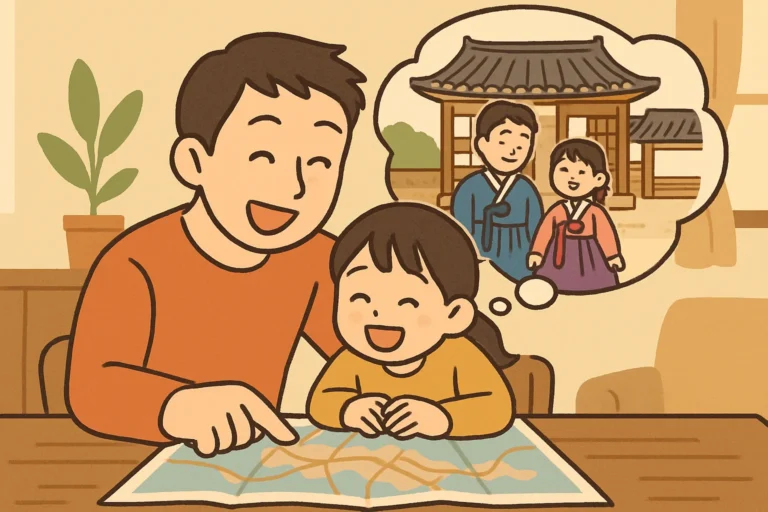
Let’s see how Minji and her Dad use these expressions while planning their trip to Jeonju (a famous city for Hanok villages).
(At home, looking at a travel brochure)
- Dad: 우리 전주에서 뭐 할까요? (What shall we do in Jeonju?)
- Minji: 저는 한복을 입고 싶어요. (I want to wear Hanbok.)
- Dad: 좋아요! 그럼 한옥 마을에 갈까요? (Good! Then shall we go to the Hanok Village?)
- Minji: 네! 거기서 같이 사진 찍어요! (Yes! Let’s take photos together there!)
Culture Tip & Trend Deep Dive 🇰🇷
📸 The “Insaeng Shot” (Life Shot) Culture
In the dialogue, Minji wanted to wear Hanbok (traditional Korean clothes).
Recently, among the Korean Z generation and families, taking an “Insaeng Shot” (인생샷) is the most important part of a trip!
* Insaeng Shot means the “best photo of your life.”
When families visit places like Gyeongbokgung Palace in Seoul or the Hanok Village in Jeonju, renting Hanbok is very popular.
* Did you know? If you wear Hanbok, admission to many Korean palaces is free!
* Use the phrase “같이 사진 찍어요” to get that perfect family “Insaeng Shot”!
Wrap-up & Practice
Today we learned how to suggest activities using “~할까요?” and express what we want using “~고 싶어요.” Now you are ready to plan a fun family trip in Korean!
📝 Mini Quiz
Complete the sentence using the words in the brackets.
Q: I want to eat Bulgogi.
A: 저는 불고기를 ( 먹다 + 고 싶어요 ) -> ______________.
Please leave your answer in the comments! I’m excited to see your sentences.
See you in the next lesson! Annyeong! 👋







