

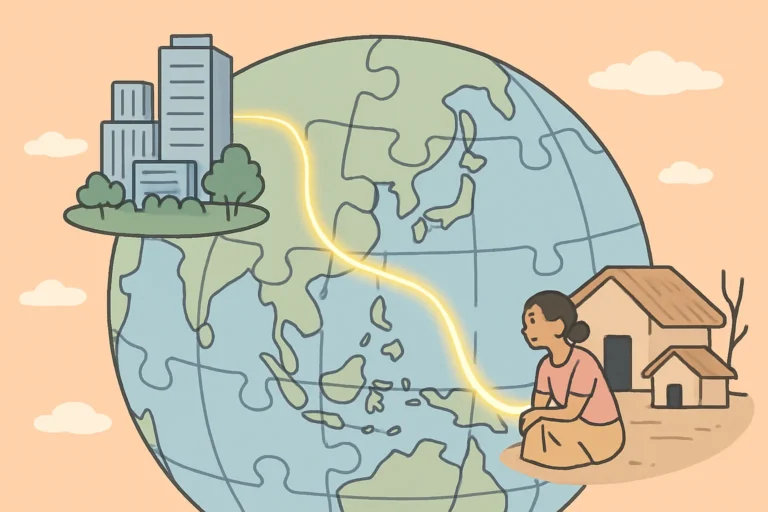
Global Health: Is Aid Charity or Duty?
1. Introduction
Hello! This is [Daily Hangul], here to upgrade your Korean skills to the next level!
Today, we are stepping away from casual daily conversation and diving into a topic suitable for C2 Advanced Learners: Global Health and Pandemic Preparedness. specifically focusing on the moral responsibility of developed nations to support developing countries.
In the wake of the recent global health crisis, terms like “Vaccine Apartheid” and “Global Health Security” have become hot topics in Korean news and academic debates. Nowadays in Korea, there is a heated discussion about whether aid to developing nations is merely charity or a necessary strategy for everyone’s survival.
If you want to participate in high-level discussions about international relations or write an essay on social issues in Korean, this lesson is for you. Let’s dive in!
2. Key Expressions (Advanced)
Here are 4 high-level expressions to help you sound like a professional debater or news anchor.
1. 도의적 책임 (Moral responsibility)
- Pronunciation: [Do-ui-jeok chae-gim] or [Do-i-jeok chae-gim]
- Meaning: Moral responsibility
- Detail: This refers to a responsibility based on ethics and conscience rather than legal obligation. It is frequently used when arguing that wealthy nations should help others even if no law forces them to.
- 💡 Pronunciation Tip:
- The vowel ‘의(ui)’ can be tricky. In the first syllable of a word, it is pronounced [ui]. However, when it acts as a possessive particle or, as in this case, part of a Sino-Korean word (meaning ‘righteousness’), it is often pronounced as [이(i)] in spoken Korean for ease. So, [도이적 책임] is perfectly natural and acceptable!
2. 보건 안보 (Health security)
- Pronunciation: [Bo-geon an-bo]
- Meaning: Health security
- Detail: This concept treats public health not just as a medical issue, but as a national security issue. It implies that infectious diseases can threaten a nation’s stability just like a war.
- 💡 Pronunciation Tip:
- This is pronounced clearly as written. Focus on the ‘ㄴ(n)’ batchim (final consonant) in ‘건(geon)’ and ‘안(an)’. Make sure your tongue touches the roof of your mouth behind your teeth to make a distinct [n] sound, ensuring it doesn’t slide into an ‘m’ or ‘ng’ sound.
3. 상호 의존성 (Interdependence)
- Pronunciation: [Sang-ho ui-jon-sseong]
- Meaning: Interdependence
- Detail: A crucial term in international relations. It explains that in a globalized world, no country stands alone. A virus in one country affects another; therefore, we depend on each other.
- 💡 Pronunciation Tip:
- Tensification (경음화): Look at ‘성(seong)’. Because it follows the ‘ㄴ(n)’ sound in ‘존(jon)’, it is often pronounced with more tension as [썽(sseong)]. While not a strict rule for all n-s combinations, in this compound word, stressing the final syllable adds emphasis to the “nature/quality” of the word.
4. 선제적 대응 (Preemptive response)
- Pronunciation: [Seon-je-jeok dae-eung]
- Meaning: Preemptive response / Proactive measure
- Detail: Instead of reacting after a problem occurs (reactive), this means taking action before the problem spreads. This is a keyword in evaluating government policies.
- 💡 Pronunciation Tip:
- Liaison (연음): When saying ‘대응’, the ‘ㅇ’ has no sound value at the start of a syllable. So it flows smoothly. However, be careful not to merge them too much into one slurred sound. Keep the ‘ae’ and ‘eung’ distinct: [Dae-eung].
3. Real-life Dialogue
Let’s see how these words are used in a serious discussion between two colleagues, Min-ji and Alex, discussing a news report on a new infectious disease outbreak.
Min-ji: 이번 뉴스 봤어요? 선진국들이 백신을 독점하는 바람에 개도국의 상황이 심각하대요.
(Did you see the news? The situation in developing countries is serious because developed nations are monopolizing vaccines.)Alex: 네, 봤어요. 저는 선진국들이 더 적극적으로 나서야 한다고 생각해요. 단순한 지원을 넘어서 도의적 책임을 느껴야 하죠.
(Yes, I saw it. I think developed nations need to step up more actively. Beyond simple aid, they need to feel a moral responsibility.)Min-ji: 맞아요. 하지만 자국민 보호가 우선이라는 여론도 만만치 않아서 쉽지 않을 거예요.
(That’s right. But public opinion prioritizing the protection of their own citizens is also strong, so it won’t be easy.)Alex: 하지만 현대 사회는 상호 의존성이 높잖아요. 개도국의 보건 안보가 무너지면 결국 전 세계가 위험해져요. 바이러스에는 국경이 없으니까요.
(But modern society has high interdependence. If the health security of developing nations collapses, the whole world eventually becomes endangered. Because viruses have no borders.)Min-ji: 동의해요. 그래서 국제 사회의 선제적 대응이 그 어느 때보다 중요한 시점이네요.
(I agree. That’s why a preemptive response from the international community is more critical now than ever.)
4. Culture Tip & Trend Analysis
“Vaccine Sovereignty vs. Global Solidarity”
Recently in Korea, the concept of “보건 ODA (Health Official Development Assistance)” has become a major trend in policy discussions.
Historically, Korea was a recipient of aid, but it has transformed into a donor country. Because of this unique history, Koreans often use the logic of “paying it back” (보은, bo-eun) when discussing aid to developing countries.
However, the recent trend in debate has shifted from “charity” to “survival strategy.”
When you discuss this topic with Koreans, mentioning the phrase “No one is safe until everyone is safe” (모두가 안전해질 때까지 아무도 안전하지 않다) will make you sound extremely persuasive and culturally aware. This phrase is widely quoted in Korean media to emphasize that supporting developing nations is not just good to do, but smart to do.
5. Conclusion & Practice
Today, we tackled a heavy but necessary topic: Global Health and Moral Responsibility.
Using words like 도의적 책임 and 보건 안보 will demonstrate that your Korean proficiency has reached a professional, academic level.
📝 Quick Quiz:
Fill in the blank with the correct expression we learned today!
“In a globalized era, ignoring the crisis in other countries is dangerous because of our deep _________.”
“세계화 시대에 타국의 위기를 외면하는 것은 우리의 깊은 [ ] 때문에 위험합니다.”
- 도의적 책임
- 상호 의존성
Answer: (Check the bottom!)
Don’t be afraid to use these complex words! Try writing a short sentence about your opinion on global health in the comments below.
See you next time!
(Answer: 2. 상호 의존성)







