

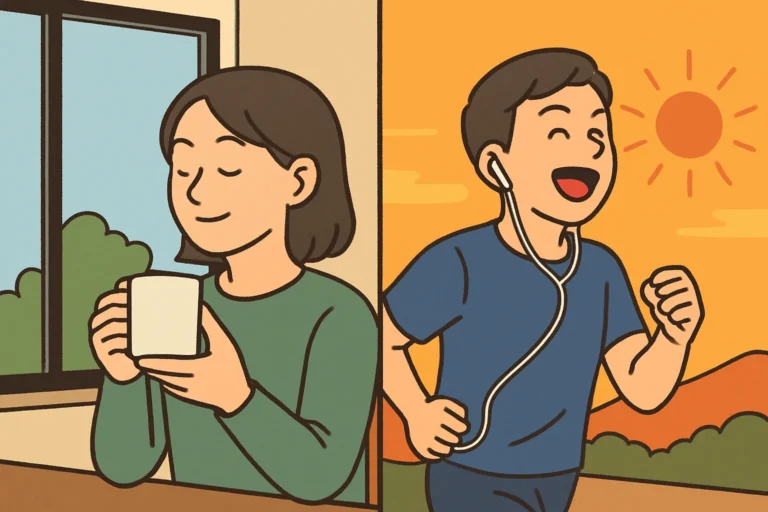
Find Your “So-hwak-haeng”! Korean Secrets to Everyday Happiness
Hello! Welcome to Maeil Hangeul, the place to upgrade your Korean skills!
Have you ever felt like you were just going through the motions, waiting for a big vacation or a major event to feel happy? Well, what if happiness could be found in the small, everyday moments? Today, we’re going to learn some wonderful Korean expressions that help you do just that!
Lately in Korea, there’s a huge trend focused on finding personal joy and satisfaction. Instead of chasing big, distant dreams, many people are embracing concepts like “소확행 (So-hwak-haeng)”—finding small but certain happiness in daily life. Let’s dive into how you can talk about this and bring more joy into your own routine!
Core Expressions You Need to Know
Here are some key phrases to help you talk about finding joy and satisfaction, just like a native speaker.
1. 소확행 (So-hwak-haeng)
- Pronunciation: [So-hwak-haeng]
- English Meaning: Small but certain happiness.
- Detailed Explanation: This is a super trendy acronym for 소소하지만 확실한 행복 (sosohajiman hwaksilhan haengbok). It refers to the small, simple pleasures that bring you definite joy, like the first sip of coffee in the morning, listening to your favorite song on the way home, or the smell of rain. It’s not a grand, life-changing event, but a small moment of pure bliss you can count on.
- 💡 Pronunciation Tip: The ‘ㅎ’ (h) in ‘확’ (hwak) and ‘행’ (haeng) is an aspirated sound. Make sure to release a puff of air, almost like a sigh, as you say it. It’s a soft ‘h’ sound that makes your pronunciation sound much more natural.
2. 갓생 (God-saeng)
- Pronunciation: [Gat-ssaeng]
- English Meaning: “God-life”; a productive and exemplary life.
- Detailed Explanation: This is a new slang term combining the English word “God” (meaning ultimate or amazing) with the Korean word 생 (saeng), which means “life.” A person living a “God-saeng” is someone who is diligent, self-disciplined, and productive. They might wake up early, exercise, study, and work on their goals consistently. For many young Koreans, living a God-saeng is a source of great satisfaction and happiness.
- 💡 Pronunciation Tip: This is a great example of a Korean sound change rule called 된소리되기 (doensori doe-gi), or “tensing.” When a consonant like ‘ㅅ’ (s) comes after a final consonant like the ‘ㄷ’ (t-sound) in ‘갓’, it tenses up and is pronounced as ‘ㅆ’ (ss). So, instead of ‘gat-saeng’, you say [갓쌩/gat-ssaeng]. It’s a strong, sharp sound!
3. 기분 전환이 되다 (Gibun jeonhwani doeda)
- Pronunciation: [Gibun jeon-hwa-ni dwe-da]
- English Meaning: To be a refreshing change of pace; to lift one’s spirits.
- Detailed Explanation: Let’s break it down: 기분 (gibun) means “feeling” or “mood,” and 전환 (jeonhwan) means “change” or “switch.” So, this phrase literally means “to become a mood switch.” You use it when an activity helps you feel refreshed and improves your mood. Taking a short walk, listening to upbeat music, or chatting with a friend can all be a good 기분 전환.
- 💡 Pronunciation Tip: Notice the word 전환이 (jeonhwani). This is an example of a linking sound rule called 연음 (yeoneum). The final consonant ‘ㄴ’ (n) from 전환 (jeonhwan) “links” to the ‘이’ (i) particle that follows it. So, you don’t pronounce them as two separate words, but smoothly as [저놔니/jeo-nwa-ni].
4. 보람을 느끼다 (Borameul neukkida)
- Pronunciation: [Bo-ra-meul neu-kki-da]
- English Meaning: To feel a sense of satisfaction or fulfillment.
- Detailed Explanation: 보람 (boram) is a wonderful word that describes the positive feeling of worthiness and reward you get after putting effort into something. It’s deeper than just having fun. You feel 보람 after finishing a difficult project, volunteering, or successfully teaching someone something new. 느끼다 (neukkida) means “to feel.”
- 💡 Pronunciation Tip: Here’s 연음 (yeon-eum) in action again! The final consonant ‘ㅁ’ (m) in 보람 (boram) moves over to the empty ‘ㅇ’ slot in the particle 을 (eul). So, instead of saying “boram eul,” you blend them together smoothly to say [보라믈/bo-ra-meul].
Example Dialogue
Let’s see how these expressions are used in a real conversation between two friends, Minjun and Sora.
A: 민준 (Minjun): 소라야, 요즘 뭐하고 지내? 얼굴이 좋아 보이네.
(Sora, what have you been up to? You look great.)
B: 소라 (Sora): 아, 나 요즘 ‘갓생’ 살고 있잖아! 아침마다 요가하고 책도 읽어.
(Ah, I’m living a ‘God-saeng‘ these days! I do yoga and read every morning.)
A: 민준 (Minjun): 와, 대단하다! 그렇게 하면 정말 보람을 느끼겠다. 나는 퇴근하고 새로 나온 드라마 보는 게 나의 소확행이야.
(Wow, that’s amazing! You must feel so fulfilled. For me, my ‘so-hwak-haeng‘ is watching the new K-drama after work.)
B: 소라 (Sora): 그것도 좋지! 하루의 피로가 풀리잖아. 완전 기분 전환이 되겠다.
(That’s great too! It must relieve all your stress from the day. It’s a perfect way to lift your spirits.)
Culture Tip & Trend Deep Dive
Why are concepts like 소확행 (So-hwak-haeng) and 갓생 (God-saeng) so popular in Korea right now, especially with the MZ generation?
In a society known for its fast-paced lifestyle and high pressure to succeed, these trends are a way for people to redefine success on their own terms.
* So-hwak-haeng is a gentle rebellion against the idea that you need to achieve something huge to be happy. It empowers people to find and appreciate joy in their immediate surroundings. On Instagram, you’ll see thousands of posts with the hashtag #소확행, showing everything from a pretty latte to a cute cat napping.
* God-saeng is about taking control of your life through small, consistent actions. It’s not about becoming the CEO of a company overnight, but about building a satisfying life through daily habits. Sharing progress on a #갓생 journey on social media helps people stay motivated and connect with others who have similar goals.
By understanding these two trends, you’re not just learning words; you’re getting a glimpse into the modern Korean mindset about happiness and a well-lived life.
Wrap-up & Practice Time!
Today, we learned four fantastic expressions to talk about finding happiness and satisfaction in daily life:
* 소확행 (So-hwak-haeng): Small but certain happiness
* 갓생 (God-saeng): A productive, “God-life”
* 기분 전환이 되다 (Gibun jeonhwani doeda): To be a refreshing change
* 보람을 느끼다 (Borameul neukkida): To feel fulfilled
Now it’s your turn to practice!
- Fill in the blank:
Finishing my Korean homework after studying hard makes me feel so fulfilled!
열심히 공부하고 한국어 숙제를 끝내면 정말 ______을/를 느껴요.
(Answer: 보람) -
Your turn!
What is your personal 소확행 (so-hwak-haeng)? What small thing brings you certain happiness?
Leave a comment below with your answer! We’d love to hear about your small joys. Happy learning
Frequently Asked Questions (FAQ)
Q: What does "생" mean in Korean and how do you pronounce it?
A: In Korean, "생" is pronounced [saeng] and means: , which means "life." A person living a "God-saeng" is someone who is diligent, self-disciplined, and productive. They might wake up early, exercise, study, and work on their goals consistently. For many young Koreans, living a
Q: What does "된소리되기" mean in Korean and how do you pronounce it?
A: In Korean, "된소리되기" is pronounced [doensori doe-gi] and means: , or "tensing." When a consonant like 'ㅅ' (s) comes after a final consonant like the 'ㄷ' (t-sound) in '갓', it tenses up and is pronounced as 'ㅆ' (ss). So, instead of 'gat-saeng', you say
Q: What does "기분" mean in Korean and how do you pronounce it?
A: In Korean, "기분" is pronounced [gibun] and means: means "feeling" or "mood," and
Q: What does "전환" mean in Korean and how do you pronounce it?
A: In Korean, "전환" is pronounced [jeonhwan] and means: means "change" or "switch." So, this phrase literally means "to become a mood switch." You use it when an activity helps you feel refreshed and improves your mood. Taking a short walk, listening to upbeat music, or chatting with a friend can all be a good







