
Ohae Ttaemune! How to Explain Misunderstandings in Korean
Hello! Welcome to [Maeil Hangeul], here to upgrade your Korean skills!
Have you ever had a small argument with a friend because of a simple misunderstanding? It happens to everyone! Today, we’re going to learn some essential Korean phrases to explain why something happened, especially when you need to clear up an “ohae” (오해), or misunderstanding.
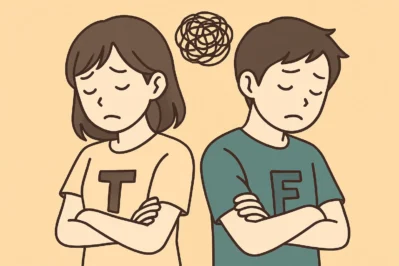
Lately in Korea, there’s a huge trend of analyzing friendships through MBTI types. People love to discuss how a “T” (Thinking) type’s directness might accidentally hurt an “F” (Feeling) type’s feelings. These little differences can easily lead to misunderstandings! Learning today’s phrases will help you navigate these moments smoothly and keep your friendships strong.
Let’s dive in!
Core Expressions You Need to Know
Here are three key expressions to help you explain yourself and make up with a friend.
1. 오해 (Ohae)
- Pronunciation [Romanization]: Ohae
- English Meaning: Misunderstanding
- Detailed Explanation: This is the core noun you need! 오해 (Ohae) is the word for “misunderstanding.” You can use it with different verbs. For example, 오해하다 (ohaehada) means “to misunderstand,” and 오해를 풀다 (ohaereul pulda) means “to clear up a misunderstanding.” It’s a neutral word used in both formal and informal situations.
- 💡 Pronunciation Tip:
The vowel ‘ㅐ’ (ae) can be tricky. It’s similar to the ‘e’ in the English word “egg.” Make sure you pronounce the ‘o’ and ‘hae’ as two distinct syllables: [O-hae]. Don’t blend them together!
2. (Noun) + 때문에 (ttyaemune)
- Pronunciation [Romanization]: ttyaemune
- English Meaning: because of (noun) / due to (noun)
- Detailed Explanation: This grammar particle is your best friend when explaining the reason for a negative outcome, like a fight. You attach it directly to a noun. For example, “오해 때문에 (ohae ttyaemune)” means “because of a misunderstanding.” It puts a strong emphasis on the noun as the direct cause. While
~서/아서also means “because,” ~때문에 (ttyaemune) is often used to explain the reason for a problem. - 💡 Pronunciation Tip:
The first sound, ‘ㄸ’ (tt), is a tense consonant. It’s not the same as ‘ㄷ’ (d/t). To make this sound, press your tongue firmly against the back of your teeth and release the sound without a puff of air. Think of the ‘t’ sound in the English word “stop,” not the airy ‘t’ in “top.” Practice saying [ttae-mu-ne] with a strong, sharp start.
3. 내 말이 그 뜻이 아니었어. (Nae mari geu tteusi anieosseo.)
- Pronunciation [Romanization]: Nae mari geu tteusi anieosseo.
- English Meaning: That’s not what I meant.
- Detailed Explanation: This is a golden phrase for clearing things up with friends. It’s informal and very natural. Let’s break it down:
- 내 말 (nae mal): My words / What I said
- 그 뜻 (geu tteut): That meaning
- 아니었어 (anieosseo): Was not (informal past tense of 아니다, to not be)
So, literally, it’s “My words were not that meaning.”
- 💡 Pronunciation Tip:
Listen for the sound linking, or 연음 (yeoneum), in 아니었어. Instead of pronouncing it asan-i-eoss-eo, the final consonant of one syllable moves to the next empty syllable. So, the ‘ㄴ’ from ‘니’ links with ‘었’, making it sound like [anieosseo]. This makes your Korean sound much smoother and more natural!
Example Dialogue
Let’s see how these expressions work in a real conversation. Imagine two friends, A (Somi) and B (Junho), talking after a small argument.
A (Somi): 준호야, 아직도 화났어? 나한테 화난 것 같아.
(Junho-ya, ajikdo hwanasseo? Nahante hwanan geot gata.)
(Junho, are you still upset? You seem mad at me.)
B (Junho): 응. 네가 내 새 헤어스타일 ‘특이하다’고 했을 때 좀 속상했어.
(Eung. Nega nae sae heeoseutail ‘teugihada’go haesseul ttae jom soksanghaesseo.)
(Yeah. I was a bit upset when you said my new hairstyle was ‘peculiar’.)
A (Somi): 아, 그거 오해야! 진짜 내 말이 그 뜻이 아니었어. 독특하고 멋있다는 뜻이었지!
(A, geugeo ohaeya! Jinjja nae mari geu tteusi anieosseo. Dokteukago meositdaneun tteusieotji!)
(Ah, that’s a misunderstanding! That’s not what I meant. I meant it was unique and cool!)
B (Junho): 정말? 나는 네가 놀리는 줄 알았어.
(Jeongmal? Naneun nega nollineun jul arasseo.)
(Really? I thought you were making fun of me.)
A (Somi): 아니야! 작은 오해 때문에 우리 사이가 어색해졌네. 미안해.
(Aniya! Jageun ohae ttaemune uri saiga eosaekaejyeonne. Mianhae.)
(No! Our friendship got awkward because of a small misunderstanding. I’m sorry.)
Culture Tip & Trend Deep Dive
As we mentioned, MBTI is a huge part of social life for young Koreans right now. People often blame disagreements on their MBTI differences! You’ll hear things like, “Of course we argued, he’s a T and I’m an F!”
When you find yourself in a misunderstanding with a Korean friend, clearing it up quickly by saying “오해야! (Ohaeya!)” shows that you value the relationship. In Korean culture, maintaining harmony (화합, hwahap) is very important. Being the first to apologize or explain, even if you think you weren’t wrong, is seen as a sign of maturity. So, don’t be afraid to use “내 말이 그 뜻이 아니었어” to fix things right away! You’ll look like a culturally savvy and caring friend.
Let’s Review and Practice!
Great job today! We learned how to explain the reason for a misunderstanding using 오해 (ohae), ~때문에 (ttyaemune), and the super useful phrase 내 말이 그 뜻이 아니었어 (Nae mari geu tteusi anieosseo).
Now it’s your turn to practice!
- Fill in the blank:
We became awkward because of a silly mistake.말도 안 되는 실수 _______ 우리는 어색해졌어.
(Maldo an doeneun silsu _______ urineun eosaekaejyeosseo.) - Your Turn!
Imagine your friend misunderstood something you said. How would you tell them, “That’s not what I meant”?
Leave your answers in the comments below! We’d love to see you try out today’s expressions. See you next time