

Found It! Korean Phrases for When You Lose (and Find!) Your Stuff
Hello! Welcome to Maeil Hangul, here to upgrade your Korean skills!
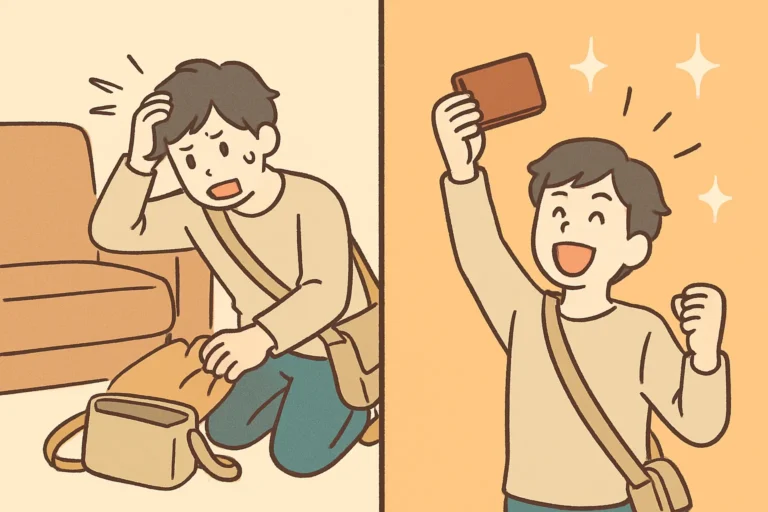
Have you ever had that mini heart attack when you can’t find your phone, wallet, or keys? That feeling of panic, followed by huge relief when you finally find it? Today, we’re going to learn how to express exactly that feeling in natural, everyday Korean!
Lately in Korea, it’s a huge trend to share stories online about losing and finding things—especially those new wireless earbuds or cute keychains attached to a bag. Knowing these phrases will not only help you in a pinch but also let you understand these relatable stories you see on social media! Let’s get started!
Core Expressions You Need to Know
Here are three key phrases to express that rollercoaster of emotions when you find a lost item.
1. 다행이다 (Dahaeng-ida)
- Pronunciation [Romanization]: Da-haeng-i-da
- English Meaning: What a relief! / Thank goodness.
- Detailed Explanation: This is the most common and essential phrase for expressing relief in any situation. You can use it when you find your lost wallet, but also when you hear good news, like narrowly avoiding being late for a flight. It’s a versatile phrase for any “phew!” moment. For a more polite version to use with elders or in formal settings, you can say 다행이에요 (Dahaeng-ieyo).
- 💡 Pronunciation Tip:
Theㅎ(h)sound in Korean can sometimes be very soft. In다행이다, make sure to pronounce it lightly, connecting it smoothly to the following vowelㅐ(ae). It’s a gentle, breathy sound: [Dahaeng-ida].
2. 찾았다! (Chajatta!)
- Pronunciation [Romanization]: Cha-jat-da!
- English Meaning: I found it! / Found it!
- Detailed Explanation: This is the exclamation you shout the moment you spot your missing item! It’s the past tense of the verb 찾다 (chatda), which means “to find” or “to look for.” You use 찾았다! as a triumphant declaration. It’s informal, perfect for using with friends or when you’re by yourself. The polite form is 찾았어요 (Chajass-eoyo).
- 💡 Pronunciation Tip:
Notice the last syllable,다(da). Even though it’s written with aㄷ(d), it’s pronounced with a strong, tense [tta] sound. This is because of theㅆ(ss)that comes before it. In Korean, when certain consonants meet, they can make the following sound stronger. This is called ‘tensification’ (경음화 – gyeong-eum-hwa). So, instead of a soft ‘cha-jat-da’, say it with a punch: [차자따! – Chajatta!].
3. 식겁했네 (Sikkeophaenne)
- Pronunciation [Romanization]: Sik-keop-haen-ne
- English Meaning: That scared me! / I nearly had a heart attack!
- Detailed Explanation: This is a very colloquial and expressive phrase that captures the panic you felt before you found your item. 식겁하다 (sikkeop-hada) means to be suddenly frightened or shocked. Using this phrase right after you find something shows just how worried you were. It’s very informal and adds a bit of drama, so use it with close friends!
- 💡 Pronunciation Tip:
Here’s another great example of tensification! The word is written식겁 (sik-geop), but theㄱ(g)at the end of식makes theㄱ(g)in겁tense. So, the actual pronunciation is [식껍 – sik-kkeop]. The full phrase sounds like [식껍했네 – Sik-kkeop-haenne]. Mastering this will make you sound much more like a native speaker!
Example Dialogue
Let’s see how these phrases work in a real conversation. Imagine two friends, A and B. A has lost their new, trendy phone case.
A: 어떡해! 새로 산 폰케이스 없어졌어!
(Eotteokae! Saero san pon-keiseu eopseojyeosseo!)
(Oh no! My new phone case is gone!)
B: 가방 안에 잘 찾아봐.
(Gabang ane jal chajabwa.)
(Check your bag carefully.)
A: (뒤적이며) 아! 찾았다! 주머니에 있었네. 와, 진짜 식겁했네.
(Dwijeogimyeo) A! Chajatta! Jumeoni-e isseonne. Wa, jinjja sikkeophaenne.
(Rummaging) Ah! I found it! It was in the pocket. Wow, that really scared me.
B: 다행이다! 예쁜 거라 잃어버렸으면 아까울 뻔했어.
Dahaeng-ida! Yeppeun geora ireo-beoryeosseumyeon akkaul ppeonhaesseo.
(What a relief! It was so pretty, it would have been a shame if you lost it.)
Culture Tip & Trend Deep Dive
In Korea, the “lost and found” culture is quite strong. People often turn in lost items to police stations or subway information centers, and there’s a good chance you’ll get your things back!
Because of this, a popular type of content on Korean social media is the “분실물 찾은 썰 (bunsinmul chajeun sseol)”—a story about finding a lost item. People will dramatically describe the moment of panic (“진짜 식겁했어요 – Jinjja sikkeopaesseoyo” – I was so scared), the frantic search, and the final, triumphant moment of discovery (“드디어 찾았다! – Deudieo chajatta!” – I finally found it!). The comments are always full of people sharing in the relief, saying “정말 다행이네요! (Jeongmal dahaeng-ineyo!)” – “That’s such a relief!”
By using these phrases, you’re not just speaking Korean; you’re sharing in a common cultural experience of panic and relief that everyone understands!
Wrap-up & Practice Time!
Great job today! We learned three fantastic phrases for when you find something you thought you lost:
- 다행이다 (Dahaeng-ida): What a relief!
- 찾았다! (Chajatta!): I found it!
- 식겁했네 (Sikkeophaenne): That scared me!
Now, let’s test your knowledge!
Quick Quiz:
You thought you left your passport at home, but you just found it in your bag right before your flight. What’s the BEST combination of phrases to say to your friend?
- 안녕하세요! 맛있어요. (Annyeonghaseyo! Masisseoyo.)
- 찾았다! 아, 다행이다. (Chajatta! A, dahaeng-ida.)
- 괜찮아요. 미안해요. (Gwaenchanayo. Mianhaeyo.)
(The answer is 2!)
Now it’s your turn! Tell us about a time you lost and found something using one of the phrases you learned today. Leave your story in the comments below! We’d love to read them. See you next time
Frequently Asked Questions (FAQ)
Q: What does "찾다" mean in Korean and how do you pronounce it?
A: In Korean, "찾다" is pronounced [chatda] and means: , which means "to find" or "to look for." You use
Q: What does "식겁하다" mean in Korean and how do you pronounce it?
A: In Korean, "식겁하다" is pronounced [sikkeop-hada] and means: means to be suddenly frightened or shocked. Using this phrase right after you find something shows just how worried you were. It’s very informal and adds a bit of drama, so use it with close friends!
Q: What does "다행이다" mean in Korean and how do you pronounce it?
A: In Korean, "다행이다" is pronounced [Dahaeng-ida] and means: What a relief!
Q: What does "찾았다!" mean in Korean and how do you pronounce it?
A: In Korean, "찾았다!" is pronounced [Chajatta!] and means: I found it!







