

The Gig Economy: Korean Insights for Global Citizens
Hello! Welcome back to [Maeil Hangeul], your key to upgrading your Korean skills!
Today, we’re diving into a topic that’s reshaping economies worldwide: the gig economy. Whether you’re discussing global labor markets, analyzing business trends, or just want to understand modern work culture, these expressions will be incredibly useful. In Korea, the rise of digital platforms has created a massive shift in the job market, from delivery riders zipping through Seoul to highly skilled freelancers collaborating on global projects. Understanding how Koreans talk about this phenomenon will not only boost your vocabulary but also give you a deeper insight into the social and economic debates happening in the country today. Let’s get started!
Core Expressions for Analyzing the Gig Economy
Here are some essential terms and grammar points you need to discuss the gig economy like a pro.
1. 긱 이코노미 (Gig Economy)
- Pronunciation [Romanization]: Gik ikonomi
- English Meaning: Gig Economy
- Detailed Explanation: This is a direct loanword from English, referring to a labor market characterized by the prevalence of short-term contracts or freelance work as opposed to permanent jobs. In Korea, this term is widely used in news, business, and academic contexts to discuss everything from app-based delivery services (
배달 앱) to professional freelance platforms (프리랜서 플랫폼). While it represents flexibility and new opportunities for some, it also raises critical questions about worker’s rights and stability. - 💡 Pronunciation Tip:
As a Konglish term, the pronunciation is very close to the English original. The key is to pronounce each syllable clearly: 긱 (gik) – 이 (i) – 코 (ko) – 노 (no) – 미 (mi). Remember that the Korean ‘ㅣ’ (i) is a pure vowel sound, similar to the “ee” in “see.”
2. N + (으)로 인해 (Due to N / As a result of N)
- Pronunciation [Romanization]: N + (eu)ro inhae
- English Meaning: Due to N / As a result of N
- Detailed Explanation: This grammar pattern is used to state the cause or reason for a situation, and it carries a formal and objective nuance. You’ll frequently see it in reports, academic papers, and news articles. While
~때문에also means “because of,”~(으)로 인해is preferred when analyzing a phenomenon without personal emotion, making it perfect for discussing economic trends.- Use 로 인해 after a noun ending in a vowel (e.g., 기술 발전로 인해 – due to technological development).
- Use 으로 인해 after a noun ending in a consonant (e.g., 정책으로 인해 – due to the policy).
- 💡 Pronunciation Tip:
When a noun ending in a consonant is followed by으로, the sounds often link together. For example,발전으로 인해(baljeon-euro inhae) is pronounced naturally as [발쩌느로 인해 baljjeoneuro inhae]. This sound-linking rule, or yeon-eum (연음), makes your speech flow much more smoothly.
3. 양날의 검 (A double-edged sword)
- Pronunciation [Romanization]: Yangnarui geom
- English Meaning: A double-edged sword
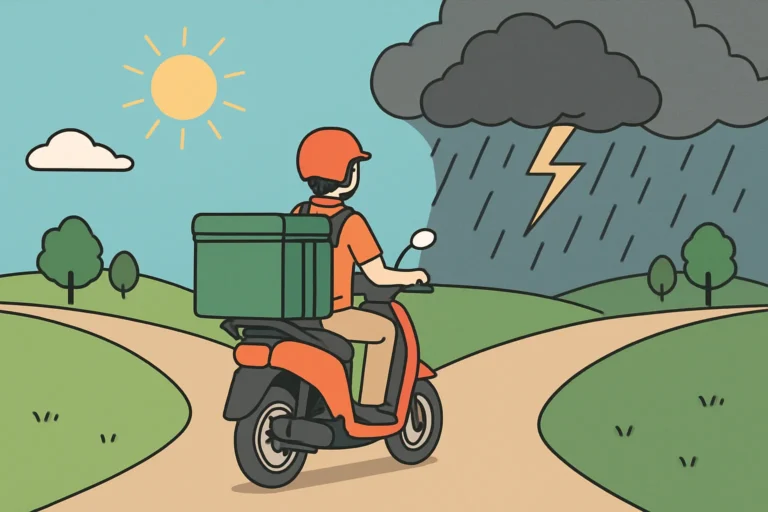
- Detailed Explanation: This is a fantastic idiom for expressing complexity. It literally means “a sword with two blades” and is used to describe something that has both significant advantages and disadvantages. The gig economy, with its promise of freedom but lack of security, is a perfect example of a
양날의 검. Using this idiom will make your Korean sound incredibly sophisticated and nuanced. - 💡 Pronunciation Tip:
The possessive particle ‘의’ (ui) can be tricky. While its official pronunciation is [ui], in everyday speech, it’s often pronounced as [에/e] when used after a noun. So, while you might read양날의 검(yangnal-ui geom), you’ll often hear it pronounced as [양나레 검/yangnare geom].
4. 고용 안정성 (Employment stability / Job security)
- Pronunciation [Romanization]: Goyong anjeongseong
- English Meaning: Employment stability / Job security
- Detailed Explanation: This is a cornerstone concept in Korean work culture.
고용(goyong) means “employment,”안정(anjeong) means “stability,” and~성(~seong) is a suffix that turns a noun into an abstract concept, like “-ity” or “-ness” in English. For decades,고용 안정성was the most prized aspect of a “good job” in Korea. The gig economy directly challenges this value by prioritizing flexibility (유연성/yuyeonseong) over stability, which is a major point of social debate. - 💡 Pronunciation Tip:
Pay attention to the final consonants (받침). In고용(goyong), theㅇis an [ng] sound. In안정성(anjeongseong), the finalㅇin each syllable block is also an [ng] sound. Practice distinguishing the silentㅇat the beginning of a syllable (like in안/an) from thengsound of theㅇat the end (정/jeong).
Example Dialogue
Let’s see how these expressions are used in a real conversation between two colleagues analyzing a news report.
A: 최신 기사 봤어요? 전 세계적으로 긱 이코노미가 확산되고 있다고 하네요.
(Choesin gisa bwasseoyo? Jeon segyeojeogeuro gik ikonomiga hwaksandoego itdago haneyo.)
Have you seen the latest article? It says the gig economy is expanding globally.
B: 네, 저도 봤어요. 디지털 플랫폼의 발전으로 인해 노동 시장의 구조가 완전히 바뀌고 있는 것 같아요.
(Ne, jeodo bwasseoyo. Dijiteol peullaetpomui baljjeon-euro inhae nodong sijangui gujoga wanjeonhi bakkwigo inneun geot gatayo.)
Yes, I saw it too. It seems the structure of the labor market is completely changing due to the development of digital platforms.
A: 맞아요. 자유롭게 일할 수 있다는 장점도 있지만, 고용 안정성이 부족하다는 게 가장 큰 문제죠.
(Majayo. Jayuropge ilhal su itdaneun jangjeomdo itjiman, goyong anjeongseongi bujokadaneun ge gajang keun munjyeojyo.)
That’s right. While the freedom to work is an advantage, the lack of job security is the biggest problem.
B: 정말 양날의 검인 셈이네요. 앞으로 정부와 기업이 어떻게 대응할지 지켜봐야겠어요.
(Jeongmal yangnarui geomin semineyo. Apeuro jeongbuwa gieobi eotteoke daeeunghalji jikyeobwayagesseoyo.)
It really is a double-edged sword. We’ll have to see how the government and companies respond in the future.
Culture Tip & Trend Deep Dive: The Korean Gig Economy
In Korea, the discussion around the 긱 이코노미 is impossible to separate from platforms like 배달의민족 (Baemin) and 쿠팡이츠 (Coupang Eats). The sight of their delivery riders (라이더/raideo) is a symbol of this new economy.
However, the debate goes far deeper. The term 플랫폼 노동자 (platform nodongja – platform worker) has been coined to describe these workers. A major social issue is whether they should be classified as independent contractors (개인 사업자/gaein saeopja) or employees (근로자/geulloja) entitled to benefits like insurance and severance pay. This conflict between the platform giants and workers’ unions is a constant topic in Korean news.
When you use a phrase like “긱 이코노미는 고용 안정성 측면에서 양날의 검이다” (The gig economy is a double-edged sword in terms of job security), you’re not just using advanced vocabulary; you’re tapping into a core, ongoing debate about the future of work in Korean society.
Wrap-up & Practice!
Today, we learned four key expressions to help you analyze and discuss the global gig economy in Korean. By mastering 긱 이코노미, (으)로 인해, 양날의 검, and 고용 안정성, you can now articulate complex opinions on this important topic.
Now, it’s your turn to practice!
- Fill in the blank:
팬데믹___________ 재택근무와 프리랜서 시장이 크게 성장했다.
(Pandemic-___________ the remote work and freelance markets grew significantly.) -
Your Opinion (Short Answer):
여러분 나라의 긱 이코노미는 어떤가요? 긱 이코노미는 ‘양날의 검’이라고 생각하세요? 한국어로 짧게 의견을 써 보세요.
(What is the gig economy like in your country? Do you think it’s a ‘double-edged sword’? Write your opinion briefly in Korean.)
Leave your answers in the comments below using the expressions you learned today! We’d love to hear your thoughts.
Frequently Asked Questions (FAQ)
Q: What does "쿠팡이츠" mean in Korean and how do you pronounce it?
A: In Korean, "쿠팡이츠" is pronounced [Coupang Eats] and means: . The sight of their delivery riders (
Q: What does "플랫폼 노동자" mean in Korean and how do you pronounce it?
A: In Korean, "플랫폼 노동자" is pronounced [platform nodongja - platform worker] and means: has been coined to describe these workers. A major social issue is whether they should be classified as independent contractors (







