

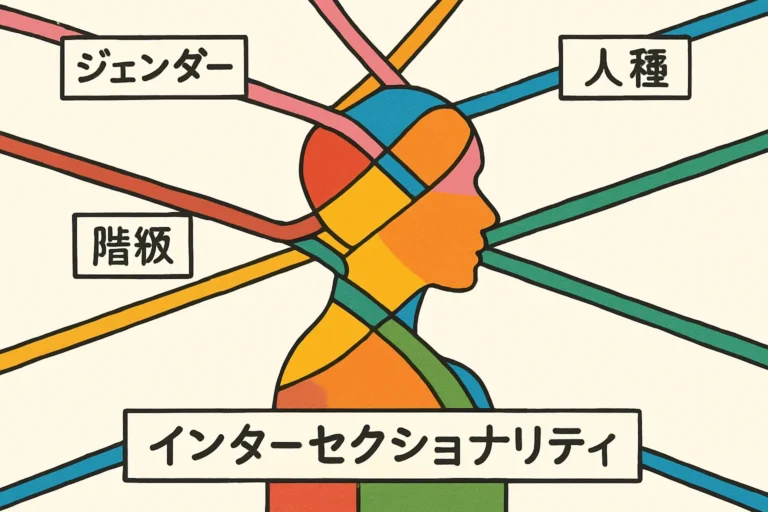
Beyond the Surface: Decoding Korean Society with 교차성
Hello! Welcome back to [Maeil Han-geul], your go-to for upgrading your Korean skills!
Today, we’re moving beyond everyday conversation and diving into a powerful concept essential for understanding the complex dynamics of modern society: intersectionality, or 교차성 (gyochaseong) in Korean. Have you ever read a Korean news article or academic paper about social issues and felt like you were missing some of the deeper context? This lesson is for you. Recently in Korea, public discourse on social justice has become much more nuanced. Understanding ‘교차성’ is your key to not just following these conversations, but actively participating in them. Let’s get started!
Core Expressions for In-Depth Analysis
Here are some key terms that will elevate your ability to discuss social issues like a native intellectual.
1. 교차성 (Gyochaseong)
- Pronunciation [Gyochaseong]
- English Meaning: Intersectionality
- Detailed Explanation: This is a direct translation of “intersectionality.” It’s an analytical framework for understanding how various social and political identities (like gender, race, class, sexual orientation, disability, etc.) combine to create unique modes of discrimination and privilege. Instead of viewing inequality through a single lens (e.g., only gender or only class), ‘교차성’ examines how these identities “intersect” and overlap. It’s a crucial term in modern sociology, gender studies, and critical theory in Korea.
- 💡 Pronunciation Tip: The word is composed of Hanja characters: 교차 (交叉), meaning ‘to cross’ or ‘intersect,’ and 성 (性), meaning ‘nature’ or ‘characteristic.’ Thinking of the Hanja can help you remember the meaning! The pronunciation is straightforward, with each syllable pronounced clearly.
2. 다차원적 불평등 (Dachawonjeok bulpyeongdeung)
- Pronunciation [Dachawonjeok bulpyeongdeung]
- English Meaning: Multidimensional inequality
- Detailed Explanation: This phrase is the perfect partner to ‘교차성’. It refers to the complex and layered nature of social inequality. Rather than a simple rich-vs-poor or man-vs-woman binary, it acknowledges that inequality operates on multiple dimensions simultaneously. For example, a person can face discrimination based on their gender, economic status, and regional background all at once.
- 💡 Pronunciation Tip: This is a long one, so let’s break it down! In 불평등 [bulpyeongdeung], the ‘ㅂ’ (b) sound in ‘평’ becomes a tense ‘ㅃ’ (pp) sound due to the preceding ‘ㄹ’ (l) and the nature of Sino-Korean words. It’s a subtle change that makes you sound more natural.
3. 사회적 약자 (Sahoejeok yakja)
- Pronunciation [Sahoejeok yakja]
- English Meaning: The socially vulnerable / marginalized groups
- Detailed Explanation: This is a common and important term in Korean social discourse. It’s a broad term for groups of people who are in a disadvantaged position in society due to structural factors. This can include low-income individuals, people with disabilities, ethnic minorities, and more. The concept of ‘교차성’ helps us analyze who might be the most vulnerable within this broad category.
- 💡 Pronunciation Tip: Notice the linking sound (연음) in 사회적. The final ‘ㄱ’ (k) sound of ‘적’ moves to the next syllable when followed by a vowel, but here it’s followed by ‘약자’, so it retains its sound. However, pay attention to the initial ‘야’ (ya) in ‘약자’ – it’s a ‘y’ sound, not just ‘a’.
4. -을/를 조명하다 (-eul/reul jomyeonghada)
- Pronunciation [-eul/reul jomyeonghada]
- English Meaning: To shed light on / to illuminate (an issue)
- Detailed Explanation: This verb is frequently used in academic and formal contexts, like news reports, documentaries, and research papers. It means to bring attention to an issue, often one that was previously overlooked. It’s a sophisticated alternative to simply saying ‘보여주다’ (to show) or ‘설명하다’ (to explain).
- 💡 Pronunciation Tip: The pronunciation is straightforward. 조명 (jomyeong) literally means ‘lighting’ or ‘illumination,’ so you can think of this phrase as literally “shining a light” on a problem.
Example Dialogue
Here’s how these terms might be used by two university students discussing a documentary.
A: 이 다큐멘터리는 단순히 여성 문제만 다루는 게 아니라, 지방에 거주하는 저소득층 장애 여성이라는 특정 계층이 겪는 다차원적 불평등을 조명하고 있어서 아주 의미가 깊었어요.
(A: This documentary was incredibly meaningful because it didn’t just deal with women’s issues; it shed light on the multidimensional inequality faced by a very specific group: low-income women with disabilities living in rural areas.)
B: 맞아요. 그게 바로 교차성의 관점이죠. 여러 정체성이 겹치면서 발생하는 복합적인 차별을 이해해야 진정한 의미의 사회적 약자가 누구인지 파악하고 도울 수 있으니까요.
(B: Exactly. That’s precisely the perspective of intersectionality. We can only identify and help the truly socially vulnerable when we understand the complex discrimination that arises from the overlap of multiple identities.)
Cultural Tip & Trend Analysis
In Korea, the concept of 교차성 has gained significant traction in recent years, especially within feminist circles and academia. It has pushed social movements to look beyond monolithic categories. For example, instead of discussing “women’s issues” as a single block, activists and researchers now often analyze the unique challenges faced by different groups, such as elderly women in poverty, female North Korean defectors, or multicultural family wives.
When you read a Korean newspaper’s opinion column (사설) or a critical review (논평), you’ll find that using terms like ‘다차원적 불평등’ and ‘교차성’ is a hallmark of a well-reasoned argument. Mastering these terms will allow you to engage with Korean media and intellectual discourse on a much deeper level, demonstrating a sophisticated understanding of contemporary Korean society.
Wrap-up & Practice
Today, we’ve learned how to discuss complex social issues in Korean using the key concept of 교차성 (intersectionality) and related advanced vocabulary. This is your ticket to participating in higher-level conversations!
Now, let’s put it into practice.
- Fill in the Blank:
이 연구는 한국 사회의 이주 노동자들이 겪는 ___________ ___________을/를 심도 있게 분석한다.
(This research deeply analyzes the ___________ ___________ that migrant workers in Korean society experience.)
Answer: 다차원적 불평등 -
Your Turn! (Sentence Creation):
Using the verb -을/를 조명하다, write a short sentence about a social issue you think needs more attention.
Share your answers and thoughts in the comments below! We’d love to see how you use these powerful new expressions.
Frequently Asked Questions (FAQ)
Q: What does "교차성" mean in Korean and how do you pronounce it?
A: In Korean, "교차성" is pronounced [gyochaseong] and means: in Korean. Have you ever read a Korean news article or academic paper about social issues and felt like you were missing some of the deeper context? This lesson is for you. Recently in Korea, public discourse on social justice has become much more nuanced. Understanding '교차성' is your key to not just following these conversations, but actively participating in them. Let's get started!
Q: What does "교차" mean in Korean and how do you pronounce it?
A: In Korean, "교차" is pronounced [交叉] and means: , meaning 'to cross' or 'intersect,' and
Q: What does "성" mean in Korean and how do you pronounce it?
A: In Korean, "성" is pronounced [性] and means: , meaning 'nature' or 'characteristic.' Thinking of the Hanja can help you remember the meaning! The pronunciation is straightforward, with each syllable pronounced clearly.
Q: What does "불평등" mean in Korean and how do you pronounce it?
A: In Korean, "불평등" is pronounced [bulpyeongdeung] and means: , the 'ㅂ' (b) sound in '평' becomes a tense 'ㅃ' (pp) sound due to the preceding 'ㄹ' (l) and the nature of Sino-Korean words. It’s a subtle change that makes you sound more natural.







