

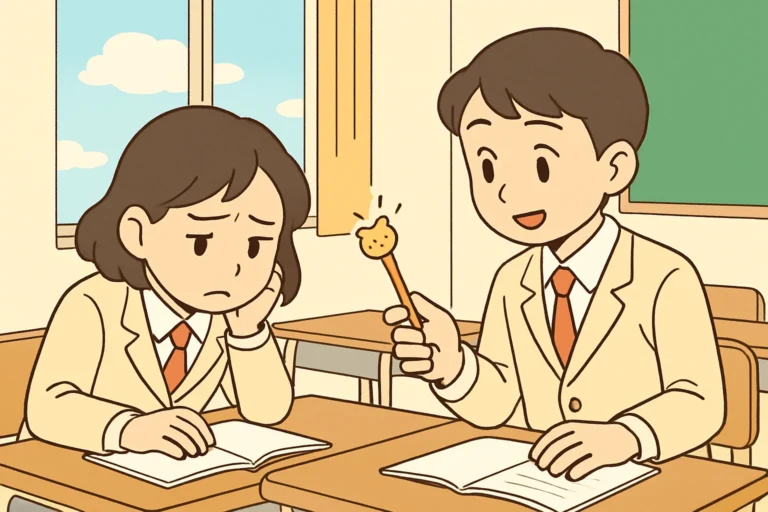
Is This Your Pencil? Be a Hero at Your Korean School with This Phrase!
Hello! Welcome to [Maeil Hangeul], here to upgrade your Korean skills! ✨
Have you ever found a lost pen or a forgotten notebook in a classroom? Being able to ask “Is this yours?” is a simple but powerful way to make a new friend and be a helpful classmate.
Today, we’re going to learn exactly how to do that! Lately in Korea, cute and unique stationery, especially items with characters like Kakao Friends or TinyTAN, are super popular among students. Imagine finding a super cute Ryan pencil on the floor! You’d definitely want to find its owner, right? Let’s learn the phrases that will make you a classroom hero!
Core Expressions You Need to Know
Here are the essential building blocks for asking about a lost item.
1. 이거 (Igeo)
- Pronunciation [Romanization]: Igeo
- English Meaning: This / This thing
- Detailed Explanation:
이거 (igeo)is the casual, everyday way to say “this thing.” It’s a shortened version of이것 (igeot). You’ll hear이거constantly in conversations between friends. It’s the perfect word to use when you’re pointing to or holding an object right in front of you. -
💡 Pronunciation Tip:
Although it’s written as이것 (igeot), in casual speech, the finalㅅ(t)sound is often dropped, making it sound like [이고 (igo)] or [이거 (igeo)]. Stick with [igeo] for a natural sound!
2. 네 (Ne)
- Pronunciation [Romanization]: Ne
- English Meaning: Your (casual)
-
Detailed Explanation:
네 (ne)is how you say “your” when talking to a friend or someone of the same age. It’s informal and friendly. You simply place it before the noun, like네 연필 (ne yeonpil)for “your pencil” or네 책 (ne chaek)for “your book.” -
💡 Pronunciation Tip:
This is a tricky one! The word for “your,”네 (ne), sounds exactly the same as the word for “yes,”네 (ne). How do you tell them apart? Context is everything! If someone asks you a question,네probably means “yes.” If it’s in front of a noun like네 이름 (ne ireum - your name), it means “your.”
3. ~이야? (~iya?)
- Pronunciation [Romanization]: ~iya?
- English Meaning: Is it…? (casual question ending)
-
Detailed Explanation: This is a super common informal question ending you attach to nouns. The rule is simple:
- If the noun ends in a consonant, you add
이야? (iya?).- Example: 책 (chaek) → 책이야? (chaegiya?) – Is it a book?
- If the noun ends in a vowel, you add
야? (ya?).- Example: 지우개 (jiugae) → 지우개야? (jiugaeya?) – Is it an eraser?
- If the noun ends in a consonant, you add
- 💡 Pronunciation Tip:
Let’s look at연필이야? (yeonpiriya?). The last letter of연필 (yeonpil)is the consonantㄹ(l). When it’s followed by the vowelㅣ(i), theㄹsound “links” or moves over to the next syllable. This is called 연음 (yeon-eum) or “linking sound.”- Instead of
yeonpil-iya, it’s pronounced smoothly as [연피리야? yeon-pi-ri-ya?]. - This happens all the time in Korean and mastering it will make you sound much more natural!
- Instead of
Example Dialogue
Let’s see how these expressions work in a real conversation between two students, Minjun and Sora.
A: 민준 (Minjun)
(Picks up a pencil from the floor)
소라야, 이거 네 연필이야?
[Soraya, igeo ne yeonpiriya?]
Sora, is this your pencil?
B: 소라 (Sora)
음… 아니, 내 거 아니야.
[Eum… ani, nae geo aniya.]
Umm… no, it’s not mine.
A: 민준 (Minjun)
아, 그래?
[A, geurae?]
Oh, okay.
B: 소라 (Sora)
아! 그거 유나 펜이야! 유나가 아까 찾고 있었어.
[A! Geugeo Yuna pen-iya! Yunaga akka chatgo isseosseo.]
Ah! That’s Yuna’s pen! She was looking for it earlier.
Culture Tip & Trend Deep Dive 🇰🇷
Remember we talked about the craze for cute character stationery in Korea? This is a huge part of school culture! Students often collect and trade unique pens, erasers, and notebooks. Losing a favorite, limited-edition BT21 pen can be a mini-tragedy for a student.
So, when you use the phrase 이거 네 펜이야? (Igeo ne pen-iya?), you’re not just asking a simple question. You’re showing that you’re observant, kind, and a good friend. It’s a small act that can make someone’s day!
By the way, you’ll notice Sora used the Konglish word 펜 (pen). While there is a Korean word for it (볼펜 - bolpen), 펜 is used far more commonly in daily life. Using little words like this will make you sound just like a local!
Let’s Practice!
Time to check what you’ve learned!
1. Fill in the blank:
You found an eraser (지우개 - jiugae). How do you ask your friend Minjun if it’s his?
민준아, 이거 네 ___________?
(Minjun, is this your eraser?)
Hint:지우개ends in a vowel!
2. Sentence Building:
Combine the following words to ask your friend, “Is this your book?”
이거 / 책 / 네 / 이야?
(igeo / chaek / ne / iya?)
Great job today! You’re now ready to be a helpful friend in any Korean classroom.
Why not try making your own sentence in the comments below? Tell us what you “found”! For example: “이거 네 휴대폰이야?” (Is this your phone?). We’ll check your answers! 👇
Frequently Asked Questions (FAQ)
Q: What does "연음" mean in Korean and how do you pronounce it?
A: In Korean, "연음" is pronounced [yeon-eum] and means: or "linking sound."
Q: What does "A: 민준" mean in Korean and how do you pronounce it?
A: In Korean, "A: 민준" is pronounced [Minjun] and means: (Picks up a pencil from the floor)
Q: What does "B: 소라" mean in Korean and how do you pronounce it?
A: In Korean, "B: 소라" is pronounced [Sora] and means: 음... 아니, 내 거 아니야.
Q: What does "A: 민준" mean in Korean and how do you pronounce it?
A: In Korean, "A: 민준" is pronounced [Minjun] and means: 아, 그래?







