
Beyond Major & Minor: A Deep Dive into Korean Music Theory
Hello! Welcome back to [Maeil Hangeul], your key to unlocking the next level of Korean fluency!
Today, we’re stepping away from daily conversation and venturing into the fascinating, academic world of Korean music. Have you ever listened to a K-Pop song and heard a sound that felt distinctly, anciently Korean? Or watched a historical drama and been captivated by the soundtrack? That’s what we’re exploring today.
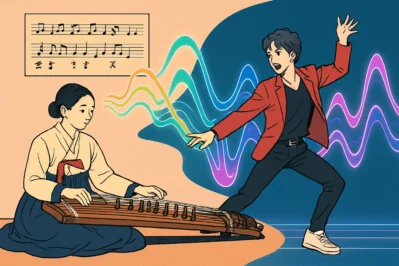
Lately in Korea, there’s a huge trend of “Gugak fusion” (국악 퓨전), where top artists like BTS’s Suga, Stray Kids, and (G)I-DLE are masterfully blending traditional Korean musical elements with pop, hip-hop, and EDM. To truly understand the genius behind these tracks, you need to understand the theory. So, let’s tune our linguistic skills and analyze the unique musical systems of Korea!
Core Concepts: The Building Blocks of Korean Music
Here are some essential terms that will move you from a casual listener to a knowledgeable analyst.
1. 음계 (Eumgye)
- Pronunciation [Romanization]: [Eumgye]
- English Meaning: Musical Scale
- Detailed Explanation: This is the fundamental term for a musical scale, derived from the Sino-Korean characters 音 (eum – sound) and 階 (gye – stair/level). While you’re familiar with the Western major (장조, jangjo) and minor (단조, danjo) scales, Korean traditional music, or 국악 (Gugak), is built on entirely different systems. This term is your starting point for any academic discussion on the subject.
- 💡 Pronunciation Tip: The ‘계’ (gye) sound can be tricky for English speakers. It’s not pronounced ‘gai’ or ‘gee’. It’s a quick, smooth glide from a ‘g’ sound into ‘ye’ (like in ‘yes’). Practice saying ‘g-ye’ as one fluid syllable: [gye].
2. 5음 음계 (O-eum eumgye)
- Pronunciation [Romanization]: [O-eum eumgye]
- English Meaning: Pentatonic scale (literally “5-sound scale”)
- Detailed Explanation: This is the absolute cornerstone of most East Asian music, including Gugak. The pentatonic scale consists of five notes per octave, in contrast to the seven notes of a Western diatonic scale. This absence of half-steps (semitones) is what gives traditional Korean music its characteristic open, floating, and harmonious sound. The two primary modes in court music are 평조 (pyeongjo), often described as bright and peaceful, and 계면조 (gyemyeonjo), which conveys a feeling of sorrow or pathos.
- 💡 Pronunciation Tip: The number 5 in Korean is ‘오 (o)’. When it’s followed by ‘음 (eum)’, the two vowel sounds are pronounced distinctly but flow together smoothly: [o-eum]. There’s a very slight pause, but no added consonant sound between them.
3. 시김새 (Sigimsae)
- Pronunciation [Romanization]: [Sigimsae]
- English Meaning: Musical ornamentation; expressive nuance.
- Detailed Explanation: This is a beautiful and complex concept with no perfect English equivalent.
시김새refers to the decorative and expressive techniques that are not explicitly written in the music but are performed to give the melody life and soul. This includes specific types of vibrato (농현, nonghyeon), pitch bending, and grace notes. It’s the difference between a robot playing notes and a master musician telling a story. Understanding시김새is crucial to appreciating the profound emotional depth of Gugak. - 💡 Pronunciation Tip: The vowel ‘ㅣ’ (i) in ‘시’ and ‘김’ is a bright ‘ee’ sound as in ‘see’. The final ‘새’ (sae) is a diphthong, a single vowel sound that combines ‘ㅏ’ (a) and ‘ㅣ’ (i). Pronounce it as one smooth sound, just like the English word ‘say’.
4. 정간보 (Jeongganbo)
- Pronunciation [Romanization]: [Jeong-gan-bo]
- English Meaning: Jeongganbo; traditional Korean mensural notation.
- Detailed Explanation: Created by King Sejong the Great in the 15th century (yes, the same king who invented Hangeul!),
정간보is one of the oldest mensural notation systems in Asia. It uses a grid of squares called ‘정간 (jeonggan)’. Each square represents one beat. Unlike Western notation where a note’s vertical position indicates pitch, in정간보, the name of the note is written inside the box. It’s a fundamentally different way of visualizing rhythm and melody, tying them together in a single unit. - 💡 Pronunciation Tip: The syllable ‘정’ contains the final consonant ‘ㅇ’, which is pronounced like the ‘ng’ in ‘singing’ [jeong]. Don’t pronounce it with a hard ‘g’ at the end. The three syllables are pronounced clearly and distinctly: [Jeong-gan-bo].
Example Dialogue
Let’s see how these terms might appear in a conversation between two musicology students.
A: The arrangement on that new Stray Kids track is incredible. They sampled a gayageum (가야금), but the melody itself feels so modern.
B: I agree! It’s definitely built on a 5음 음계 (o-eum eumgye), which lets it blend seamlessly with the hip-hop beat. The main melodic line has that slightly melancholic feel of the gyemyeonjo mode.
A: Right! And the vocalist’s performance… the way she bends the end of her phrases isn’t typical in Western pop. It’s a clear use of vocal 시김새 (sigimsae) to add that emotional weight.
B: For sure. It’s an oral tradition passed down through masters. You could never fully capture that nuance in standard notation. It makes me appreciate how revolutionary 정간보 (Jeongganbo) was for trying to codify rhythm and pitch in its own unique way.
A: It truly shows how a deep understanding of the Korean 음계 (eumgye) system can create something totally new and globally appealing.
Culture Tip: From Pansori to Pop
The concepts we’ve discussed today aren’t just for academics; they are the living, breathing heart of K-Pop’s global identity.
When producers want to create a sound that is undeniably “Korean,” they turn to these tools. In Agust D’s (BTS’s Suga) masterpiece “Daechwita” (대취타), the entire track is built around a sample of traditional royal military music. His aggressive, rhythmic rap style itself mirrors the narrative delivery of Pansori (판소리), a traditional form of musical storytelling where the expressive power of 시김새 is paramount.
Your Pro-Listener Mission: The next time you listen to a K-Pop song described as having “traditional elements,” listen closely. Can you identify the five-note 5음 음계? Can you hear the expressive pitch bends and vibrato of 시김새 in the vocals or instruments like the haegum (해금) or daegeum (대금)? Recognizing these elements will give you a profound new layer of appreciation for the artistry and cultural depth of the music you love.
Wrap-up & Practice
Today, we explored the sophisticated theoretical framework of Korean music, from the basic 음계 and the foundational 5음 음계 to the expressive soul of 시김새 and the unique notation of 정간보.
Now, let’s test your knowledge!
- Fill-in-the-blank: The ornamental techniques that give Gugak its emotional depth, such as specific types of vibrato and grace notes, are collectively known as __________.
- Sentence Building: Using the term 5음 음계, write a short sentence explaining why a certain K-Pop song sounds “traditionally Korean.”
We’d love to see your answers and hear your thoughts! What are some of your favorite songs that blend modern and traditional Korean sounds? Share them in the comments using the terms we learned today!