

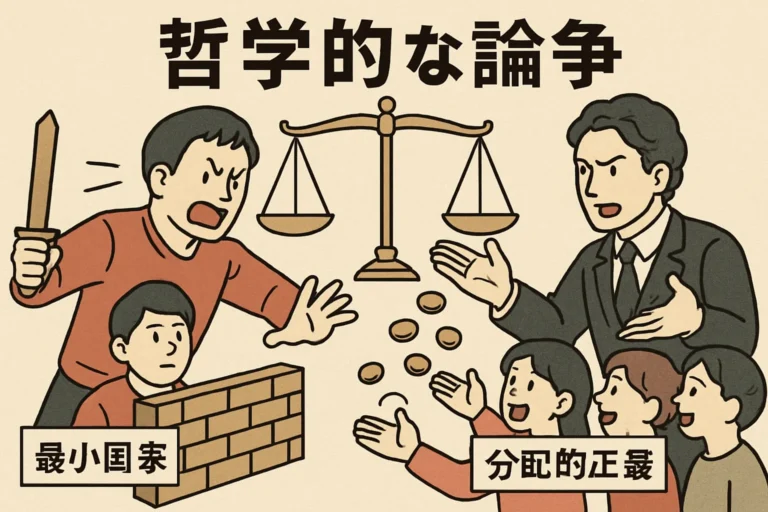
Debate Like a Philosopher in Korean: Arguing Nozick’s Minimal State
Hello! Welcome back to [Maeil Hangeul], the place to upgrade your Korean skills to the next level!
Are you ready to move beyond daily conversation and dive into complex, intellectual discussions in Korean? Today, we’re tackling a fascinating topic from modern philosophy: Robert Nozick’s theory of the “minimal state.” You might wonder, “Why philosophy?” Well, discussions about the government’s role, taxes, and individual freedom are happening everywhere, all the time. Especially in Korea, where debates about welfare policies and economic freedom are constantly in the news, understanding these concepts will allow you to participate in high-level conversations and truly grasp the nuances of modern Korean society. Let’s learn how to argue your point like a true intellectual!
Core Expressions for Your Philosophical Toolkit
Here are some essential terms and phrases you’ll need to debate Nozick’s ideas in Korean.
1. 최소 국가론 (Choeso Gukka-ron)
- Pronunciation [Romanized]: [Choe-so Guk-ka-ron]
- English Meaning: The Minimal State Theory
- Detailed Explanation: This is the core concept. ‘최소’ (choeso) means ‘minimum,’ and ‘국가론’ (gukka-ron) means ‘theory of the state.’ This term refers to the libertarian political philosophy that the state’s only legitimate functions are to protect individuals against violence, theft, and breach of contract. Any state that does more is considered unjust. This is your starting point for any discussion on Nozick.
- 💡 Pronunciation Tip:
The word ‘국가’ is technicallyguk-ga. However, in natural speech, the finalㄱ (k)of ‘국’ and the initialㄱ (g)of ‘가’ blend together. You don’t pronounce them as two separate ‘k’ sounds. Instead, you hold the ‘k’ sound slightly longer, creating a “tense” sound, almost like [국까 (guk-kka)]. This is called ‘경음화’ (gyeong-eumhwa) or ‘tensing.’
2. 개인의 권리를 침해하다 (Gaein-ui gwolli-reul chimhae-hada)
- Pronunciation [Romanized]: [Gae-i-nui gwol-li-reul chim-hae-ha-da]
- English Meaning: To infringe upon individual rights
- Detailed Explanation: This is the crux of the argument against a larger state. ‘개인의 권리’ (gaein-ui gwolli) means ‘individual rights,’ and ‘침해하다’ (chimhae-hada) is a formal verb for ‘to infringe’ or ‘to violate.’ You would use this phrase to argue that actions like taxation for social welfare programs violate a person’s right to their own property.
- 💡 Pronunciation Tip:
Notice the pronunciation of ‘권리’ is not [gwon-ri] but [궐리 (gwolli)]. This is a classic example of ‘유음화’ (yu-eumhwa) or ‘liquidization.’ When a syllable ending in ‘ㄴ (n)’ is followed by a syllable beginning with ‘ㄹ (r/l),’ the ‘ㄴ (n)’ sound assimilates and changes to ‘ㄹ (l).’ It makes the pronunciation flow much more smoothly.
3. 재분배 정의 (Jaebunbae jeong-ui)
- Pronunciation [Romanized]: [Jae-bun-bae jeong-ui]
- English Meaning: Distributive Justice
- Detailed Explanation: This is the opposing concept. ‘재분배’ (jaebunbae) means ‘redistribution,’ and ‘정의’ (jeong-ui) means ‘justice.’ This term refers to the idea that it is fair and just for a state to redistribute wealth (usually through taxes and welfare) to create a more equitable society. Proponents of a larger welfare state would argue for the necessity of ‘재분배 정의.’
- 💡 Pronunciation Tip:
The word ‘정의’ is pronounced [정의 (jeong-ui)], but in casual, fast speech, the second syllable ‘의 (ui)’ is often simplified to [이 (i)], making it sound like [정이 (jeong-i)]. While the formal pronunciation is [jeong-ui], hearing it as [jeong-i] is very common and will help you understand native speakers better.
4. ~에 입각하여 (~e ipgak-hayeo)
- Pronunciation [Romanized]: [~e ip-ga-ka-yeo]
- English Meaning: Based on / Founded on
- Detailed Explanation: This is a sophisticated grammatical pattern used to state the basis or foundation of an argument, perfect for a formal debate. It’s more formal and academic than simply saying ‘~에 따라서’ (according to). You would use it like: “노직의 최소 국가론에 입각하여 볼 때, 이 정책은 부당합니다.” (When viewed based on Nozick’s minimal state theory, this policy is unjust.)
- 💡 Pronunciation Tip:
This is a great example of ‘연음’ (yeon-eum) or ‘linking.’ The final consonant ‘ㄱ (k)’ of ‘입각’ moves over to the empty consonant spot in the next syllable ‘하’. So, instead ofip-gak-ha-yeo, it is pronounced smoothly as [입가카여 (ip-ga-ka-yeo)]. Mastering this will make your Korean sound incredibly fluent.
Example Dialogue: A Coffee Shop Debate
Let’s see how these expressions are used in a real conversation. Imagine two friends, Minjun (a Nozick supporter) and Sora (a proponent of distributive justice), discussing a new government proposal to increase taxes to fund universal basic income.
A (민준): 소라야, 정부가 기본소득을 위해 증세한다는 기사 봤어? 나는 로버트 노직의 최소 국가론에 입각하여 이 정책에 반대해.
(Sora, did you see the article about the government raising taxes for universal basic income? Based on Robert Nozick’s minimal state theory, I oppose this policy.)
B (소라): 왜? 나는 사회적 약자를 돕는 재분배 정의의 실현이라고 보는데. 모두에게 최소한의 인간다운 삶을 보장해주는 게 국가의 역할 아닐까?
(Why? I see it as the realization of distributive justice that helps the socially vulnerable. Isn’t it the state’s role to guarantee a minimal standard of living for everyone?)
A (민준): 그 목적은 이해하지만, 강제적인 세금 징수는 결국 노동의 결실을 빼앗는 거잖아. 이건 명백히 개인의 권리를 침해하는 행위야. 국가는 도둑이나 사기로부터 우리를 보호하는 역할에 그쳐야 해.
(I understand the goal, but mandatory taxation is ultimately taking the fruits of someone’s labor. This is clearly an act that infringes upon individual rights. The state should be limited to protecting us from theft and fraud.)
B (소라): 그건 너무 극단적인 생각 같아. 공동체의 안정 없이는 개인의 권리도 의미가 없다고 생각해. 우리는 더불어 사는 사회의 구성원이니까.
(I think that’s too extreme. I believe individual rights are meaningless without the stability of the community. We are all members of a society where we live together.)
Culture Tip & Trend Deep Dive
In South Korea, the debate between economic growth driven by individual freedom and the establishment of a robust welfare state is a central political and social issue. This isn’t just an abstract philosophical debate; it’s a real conversation that impacts elections and national policy.
For instance, recent discussions about real estate taxes (종합부동산세), inheritance taxes (상속세), and the scope of the National Health Insurance (건강보험) are all fundamentally tied to the questions Nozick raises. Young Koreans, in particular, are highly engaged in these topics. On online forums and social media, you’ll see intense debates where people argue for lower taxes and less government intervention, using logic very similar to Nozick’s, while others advocate for stronger social safety nets, echoing the principles of 재분배 정의.
By understanding these terms, you can not only follow these complex news stories but also understand the ideological underpinnings of different political viewpoints in Korea. Saying something like, “그 주장은 노직의 관점과 유사하네요” (“That argument is similar to Nozick’s perspective”) in a discussion will instantly mark you as a thoughtful and advanced speaker.
Let’s Practice!
Time to put your new knowledge to the test.
- Fill in the blank:
과도한 세금은 열심히 일한 사람들의 재산권을 _______________ 수 있다는 비판이 있다.
(There is criticism that excessive taxes can _______________ the property rights of people who work hard.) -
Sentence Building:
Using the grammar pattern ~에 입각하여, write a short sentence expressing an opinion about the role of the government. (e.g., “Based on the principle of equality…”)
Great job today! Grappling with these advanced topics is a huge step in your Korean journey. Now, we’d love to hear from you. What are your thoughts on the minimal state? Try leaving a comment below using the expressions we learned today
Frequently Asked Questions (FAQ)
Q: What does "'경음화'" mean in Korean and how do you pronounce it?
A: In Korean, "'경음화'" is pronounced [gyeong-eumhwa] and means: or 'tensing.'
Q: What does "'유음화'" mean in Korean and how do you pronounce it?
A: In Korean, "'유음화'" is pronounced [yu-eumhwa] and means: or 'liquidization.' When a syllable ending in 'ㄴ (n)' is followed by a syllable beginning with 'ㄹ (r/l),' the 'ㄴ (n)' sound assimilates and changes to 'ㄹ (l).' It makes the pronunciation flow much more smoothly.
Q: What does "'연음'" mean in Korean and how do you pronounce it?
A: In Korean, "'연음'" is pronounced [yeon-eum] and means: or 'linking.' The final consonant 'ㄱ (k)' of '입각' moves over to the empty consonant spot in the next syllable '하'. So, instead of







