

Sick in Korea? Ask ‘보험 돼요?’ & Save Money at the Hospital!
Hello! This is [Daily Hangul], here to upgrade your Korean skills! ✨
Feeling under the weather in a foreign country can be stressful. But don’t worry! Today, we’re going to learn the most essential Korean phrases for visiting a hospital or clinic, so you can get treated with confidence.
Lately in Korea, many foreigners and international students are sharing their surprise online about how efficient and affordable the healthcare system is. The big secret behind this? The amazing National Health Insurance! Let’s learn how to make sure you can use it.
Key Expressions for Your Hospital Visit 🩺
Here are the absolute must-know phrases for your next doctor’s visit.
1. 보험 돼요? (Is insurance accepted?)
- Pronunciation [Romanization]: Bo-heom dwae-yo?
- English Meaning: Is it covered by insurance? / Do you accept insurance?
- Detailed Explanation: This is the golden question! 보험 (bo-heom) means ‘insurance’, and 돼요? (dwae-yo?) is a versatile phrase meaning ‘Does it work?’ or ‘Is it possible?’. It’s the most direct and polite way to ask the receptionist if they accept your health insurance plan.
- 💡 Pronunciation Tip:
The vowel ‘ㅓ’ (eo) in 험 (heom) is a relaxed ‘uh’ sound, like in the word ‘fun’. It’s different from the ‘o’ sound in ‘boat’. Try not to round your lips!
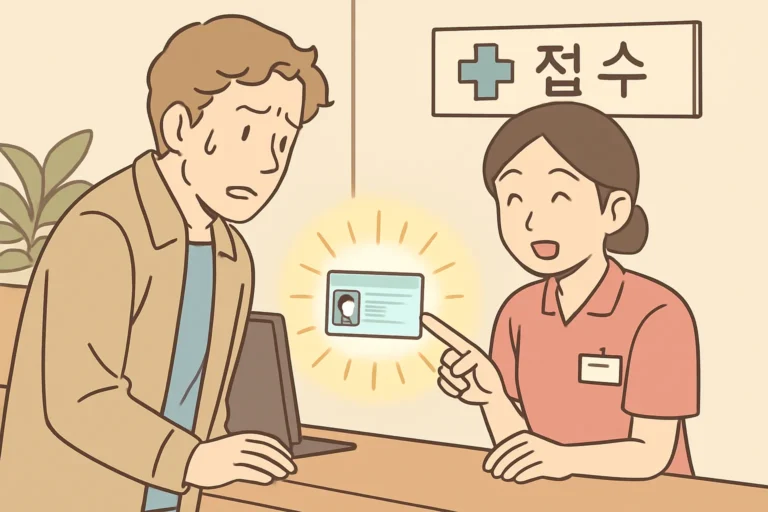
2. 외국인 등록증 여기 있어요. (Here is my ARC.)
- Pronunciation [Romanization]: Oe-gu-gin deung-nok-jjeung yeo-gi i-sseo-yo.
- English Meaning: Here is my ARC (Alien Registration Card).
- Detailed Explanation: For registered foreigners in Korea, your 외국인 등록증 (oe-gu-gin deung-nok-jjeung), or ARC, is your key to the health insurance system. When the receptionist asks for your ID or confirmation, you can confidently hand over your card and say this phrase.
- 💡 Pronunciation Tip:
The last part, 증 (jjeung), has a double consonant ‘ㅉ’ (jj). It’s a short, strong sound with no puff of air, like the ‘j’ in ‘jeep’ but tenser. Practice saying it with a little punch: [deung-nok-jjeung]!
3. 진료비가 얼마예요? (How much is the consultation fee?)
- Pronunciation [Romanization]: Jil-lyo-bi-ga eol-ma-ye-yo?
- English Meaning: How much is the doctor’s fee/consultation fee?
- Detailed Explanation: After your appointment, you’ll need to pay. 진료비 (jil-lyo-bi) means ‘medical fee’ or ‘consultation fee’. Combined with 얼마예요? (eol-ma-ye-yo?), which means ‘How much is it?’, you can easily ask about the cost.
- 💡 Pronunciation Tip:
This phrase has a cool sound change called ‘liquidization’. When the 받침 (final consonant) ‘ㄴ’ (n) in 진 (jin) is followed by ‘ㄹ’ (r/l) in 료 (ryo), the ‘ㄴ’ sound changes to an ‘ㄹ’ sound to make pronunciation smoother. So, instead of ‘jin-ryo-bi’, it sounds like [질료비 (jillyobi)].
4. 처방전 주세요. (Please give me the prescription.)
- Pronunciation [Romanization]: Cheo-bang-jeon ju-se-yo.
- English Meaning: Please give me the prescription.
- Detailed Explanation: In Korea, you get your medicine from a pharmacy (약국, yak-guk), which is usually a separate store outside the clinic. The doctor will give you a 처방전 (cheo-bang-jeon), or prescription, which you take to the pharmacist.
- 💡 Pronunciation Tip:
The first sound, ‘ㅊ’ (ch), is an aspirated consonant. This means you should release a strong puff of air when you say it, like the ‘ch’ in ‘chart’. Put your hand in front of your mouth – you should feel the air!
Example Dialogue at the Clinic
Let’s see how these phrases work in a real conversation! (A = Receptionist, B = You)
A: 안녕하세요. 어떻게 오셨어요?
(Annyeonghaseyo. Eotteoke osyeosseoyo?)
Hello. How can I help you?B: 안녕하세요. 목이 아파서 왔어요.
(Annyeonghaseyo. Mogi apaseo wasseoyo.)
Hello. I came because my throat hurts.A: 처음이세요? 성함이 어떻게 되세요?
(Cheoeumiseyo? Seonghami eotteoke doeseyo?)
Is this your first time? What is your name?B: 네, 처음이에요. 김메간입니다. 저, 보험 돼요?
(Ne, cheoeumieyo. Kim Megan-imnida. Jeo, bo-heom dwae-yo?)
Yes, it’s my first time. My name is Megan Kim. Um, is insurance accepted?A: 네, 그럼요. 외국인 등록증 좀 보여주세요.
(Ne, geureomyo. Oe-gu-gin deung-nok-jjeung jom boyeojuseyo.)
Yes, of course. Please show me your ARC.B: 네, 여기 있어요.
(Ne, yeo-gi i-sseo-yo.)
Yes, here it is.(After the consultation…)
B: 진료비가 얼마예요?
(Jil-lyo-bi-ga eol-ma-ye-yo?)
How much is the consultation fee?A: 보험 적용해서 6,200원입니다. 이 처방전 가지고 약국 가시면 돼요.
(Boheom jeogyonghaeseo yuk-cheon-ibaek-won-imnida. I cheo-bang-jeon gajigo yakguk gasimyeon dwaeyo.)
With insurance applied, it’s 6,200 won. You can take this prescription and go to the pharmacy.
Culture Tip: The Power of Your ARC & the Pharmacy System
Here’s something that surprises many foreigners: if you are a registered resident in Korea for over 6 months (like on a student or work visa), you are required to enroll in the National Health Insurance Service (NHIS).
This means your ARC card acts as your health insurance card! You don’t need a separate card. Just present your ARC, and the system automatically confirms your coverage. This is why a doctor’s visit can cost as little as a cup of coffee.
Also, remember the 처방전 (cheo-bang-jeon)? You won’t get your medicine at the doctor’s office. You must take that paper to a separate 약국 (yak-guk), or pharmacy. Don’t worry, there is always at least one right next to or across the street from any clinic. It’s a very convenient system!
Let’s Practice!
Time to check what you’ve learned.
- Fill in the blank: You walk up to the reception desk and want to ask if they accept your insurance. What do you say?
저기요, ______ ______?
- Sentence Building: You’ve finished your appointment and need the prescription paper. How do you ask for it politely using
주세요(please give me)?
Great job today! Getting sick is never fun, but knowing these phrases will make the experience so much smoother.
Now it’s your turn! Try answering the practice questions in the comments below. You’ve got this! 💪
Frequently Asked Questions (FAQ)
Q: What does "보험" mean in Korean and how do you pronounce it?
A: In Korean, "보험" is pronounced [bo-heom] and means: means 'insurance', and
Q: What does "돼요?" mean in Korean and how do you pronounce it?
A: In Korean, "돼요?" is pronounced [dwae-yo?] and means: is a versatile phrase meaning 'Does it work?' or 'Is it possible?'. It's the most direct and polite way to ask the receptionist if they accept your health insurance plan.
Q: What does "험" mean in Korean and how do you pronounce it?
A: In Korean, "험" is pronounced [heom] and means: is a relaxed 'uh' sound, like in the word 'fun'. It's different from the 'o' sound in 'boat'. Try not to round your lips!
Q: What does "외국인 등록증" mean in Korean and how do you pronounce it?
A: In Korean, "외국인 등록증" is pronounced [oe-gu-gin deung-nok-jjeung] and means: , or ARC, is your key to the health insurance system. When the receptionist asks for your ID or confirmation, you can confidently hand over your card and say this phrase.







